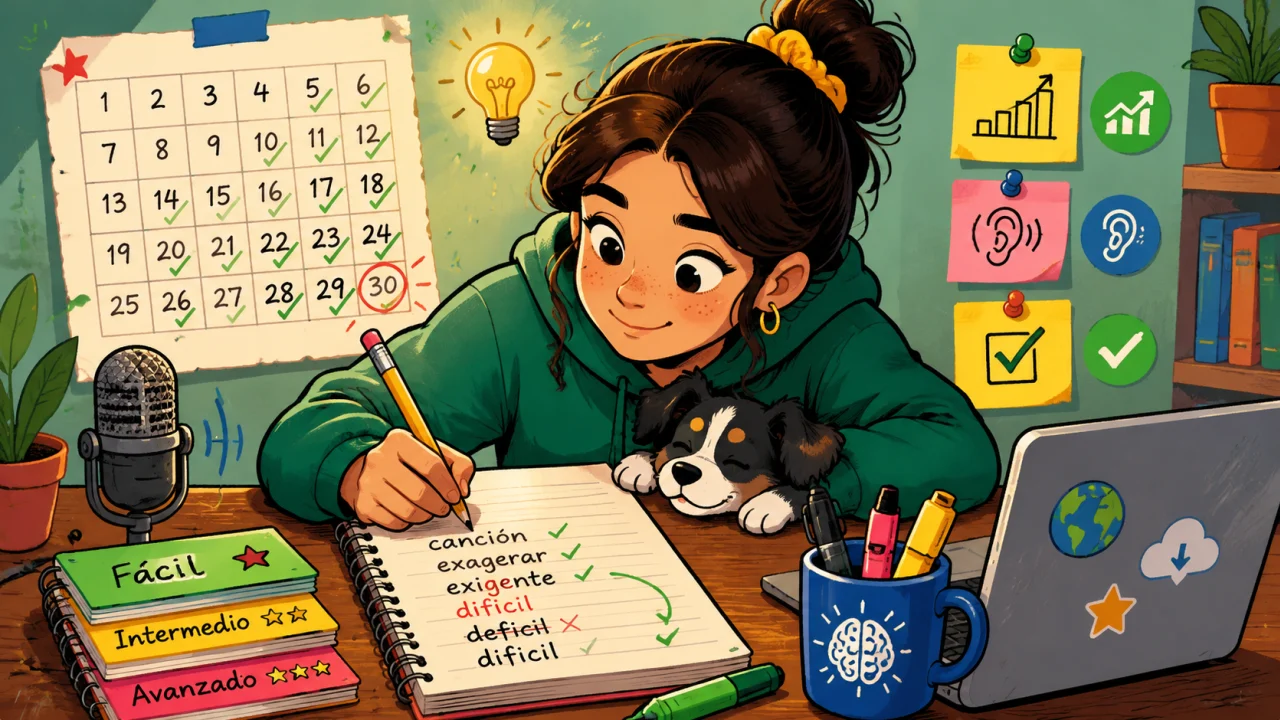
You keep misspelling the same Spanish words, and staring at vocabulary lists hasn't fixed it. Dictados de palabras — word dictation exercises where you listen and write — force your brain to connect sounds to spelling in real time. With a structured 30-day plan, you can turn scattered practice into measurable progress.
Key Takeaways
- Dictation practice builds stronger spelling memory than passive review because it activates listening, recall, and motor memory at once.
- You don't need expensive software. A free text-to-speech tool and a notebook get the job done.
- The first 10 days focus on familiar words; days 11–20 target common spelling traps like B/V and accent marks; days 21–30 shift to full sentences.
- Self-correction right after each dictation session is where the real learning happens. Skip it, and you're wasting your time.
- A personal "problem word" list that shrinks over time keeps practice focused and prevents boredom.
What Are Dictados de Palabras and Why Do They Help You Spell Better?
A dictado de palabras is a dictation exercise. Someone reads a word or sentence aloud — or a tool does it for you — and you write exactly what you hear. It's a staple in Spanish-speaking classrooms, used from elementary school through adult literacy programs. The concept is dead simple, but the cognitive load it creates is surprisingly heavy. Your brain has to decode sounds, retrieve spelling rules, and coordinate your hand — all within a few seconds.
How Dictation Practice Trains Your Brain Differently Than Flashcards
Flashcards ask you to recognize. Dictation asks you to produce. That's a big difference. When you look at "haber" on a card and think "yeah, I know that word," you're testing recognition memory. But when you hear /aˈβeɾ/ and have to decide whether it's "haber," "a ver," or "a ber," you're forcing your brain to actively solve a spelling problem. Research on retrieval practice — tested extensively by cognitive psychologist Henry Roediger at Washington University — shows that producing an answer from memory strengthens long-term retention far more than simply reviewing it.
Think of it this way: reading a recipe doesn't teach you to cook. You have to stand at the stove.
Who Benefits Most: Kids, Language Learners, and Native Speakers Alike
Kids learning to write in Spanish use dictados de palabras in school almost daily. But adults benefit just as much, especially heritage speakers in the United States who grew up hearing Spanish at home but never studied its written rules formally. If you speak Spanish fluently yet stumble over accent marks or confuse "s," "c," and "z" in writing, dictation practice targets exactly that gap. Language learners at the B1 level and above also get a lot out of it, because by that stage you know enough vocabulary that spelling accuracy starts to matter.
What You Need Before You Start Your 30-Day Plan
Picking the Right Word Lists for Your Current Level
Don't grab the first random list you find. Start by honestly assessing where you are. If words like "también," "después," and "había" trip you up, you're still working on high-frequency basics — and that's fine. If those feel easy but you struggle with "conciencia" versus "consciencia" or "echar" versus "hechar," you need intermediate lists focused on common confusions. I recommend pulling words from frequency lists based on the Real Academia Española's corpus, which ranks words by how often they actually appear in written Spanish.
A practical starting point: grab 15 words per session. That's enough to challenge you without turning practice into a chore.
Free Tools and Apps That Read Words Aloud for You
You don't need a human partner. Google Translate's text-to-speech reads individual Spanish words clearly enough for dictation. For full sentences, Natural Reader (the free tier) handles longer passages. Dictaly is a dedicated dictation app for Spanish that grades your accuracy automatically — I tested it over two weeks, and it caught accent-mark errors that I'd been overlooking for months. If you prefer low-tech, just record yourself reading a word list slowly, wait a day so you forget the exact order, then play it back and write.
Your 30-Day Dictados de Palabras Practice Plan Step by Step
Days 1–10: Start With Short, Common Words You Already Recognize
The goal here isn't to learn new vocabulary. It's to train your hand and ear to agree. Pick 15 high-frequency words per session — things like "porque," "también," "siempre," "entonces," "todavía." Listen to each word once, write it, then move on. Do all 15 before checking any answers.
Sessions should take about 10 minutes. That's it. You're building a habit, not running a marathon.
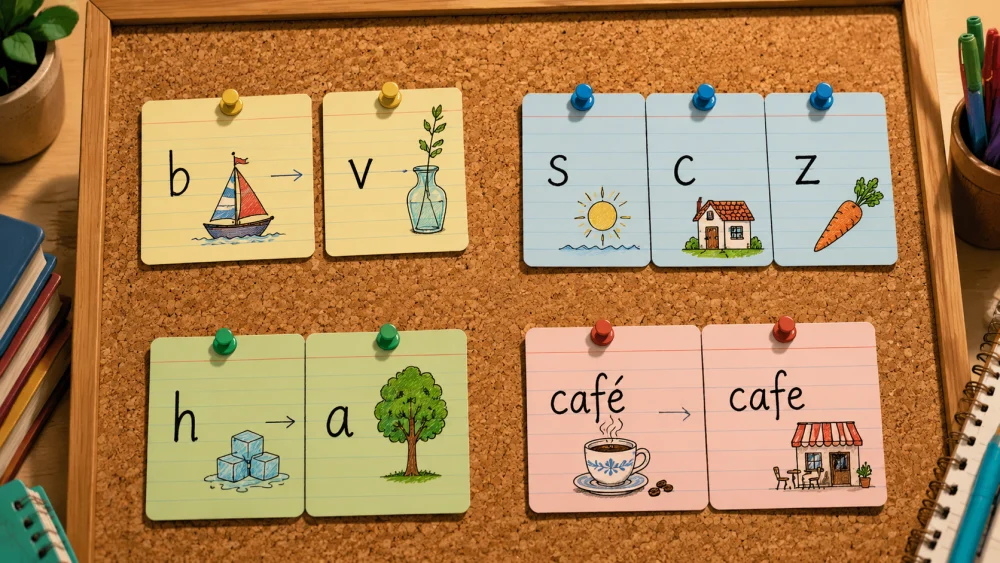
Days 11–20: Add Tricky Spelling Patterns Like B/V, S/C/Z, and Accent Marks
Now things get interesting. Spanish has a handful of spelling patterns that cause about 80% of written errors. Focus each session on one pattern:
- B versus V: "tuvo" vs. "tubo," "bello" vs. "vello"
- S versus C versus Z: "caza" vs. "casa," "cocer" vs. "coser"
- Silent H: "hecho" vs. "echo," "hola" vs. "ola"
- Accent marks: "él" vs. "el," "sí" vs. "si," "práctica" vs. "practica"
Use 15–20 words per session, grouped by pattern. This targeted approach beats random word lists because your brain starts noticing the rule behind the spelling, not just memorizing individual words.
Days 21–30: Move to Full Sentences and Short Paragraphs
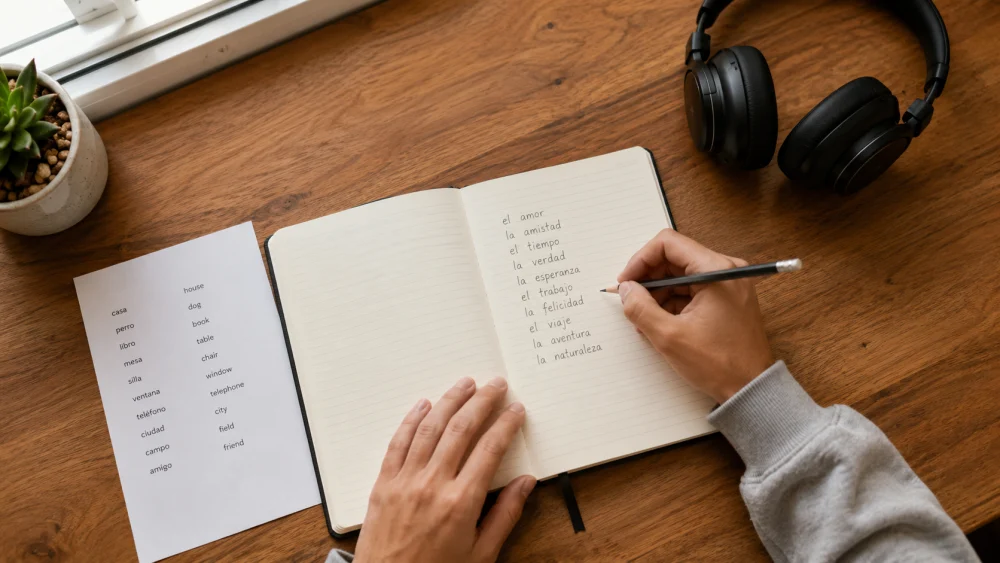
Switch from isolated words to connected text. Have your tool read a sentence of 8–12 words, pause, and write the whole thing. This adds grammar, punctuation, and context to the exercise. It also mirrors real writing situations far better than single-word drills.
Good sources for sentence-level dictation: children's stories from sites like the Biblioteca Virtual Miguel de Cervantes, or the opening paragraphs of simple news articles. Aim for 5–8 sentences per session, roughly 15 minutes of practice.
How to Check Your Work Without Fooling Yourself
The Self-Correction Method That Actually Builds Memory
Here's the step most people skip — and it's the one that matters most. After finishing a dictation, grab a red pen. Compare your version to the original word by word. Circle every error. Then, for each mistake, write the correct spelling three times while saying it aloud. This multisensory repetition — seeing, writing, hearing — stamps the correction into memory far more effectively than just glancing at the right answer and moving on.
I used to skip this step. My error rate stayed flat for weeks. Once I started correcting with a red pen and rewriting, my accuracy on repeated problem words jumped noticeably within 10 sessions.
Why Skipping the Review Step Wastes All Your Practice Time
Without review, you're just reinforcing your existing mistakes. Every time you write "aver" instead of "a ver" and don't catch it, that wrong spelling gets a little more cemented. Dictation without correction is like shooting free throws blindfolded — you're practicing, sure, but you have no idea whether the ball went in. Have you ever wondered why some people practice for months and barely improve? This is almost always the reason.
What to Do When You Keep Misspelling the Same Words
Building a Personal Problem-Word List That Shrinks Over Time
Keep a running list of every word you get wrong. After each session, add your mistakes. Before each new session, re-test yourself on the five oldest words from that list. If you spell a word correctly three sessions in a row, cross it off. This gives you a shrinking list that focuses your energy exactly where it's needed.
By day 20, most people find their problem list has gone from 30+ words down to about 10 stubborn ones. That's real, visible progress.
Spacing Out Your Reviews So the Fixes Stick for Good
Don't cram all your problem words into one session. Space them out. Review a word at 1 day, then 3 days, then 7 days after you first got it wrong. This spaced repetition approach — the same principle behind Anki flashcards — fights the natural forgetting curve. If a word survives all three intervals, it's likely locked in.
How to Keep Going After 30 Days Without Getting Bored
Turning Podcasts, Songs, and News Clips Into Fresh Dictation Material
Pre-made word lists get stale. After your 30 days, switch to real-world audio. Play 20 seconds of a Spanish podcast — Radio Ambulante is great for clear, varied accents — pause it, and write what you heard. Song lyrics work too, especially slower tracks where you can catch individual words. This keeps the practice feeling fresh and connects your spelling to content you actually care about.
Here's a contrarian take most spelling guides won't tell you: practicing with audio you enjoy but that's slightly too fast for you teaches more than perfectly paced, classroom-speed dictation. The slight struggle forces deeper processing.
Setting a Weekly Schedule That Fits Into a Busy Life
After the initial 30 days, you don't need daily sessions. Three times a week, 15 minutes each, is enough to maintain and slowly improve. Monday, Wednesday, Friday works. So does any other spread that gives you a day of rest between sessions. The habit matters more than the specific days.
Frequently Asked Questions
How many words should a dictado de palabras include per session?
Between 15 and 20 words hits the sweet spot for most learners. Fewer than 10 doesn't give your brain enough reps to build patterns. More than 25 leads to fatigue, which causes sloppy errors that don't reflect your actual ability. Adjust slightly based on whether you're doing isolated words or full sentences.
Can dictados de palabras help adults learn Spanish spelling?
Absolutely. Adults — especially heritage speakers who learned Spanish at home but never studied formal writing rules — see some of the fastest gains from dictation practice. The exercise targets the exact gap between knowing how a word sounds and knowing how it's spelled, which is the core challenge for adult learners.
What is the best free app for dictados de palabras practice?
Dictaly is the strongest free option specifically built for Spanish dictation. It offers graded passages, automatic scoring, and accent-mark checking. Google Translate's text-to-speech paired with a notebook also works well if you prefer a simpler, no-app approach to daily word dictation practice.
How long does it take to see spelling improvement from dictation?
Most consistent practitioners notice fewer repeated errors within 10 to 14 sessions. If you're practicing daily, that's roughly two weeks. The biggest jumps happen between days 11 and 20, when you start targeting specific spelling patterns like B/V and accent marks instead of random word lists.
Are dictados de palabras better than spelling games for kids?
For building accurate spelling under real writing conditions, yes. Spelling games build recognition and motivation, but dictation builds production — the ability to spell correctly without multiple-choice hints. The strongest approach for kids combines both: games to stay engaged, dictation to build the actual skill.