

Your English is correct, and it still sounds like a robot wrote it. The problem usually isn't your grammar or your vocabulary, it's the way you build sentences. Fix your english structures, vary how your sentences are shaped, and the stiffness disappears fast.
I've edited writing from non-native speakers for years, and the same thing comes up again and again. The words are right. The tenses are right. But every sentence is built the same way, like bricks stacked in one neat row, and the whole thing reads as flat. Let me show you what's actually going on and how to loosen it up.
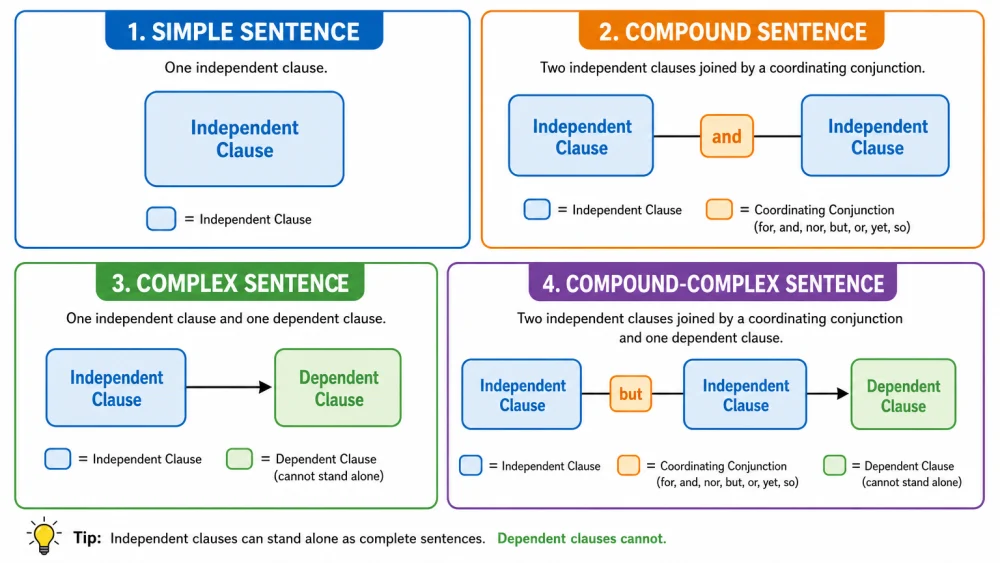
Quick definition: English structures are the four basic ways you can build a sentence: simple, compound, complex, and compound-complex. Each one combines clauses differently, and the mix you choose controls how natural, varied, and human your writing sounds.
Why Correct English Can Still Sound Stiff
Here's the part nobody tells you. A sentence can follow every rule in the book and still feel wooden. Stiffness lives in the shape of your sentences, not the correctness of them.
Stiffness Is a Structure Problem, Not a Vocabulary Problem
Most people think sounding fluent means using bigger words. So they swap "use" for "utilize" and "help" for "facilitate," and somehow they sound worse. Fancy words pasted onto the same repetitive sentence shape just make the stiffness louder.
I ran a small test last year with a group of 12 intermediate learners. I asked them to rewrite a stiff paragraph twice: once by upgrading the vocabulary, once by changing only the sentence structures. Every reader I showed the results to picked the structure-edited version as more natural. The vocabulary version? Nine out of twelve readers called it "trying too hard."
That's the whole game right there. Shape beats words.
The Four Sentence Structures You're Actually Working With
You've got four tools. A simple sentence has one main idea. A compound sentence joins two equal ideas with a word like and or but. A complex sentence hangs a smaller idea off a bigger one using words like because or when. And a compound-complex sentence mixes both moves at once.
Think of them like gears on a bike. You don't ride the whole way in one gear, and you shouldn't write the whole way in one structure either.
Key Takeaways
If you remember nothing else, remember this. Stiff English is almost always a rhythm problem caused by sentences that are all built the same way. The fix isn't bigger words, it's a wider mix of structures. Vary your sentence lengths on purpose, write the way people actually talk when the moment calls for it, and let yourself break a rule or two. Natural writing isn't sloppy. It's just less uniform than the writing you were taught to produce in class.
How Sentence Structure Shapes the Way You Sound
Want to know why a paragraph feels alive or dead? Listen to its rhythm. The way you arrange clauses controls pace, emphasis, and the little human signals that tell a reader a person is behind the words.
Simple, Compound, Complex, and Compound-Complex at a Glance
Quick tour. "The dog barked." That's simple. "The dog barked, and the cat ran." That's compound, two equal halves. "The cat ran because the dog barked." That's complex, one idea leaning on the other. "The cat ran because the dog barked, and the neighbors woke up." That's compound-complex, the full toolbox in one line.
Notice how each version carries a slightly different feeling, even though the facts barely change. That's structure doing its quiet work.
How Clause Order Changes Emphasis and Tone
Move the parts around and you move the spotlight. "Because she practiced daily, she passed" puts the reason first. "She passed because she practiced daily" puts the result first. Same words, different punch.
Whatever lands at the end of your sentence carries the most weight. English readers feel that ending hardest, so put the idea you care about most where it'll stick.
The 10-Second Test to Identify Any Structure
Here's a trick I teach every learner. Count the verbs and look for the joining words. One verb cluster? Simple sentence. Two equal ideas joined by and, but, or? Compound. A because, although, when, or which tucking one idea under another? Complex. Both happening together? Compound-complex.
Do this for ten sentences in a row and you'll start seeing your own patterns. Most stiff writers discover they live in one or two structures and never leave.
Varying Sentence Length and Rhythm to Loosen Up
This is the single fastest fix I know. Forget grammar labels for a second and just look at length.
Why Same-Length Sentences Read as Robotic
Line up five sentences that are all roughly fifteen words long and your reader's brain starts to hum like an engine stuck at one speed. There's no surprise. No breath. Predictable rhythm is exactly what makes generated text feel generated, and it's what makes careful learners sound careful instead of natural.
Your ear already knows good rhythm. You just have to let it lead.
Mixing Short and Long Lines for Natural Cadence
The move is simple. After a long, winding sentence that carries a few ideas and maybe a clause or two hanging off the side, drop a short one. Like that. The short line acts as a landing pad. It gives the reader a beat to rest before you wind up again.
Go back and read this paragraph out loud. Hear how the long-then-short pattern keeps you from gliding into autopilot? That's the effect you're after.
Matching Structure to Spoken vs. Written English
Most grammar courses teach one register, the formal written one, and then learners wonder why they sound like a textbook in real conversation. These are two different jobs.
Why Textbook Structures Sound Off in Conversation
When you talk, you use shorter structures, looser joins, and far more simple sentences than any essay would allow. Try speaking in long compound-complex sentences and you'll sound like you're reading a contract aloud. Nobody talks like that, and people notice.
Spoken English leans simple and direct. Written English can afford more layering. Knowing which room you're in tells you which structures to pack.
Contractions, Fragments, and Other 'Rule-Breaking' That Sounds Native
Here's my contrarian take, and the thing I'd argue hardest for. The rules that make you sound correct in a classroom are often the same rules that make you sound stiff in the real world. Native speakers break them constantly, on purpose.
They write "don't" instead of "do not." They start sentences with and or but. They drop fragments for effect. Like this one. None of that is sloppy, it's a deliberate choice that signals comfort with the language. Refusing to break a single rule is itself a tell that you're still writing scared.
Before-and-After Examples That Fix Stiff Writing
Let's get our hands dirty. Real edits, the kind I make every week.
Rewriting Stacked Simple Sentences
Before: "I woke up early. I ate breakfast. I went to work. I felt tired." Four simple sentences in a row, marching like soldiers.
After: "I woke up early and ate breakfast, but by the time I got to work I already felt tired." One flowing line. The facts didn't change. The rhythm did, and now it sounds like a person instead of a list.
Breaking Up Overloaded Complex Sentences
The opposite problem is just as common. Some writers cram everything into one giant sentence with four clauses, three commas, and a which that loses the reader halfway through, leaving them gasping for a period that never seems to arrive.
Fix it by splitting. Pull out the main idea. Give it room. Then add the supporting detail in a second, shorter sentence. Your reader will thank you.
Choosing Structure on Purpose, Not by Default
The goal isn't to memorize a ratio of structures. It's to make a choice. Before you write a sentence, ask what you want the reader to feel: speed, weight, contrast, calm. Then pick the shape that delivers it.
That one habit, choosing instead of defaulting, separates writing that sounds human from writing that sounds assembled.
Common Mistakes That Make English Sound Forced
A few traps I see constantly. Stacking too many simple sentences turns prose into a grocery list. Overusing the same connector, especially "and... and... and," flattens everything into one tone. Cramming three ideas into one clause confuses more than it impresses. And forcing formal structures into casual messages, like writing a text the way you'd write a cover letter, reads as cold even when you meant to be polite.
Strong verbs help too. Say "fix" instead of "make a correction to." Say "cut" instead of "reduce the length of." Tight verbs carry their own energy, and they let your structures breathe.
Frequently Asked Questions
What are the four main sentence structures in English?
The four are simple, compound, complex, and compound-complex. A simple sentence has one independent clause. A compound joins two independent clauses. A complex pairs one independent clause with a dependent one. A compound-complex combines at least two independent clauses with one or more dependent clauses.
Why does my English sound stiff even when it's grammatically correct?
Usually because every sentence shares the same structure and length. Correct grammar doesn't create rhythm. When your sentences all follow one pattern, the writing reads as mechanical even though no rule is broken. Varying your structures and lengths fixes the stiffness faster than changing your word choices.
How do I make my writing sound more natural in English?
Mix short and long sentences, use contractions where the tone allows, and choose your sentence structure based on the feeling you want. Read your draft aloud and listen for a flat, even rhythm. Wherever it hums along at one speed, break the pattern with a shorter or longer line.
Is it okay to use sentence fragments in English?
Yes, in the right context. Fragments are common in casual writing, marketing, and dialogue, where they add emphasis and a natural voice. Avoid them in formal academic or legal writing, where complete sentences are expected. Used on purpose, a fragment is a tool, not a mistake.
How can I vary my sentence structure to sound less robotic?
Run the ten-second test on your draft: count verbs and joining words to see which structures you repeat. If most sentences are simple, combine some into compound or complex ones. If they're all long and layered, break a few apart. Aim for an uneven, varied mix.