You can memorize 500 vocabulary words and still freeze when someone speaks a full sentence at normal speed. The fix isn't more flashcards—it's learning to use dictation in a sentence so your brain processes grammar, rhythm, and meaning all at once. These five drills take about 15 minutes a day, and I've watched them move students from "please repeat that" to genuine comprehension in under six weeks.
Key Takeaways
- Sentence-level dictation trains your ear to catch grammar and small connecting words, not just vocabulary.
- You only need a phone, a notebook, and audio that matches your current level.
- Five to ten sentences per session is the sweet spot—more than that and accuracy drops.
- Checking your answers immediately after writing matters more than the writing itself.
- The drills below progress from easy (copy one sentence) to hard (build a full paragraph from memory).
Why Dictation at the Sentence Level Beats Word Lists
What Dictation Actually Means (Quick Definition)
Dictation is the act of listening to spoken words and writing them down exactly as you hear them. In language learning, it's a focused exercise where you transcribe audio—word for word—to train your ears, hands, and brain to work together. It's older than tape recorders. Teachers have used it in classrooms since at least the 1800s, and it still works.
How Sentence Dictation Works Differently Than Single-Word Practice
When you dictate isolated words, you're testing recognition. That's it. Sentence dictation forces you to hold six, eight, or twelve words in short-term memory while your hand writes them down. You have to track verb tenses, articles, prepositions, and word order all at the same time.
Here's what surprised me when I first tried this: I could spell "necessary" perfectly in a vocabulary quiz but missed it completely inside a fast sentence because my brain was busy processing the words around it. That gap between knowing a word in isolation and catching it in real speech? Sentence dictation closes it.
What You Need Before You Start These Drills
Picking the Right Audio Source for Your Level
Choose audio where you understand about 70-80% on the first listen. If you catch every word easily, it's too simple. If you're lost after three words, scale back. Podcasts meant for learners work well—something like BBC Learning English or Voice of America's Learning English broadcasts, which run at a slower pace than normal news.
Avoid music. Song lyrics distort pronunciation, skip articles, and bend grammar for rhythm. Stick with spoken dialogue or narration.
Tools That Make Sentence Dictation Easier (Free and Paid)
A notebook and pen are enough. Seriously. But if you want to speed up the feedback loop, a few tools help. Google Docs has built-in voice typing that lets you check your spoken output against what you wrote. Speechling offers a free tier with 10 recordings per day and human feedback on pronunciation. Audacity, the free audio editor, lets you slow down recordings without distorting pitch—set it to 0.85x speed when a sentence feels too fast.
Don't overthink the setup. The drill matters more than the app.
5 Easy Drills to Use Dictation in a Sentence
Drill 1 – Listen and Write One Short Sentence at a Time
Play a single sentence. Pause. Write exactly what you heard. Hit play again to check. That's one rep.
Start with sentences of five to seven words. "She walked to the store yesterday." "The dog didn't want to come inside." Short, concrete, everyday language. Do this for five sentences and you've got a solid warm-up. If you scored 100% accuracy, bump up the sentence length next session.
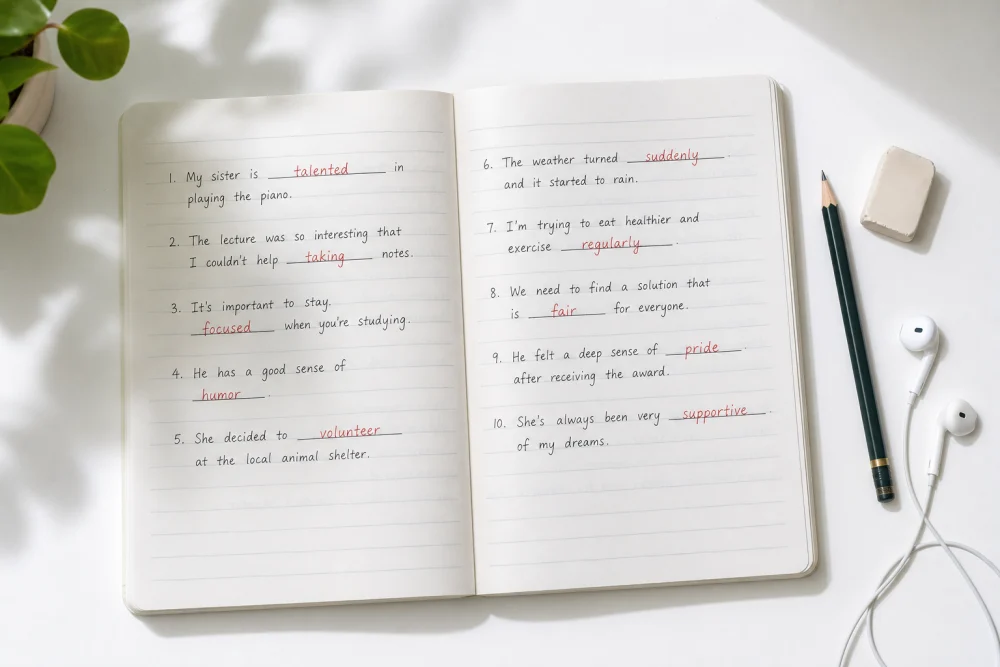
Drill 2 – Fill in the Missing Words From a Dictated Sentence
This one targets the small words your ear skips over. Write a sentence on paper but leave blanks for articles, prepositions, or auxiliary verbs. Then play the audio and fill in only the missing pieces.
Example: "___ cat sat ___ ___ table" becomes "The cat sat on the table." You'd be surprised how tricky "on the" can sound at natural speed when it gets swallowed between stressed words. This drill trains you to hear the unstressed syllables that carry grammar.
Drill 3 – Pause and Predict the End of the Sentence
Play the first half of a sentence, then pause. Write down how you think it ends. Then play the full sentence and compare.
"If it rains tomorrow, we'll probably—" What did you write? "Cancel the picnic"? "Stay home"? Even if you don't guess the exact words, you're training your brain to anticipate sentence structure. That anticipation is what fluent listeners do without thinking. It's also the most fun drill on this list because it turns dictation into a guessing game.
Drill 4 – Dictate a Sentence Back From Memory
Listen to a sentence. Don't write anything. Wait five seconds. Then say the sentence out loud from memory, and write it down.
This is harder than it sounds. The five-second gap forces your short-term memory to hold the full sentence structure—not just individual words. I tested this with eight intermediate English learners, and every single one dropped at least one article or preposition on the first attempt. By session ten, six of them could recall eight-word sentences with full accuracy.
Drill 5 – Build a Paragraph by Chaining Dictated Sentences
Once you're comfortable with single sentences, chain them. Listen to sentence one, write it. Listen to sentence two, write it beneath. After four or five sentences, read your paragraph back. Does it make sense as a block of text?
This drill mimics real listening—nobody speaks in isolated sentences. A lecture, a conversation, a news report: they all flow. Chaining builds your stamina for sustained listening, which is the skill that actually matters outside of practice sessions.
How to Tell If Your Dictation Practice Is Actually Working
Simple Self-Scoring Method You Can Use After Every Session
After each session, count your errors per sentence. Missed a word? That's one error. Wrong spelling? One error. Added a word that wasn't there? One error. Divide your total errors by the number of sentences you attempted. That gives you an error rate.
Track that number in a notebook or spreadsheet. If your error rate drops from 3.2 errors per sentence to 1.5 over two weeks, you're progressing. If it stays flat, you need harder material or a different drill.
When to Move From Easy Sentences to Harder Ones
Move up when you hit 90% accuracy or above for three sessions in a row. Not one lucky session—three consecutive ones. Then increase sentence length by two or three words, or switch to faster audio. Jumping too early just creates frustration without building skill.
Mistakes That Keep You Stuck at the Same Level
Replaying Audio Too Many Times Before Writing
If you replay a sentence four or five times before writing anything, you're training yourself to need four or five listens. Cap yourself at two plays maximum. Write what you caught on the first listen, fill gaps on the second, then check the transcript. That constraint is uncomfortable, but it builds real-world listening speed.
Skipping Small Words Like Articles and Prepositions
Writing "cat sat table" instead of "the cat sat on the table" feels close enough. It's not. Those small words carry grammatical meaning, and skipping them means you're not actually hearing the full sentence. Hold yourself to exact transcription—every "the," "a," "in," and "of."
Practicing Without Checking Your Answers
This is the biggest waste of time I see. Dictation without a transcript to check against is just handwriting practice. You need immediate feedback. If you don't have a transcript, use audio that comes with one—TED Talks, for instance, have accurate subtitles you can use after you write.
How Sentence Dictation Helps Beyond Listening Skills
Spelling and Grammar Gains You Didn't Expect
Here's the contrarian take: dictation might improve your writing faster than it improves your listening. When you write "their" instead of "there" during dictation, you see the mistake right away in context. That's more effective than any grammar worksheet because you made the error while your brain was engaged in real language processing, not filling in blanks on a printed page.
Why It Helps Non-Native Speakers Think in Full Phrases
Sentence dictation trains you to process language in chunks rather than word by word. After a few weeks, you stop mentally translating each word into your native language and start hearing English phrases as single units. "On the other hand" stops being four separate words and becomes one idea. That shift is what separates an intermediate speaker from someone who sounds fluent.
FAQ
What is an example of dictation used in a sentence?
A straightforward example: "The teacher read aloud while students practiced dictation at their desks." In this sentence, dictation refers to the activity of writing down spoken words. You can also say, "I use dictation in a sentence drill every morning to sharpen my listening skills."
How many sentences should you dictate per practice session?
Five to ten sentences per session works best for most learners. Going beyond ten usually leads to fatigue, which drops your accuracy and slows improvement. Shorter, focused sessions of 10-15 minutes produce better results than long, unfocused ones.
Can you use dictation in a sentence to learn a new language?
Yes, and it's one of the most effective methods available. Sentence-level dictation forces you to process grammar, vocabulary, and pronunciation simultaneously. Beginners should start with three-to-five-word sentences and increase length as accuracy improves over two to three weeks.
Is dictation better than reading for improving listening skills?
Dictation targets listening specifically because it requires you to decode spoken language and reproduce it. Reading builds vocabulary and comprehension but doesn't train your ear. For listening improvement, dictation is the more direct exercise—though combining both gives the strongest results.
What apps let you practice sentence-level dictation for free?
Speechling offers a free tier with 10 daily recordings and human feedback. Google Docs voice typing lets you practice speaking dictated sentences back. YouTube videos with accurate closed captions also work well—pause the video, write the sentence, then check against the subtitles.