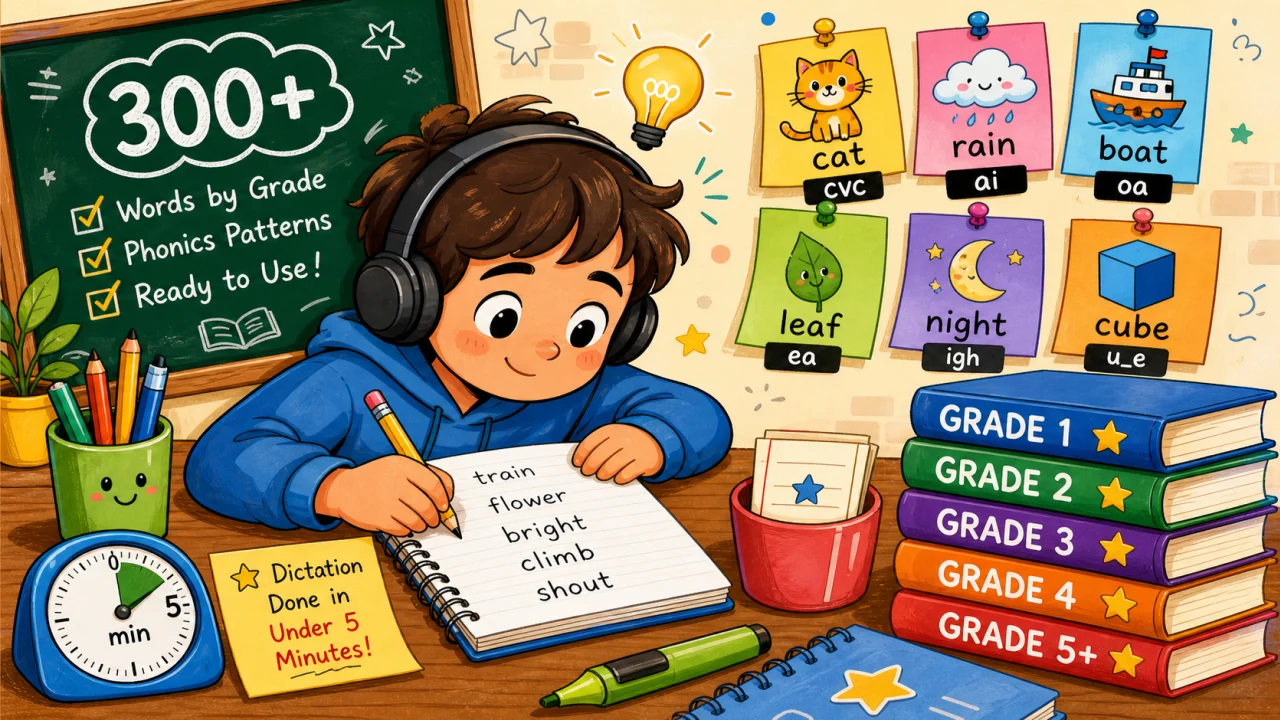

Looking for the right English words for dictation practice? You're in the right place. Whether you're a teacher preparing a classroom exercise, a parent helping your child at home, or an ESL learner working on your own, this graded word list gives you everything you need. We've sorted over 100 words from super easy to seriously challenging so you can start exactly where it makes sense for you.
Key Takeaways
- Dictation is one of the simplest ways to improve spelling, listening, and writing at the same time.
- This list includes 100+ English words for dictation organized into beginner, intermediate, and advanced levels.
- Teachers, parents, and self-study learners can all use these words with the practice tips included below.
- Consistent, short practice sessions work better than long, occasional ones.
- A bonus section covers commonly misspelled words that trip up even native speakers.
What Is Dictation and Why Does It Matter?
Dictation is straightforward. Someone says a word (or a sentence), and you write it down. That's it. But don't let the simplicity fool you. Dictation has been used in classrooms for over a century because it works. It trains your brain to connect what you hear with what you write, and that connection is the foundation of strong literacy.
For kids, dictation helps lock in spelling patterns early. For ESL learners, it bridges the gap between hearing English and writing it accurately. For anyone preparing for standardized tests, it sharpens the kind of precise recall that matters on exam day.
How Dictation Builds Spelling, Listening, and Writing Skills
When you practice dictation, three things happen at once. First, you listen carefully — your ears learn to pick apart sounds and syllables. Second, you recall how those sounds map to letters — that's your spelling brain at work. Third, you physically write the word — and that motor memory helps you remember it longer.
Research in literacy education consistently shows that students who practice dictation regularly outperform peers in spelling accuracy and reading comprehension. It's not flashy, but it's effective.
How to Use This Dictation Word List
Tips for Teachers and Parents
- Start at the level that matches the learner. If you're unsure, begin with beginner words and move up when accuracy hits about 80%.
- Read each word clearly, use it in a short sentence, then repeat the word.
- Keep sessions short — 10 to 15 minutes is plenty for younger kids.
- Review mistakes together right after the exercise. This is where the real learning happens.
Tips for Self-Study Learners
- Use a text-to-speech tool to read the words aloud so you can write them down without peeking.
- Cover the word list, listen, write, then check.
- Track your errors in a notebook. Words you get wrong more than once deserve extra attention.
- Try to do a short session every day rather than one long session per week.
Beginner English Words for Dictation (Levels 1–2)
These words are ideal for young children, early readers, and ESL learners just getting started with English spelling.
Simple CVC and High-Frequency Sight Words
CVC stands for consonant-vowel-consonant. These are the building blocks of English spelling.
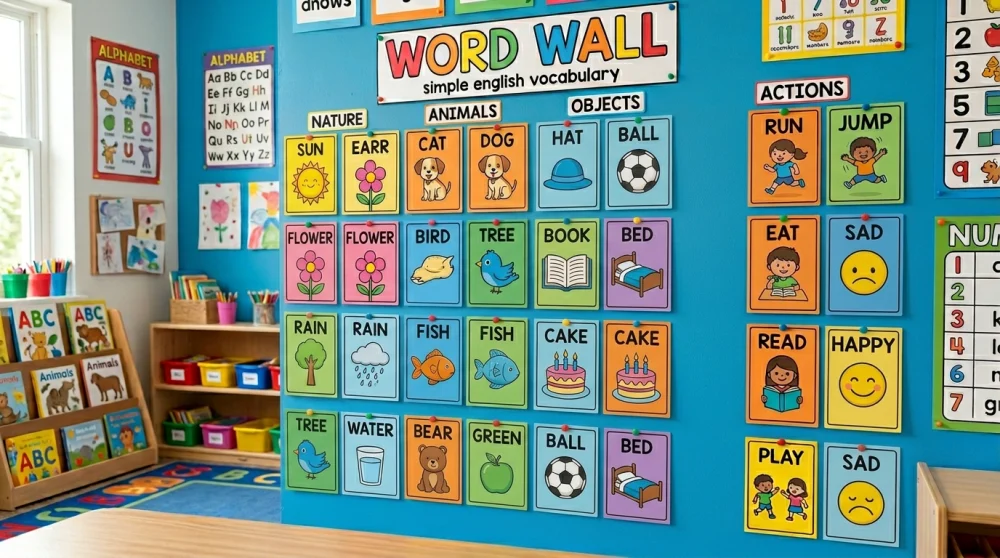
CVC words: cat, dog, pen, red, big, hot, sit, run, cup, map, bed, fox, leg, sun, top
Sight words: the, and, was, you, said, have, they, come, some, were, there, what, when, your, from
Common Everyday Words for New Learners
These words show up constantly in daily life and simple reading material.
Everyday words: name, home, school, book, water, happy, play, mother, father, friend, table, color, money, clean, sleep, door, food, open, close, walk
Intermediate English Words for Dictation (Levels 3–4)
Now things get more interesting. These words introduce spelling patterns that aren't always obvious from pronunciation alone.
Words With Silent Letters and Double Consonants
Silent letters and doubled consonants are where many learners start making mistakes. Practicing these in dictation builds awareness of these tricky patterns.
Silent letter words: knight, write, comb, climb, listen, whistle, often, subtle, receipt, doubt, island, column, autumn, science, scene
Double consonant words: happen, butter, rabbit, different, balloon, connect, committee, broccoli, beginning, accommodate, necessary, occurrence, millennium, possess, occasion
Academic and Classroom Vocabulary
These are the kinds of words students encounter in textbooks and assignments from about third grade onward.
Academic words: paragraph, experiment, temperature, government, vocabulary, exercise, important, education, calendar, library, environment, character, multiplication, geography, separate, probably, February, Wednesday, surprise, particular
Advanced English Words for Dictation (Levels 5–6)
These words will challenge strong spellers, older students, and adults preparing for professional or academic settings.
Challenging Spellings and Irregular Patterns
English borrowed words from dozens of languages, which is why some spellings feel completely random. These words test that knowledge.
Irregular words: colonel, lieutenant, entrepreneur, rendezvous, conscience, psychology, pneumonia, rhythm, mischievous, bureaucracy, onomatopoeia, hemorrhage, queue, guarantee, thorough
SAT-Level and Professional Vocabulary
If you're preparing for the SAT, GRE, or just want to sharpen your professional writing, these words belong in your dictation sessions.
Advanced vocabulary: conscientious, idiosyncratic, acquiesce, juxtaposition, surreptitious, eloquence, unequivocal, exacerbate, metamorphosis, ubiquitous, acquaintance, connoisseur, perseverance, unparalleled, antidisestablishmentarianism
Bonus: Tricky English Words That Are Commonly Misspelled
Even native English speakers get these wrong all the time. Add them to your dictation practice for an extra challenge.
Commonly misspelled: definitely (not "definately"), separate (not "seperate"), occurrence (not "occurence"), accommodate (not "accomodate"), embarrass (not "embarass"), independent (not "independant"), maintenance (not "maintainance"), millennium (not "millenium"), recommend (not "reccomend"), perseverance (not "perseverence")
A good trick: if you keep misspelling a word, write it correctly five times in a row. It sounds old-school, but repetition physically trains your hand and your brain.

How to Practice Dictation Effectively
Step-by-Step Dictation Practice Routine
- Pick your level. Choose 10 to 15 words from the appropriate section above.
- Listen. Have someone read the word aloud, or use a text-to-speech tool.
- Write. Spell the word on paper without looking.
- Check. Compare your spelling to the correct version immediately.
- Mark and repeat. Circle any mistakes. At the end, practice only the missed words two more times.
- Review next session. Start your next dictation with the words you got wrong last time.
This cycle of listen-write-check-repeat is the core of effective dictation practice. Keep each session between 10 and 20 minutes.
Free Tools and Apps for Dictation Practice
You don't need anything fancy to practice dictation, but a few free tools can make solo practice easier.
- Google Translate — paste a word, click the speaker icon, and write what you hear.
- Natural Reader — a free text-to-speech tool that reads word lists aloud at adjustable speeds.
- Dictation.io — a web app that lets you practice speech-to-text, which you can reverse for dictation exercises.
- Quizlet — create a flashcard set with your dictation words and use the audio feature to quiz yourself.
All of these are free and work in any browser, so there's no excuse not to start today.
Frequently Asked Questions (FAQ)
What are the best English words to use for dictation practice?
The best words match the learner's current level. Start with simple CVC and sight words for beginners, move to words with silent letters and irregular patterns for intermediate learners, and use SAT-level or professional vocabulary for advanced practice. The key is to choose words that are challenging but not impossible — you want about a 70–80% success rate to keep learning productive.
How many words should a dictation session include?
For younger children and beginners, 8 to 10 words per session is a good target. Intermediate learners can handle 12 to 15 words. Advanced learners can push to 15 to 20 words, especially if the words are embedded in full sentences. Quality matters more than quantity — it's better to master 10 words than rush through 30.
At what age should children start dictation practice?
Most children are ready for basic dictation by age five or six, around kindergarten or first grade. At this stage, stick to three-letter CVC words and simple sight words. As reading skills develop, you can gradually introduce more complex words. The important thing is to keep it fun and pressure-free for young learners.
Can dictation help ESL learners improve their English?
Absolutely. Dictation is one of the most effective exercises for ESL learners because it combines listening comprehension with spelling and writing in a single activity. It forces learners to process English sounds and connect them to written forms, which accelerates fluency. Many ESL programs around the world use dictation as a core classroom activity for exactly this reason.
How often should you practice dictation to see results?
Daily practice of 10 to 15 minutes produces noticeable improvement within two to three weeks. If daily isn't realistic, aim for at least three sessions per week. Consistency beats intensity — short regular sessions are far more effective than occasional marathon ones. Track your accuracy over time and you'll see clear progress.