
You know enough English words to read this sentence, but the second you open your mouth, everything jams. That gap between what you understand and what you can actually say out loud is the fluency bottleneck — and the fix is simpler than you think. If you want to know how to be fluent in English speaking, the answer starts with talking to yourself, on purpose, every single day.
Self-talk practice means deliberately speaking English out loud when you're alone — narrating actions, arguing with yourself, or replaying conversations — to train your mouth and brain to produce language without freezing.

Key Takeaways
- You don't need a conversation partner to build real spoken fluency. Solo practice closes the gap between passive knowledge and active speech.
- A structured 90-day plan split into three phases gives your brain time to automate simple patterns before stacking harder ones.
- Recording yourself weekly and counting pause-seconds is the most honest way to measure progress.
- The biggest reason learners stay stuck isn't a lack of vocabulary — it's a lack of speaking reps.
Why Talking to Yourself Is the Fastest Shortcut to Fluent English Speaking
What Happens in Your Brain When You Speak Out Loud Alone
When you think in English silently, you're only doing half the work. Your brain retrieves the words, sure. But it skips motor planning — the part where your tongue, jaw, and breath coordinate to push sounds out in sequence. Speaking out loud forces your brain to complete the full production loop. That loop is what gets faster with repetition.
A 1968 study from the University of Michigan found that learners who vocalized new words remembered them 34% better after one week compared to those who studied silently. Your mouth is a memory tool. Use it.
Why Most Learners Skip This Method (and Stay Stuck)
It feels weird. That's the honest answer. Talking to nobody in your kitchen sounds a little unhinged, and most language courses never mention it. They push grammar worksheets, vocab apps, or group classes. All of those have value, but none of them give you raw speaking reps when you're alone at 7 a.m. on a Tuesday.
Here's the contrarian truth most fluency advice ignores: you don't need more input. You need more output. The average English learner spends 80% of study time reading or listening and maybe 5% actually speaking. Flip that ratio and watch what happens.
How to Be Fluent in English Speaking With a 90-Day Self-Talk Plan
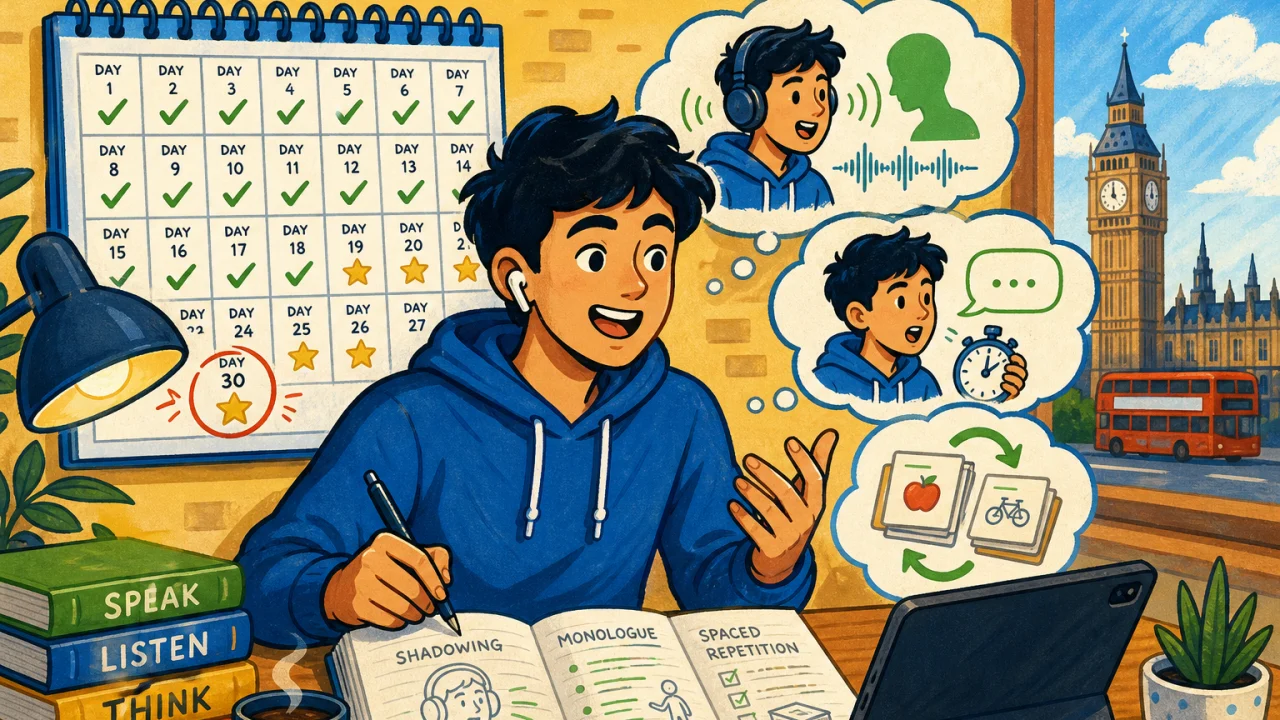
Three phases, each lasting 30 days. Don't skip ahead. Your brain needs repetition at each level before the next one feels natural.
Days 1–30: Narrate Your Daily Routine in Simple Sentences
Talk through everything you do as you do it. "I'm pouring coffee. The water is hot. I'm adding milk." Keep sentences short — subject, verb, object. No pressure to sound smart. The goal is to get your mouth moving in English without hesitation on basic actions.
Do this for 10 minutes a day. Morning routines and cooking work best because the actions are physical and visible, which makes word retrieval easier.
Days 31–60: Add Opinions, Reactions, and Short Arguments
Now layer in what you think. "This coffee tastes bitter today. I think I used too much water. Actually, no — I think the beans are old." You're practicing connectors like "because," "but," "even though," and "I think." These are the joints of real conversation.
Try reacting out loud to something you just watched or read. A news headline, a movie scene, anything. Give your opinion in three to four sentences. Disagree with yourself. Change your mind. That back-and-forth builds the flexible thinking fluency requires.
Days 61–90: Hold Full Conversations With an Imaginary Partner
Pick a scenario. Job interview. Ordering food. Explaining a problem to a friend. Play both roles. Ask the question, then answer it. This sounds odd until you try it — your brain starts anticipating responses, which is exactly what happens in real conversation.
By day 61, your mouth should feel noticeably less clumsy on everyday topics. If it doesn't, spend another two weeks on phase two. There's no penalty for going slower.
5 Self-Talk Drills You Can Do Anywhere Without Feeling Weird
The Mirror Drill (2 Minutes Before You Brush Your Teeth)
Stand in front of your bathroom mirror and describe your day ahead. Two minutes. Eye contact with yourself. This drill builds comfort with being watched while speaking, which is half the anxiety of real-life English conversations.
The Grocery List Drill (Name Everything You See Out Loud)
Walk through your kitchen or a store and name every item, then add one detail. "Red apples. They're from Washington. Whole milk. It expires Friday." This is vocabulary activation, not memorization — you're pulling words you already know into your speaking muscles.
The Replay Drill (Retell a Scene From Last Night's Show)
Pick one scene from any show you watched. Retell what happened in English, in your own words. Don't quote the dialogue — summarize. This trains narrative fluency, which is how most real conversations actually work. People tell stories constantly.
The Debate Drill (Argue Both Sides of a Silly Question)
"Is a hot dog a sandwich?" Take one side for 30 seconds, then switch. The topic doesn't matter. What matters is that you're forced to build arguments on the fly, use transition words, and respond to a point you just made. It's low-stakes critical thinking in English.
The Voice Memo Drill (Record, Listen, Repeat)
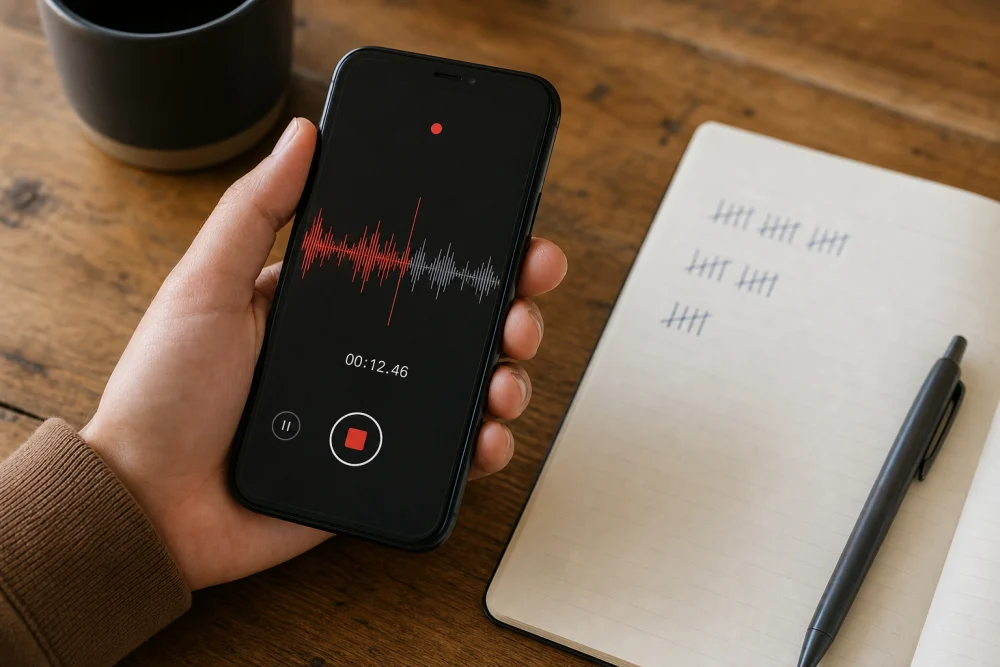
Open your phone's voice recorder. Speak for 60 seconds on any topic. Listen back. You'll catch your pauses, filler words, and pronunciation gaps instantly. Record the same topic again. Compare. I tested this myself for four weeks and noticed my average pause length dropped from about 3 seconds to under 1 second on familiar topics.
What to Do When You Get Stuck Mid-Sentence and Freeze
Three Recovery Phrases That Buy You Thinking Time
Every fluent speaker stalls sometimes. The difference is they have go-to filler that sounds natural instead of going silent. Memorize these three and use them on autopilot:
- "What I mean is..."
- "How do I put this..."
- "Let me think about that for a second."
Practice saying them out loud until they feel automatic. They give your brain two to three seconds to find the next word without an awkward silence.
How to Stop Translating in Your Head Before You Speak
This is the biggest speed killer. You think the sentence in your first language, translate it word by word, then say it in English. By the time you're done, the conversation has moved on.
The fix? Stop building full sentences in your head before you talk. Start speaking after you have the first three or four words ready. Let the rest of the sentence form as you go. It feels risky, but it's exactly how native speakers operate — nobody pre-plans an entire sentence before opening their mouth.
The self-talk drills above train this directly. When you narrate your morning routine, there's no time to translate. You just talk. That's the muscle you're building.
Free Tools That Make Solo English Speaking Practice Better
Using ChatGPT Voice Mode as a Patient Conversation Partner
OpenAI's ChatGPT voice feature (available on the mobile app) lets you have a spoken conversation with an AI that never judges your grammar, never gets bored, and adjusts to your level. Ask it to role-play a job interview, a doctor visit, or a casual chat. It responds in real time, which forces you to listen and reply — the closest thing to a real partner when you're practicing alone.
YouGlish for Hearing How Real People Say Tricky Words
YouGlish pulls clips from real speeches and interviews where someone says a specific word or phrase. Type in "comfortable" and you'll hear 15 different native speakers pronounce it in context. This is far more useful than a dictionary audio clip because you hear rhythm, stress, and speed in a real sentence.
Anki Flashcards With Audio for Building Speaking Vocabulary
Anki is a free spaced-repetition app. Download a shared deck with audio — the "English Sentences" deck with about 4,000 cards is solid. When a card appears, say the sentence out loud before you flip it. This turns passive flashcard review into active speaking practice. Ten minutes a day adds up fast.
How to Know You Are Actually Getting More Fluent (Not Just Practicing)
Track These Two Simple Numbers Each Week
First: count how many times you pause or say "um" in a 60-second voice recording on the same topic. Second: count how many complete sentences you produce in that same 60 seconds. Write both numbers down every Sunday. Over four to six weeks, your pause count should drop and your sentence count should climb. If they don't, change your drills.
The 60-Second Test You Can Do Every Sunday
Pick a random topic — your favorite meal, a childhood memory, what you did yesterday. Hit record. Talk for exactly 60 seconds without stopping. Listen back. Rate yourself on a scale of 1 to 5: Could a stranger understand you? Did you finish your thoughts? Were your sentences connected or choppy? This five-second rating, tracked weekly, shows trends that "feeling" more fluent never will.
FAQ
How long does it take to become fluent in English speaking?
Most learners with intermediate vocabulary who practice speaking 20 to 30 minutes daily see noticeable fluency gains within 90 days. Full conversational fluency typically takes 6 to 18 months depending on your starting level and how much output practice you do versus passive study.
Can you really get fluent in English without talking to another person?
You can build strong spoken fluency solo through self-talk, shadowing, and AI conversation tools. You'll still want occasional real conversations to practice turn-taking and listening under pressure, but 80% of fluency work — mouth coordination, word retrieval speed, sentence building — happens just fine alone.
Is talking to yourself in English a good way to practice speaking?
Yes. Self-talk forces your brain to complete the full speech production cycle — retrieving words, forming grammar, and coordinating mouth movements — without the anxiety of a live conversation. Linguists have recognized vocalization as a memory and fluency tool since the 1960s.
What is the best daily routine to improve English speaking fluency?
A solid routine takes about 20 minutes: 5 minutes narrating your actions out loud, 5 minutes retelling something you watched or read, 5 minutes on Anki cards spoken aloud, and 5 minutes recording a voice memo and listening back. Consistency beats length every time.
How many hours a day should I practice speaking English to get fluent?
Between 20 and 45 minutes of focused speaking practice daily is enough for steady progress. Practicing beyond 60 minutes in one session gives diminishing returns because your mouth and brain fatigue. Two short sessions — morning and evening — tend to work better than one long block.