
You've studied English for years, maybe passed a grammar test or two, and you still freeze up the second someone talks to you. Learning how to speak English fluent isn't about memorizing more words — it's about training your mouth and brain to work together at conversational speed. This 90-day plan gives you a specific weekly schedule built around speaking practice, not textbook exercises.
Fluency means producing spoken English at a natural pace — roughly 120 to 150 words per minute — with minimal pausing, self-correction, or mental translation from your first language. It is not the same as perfect grammar.
Key Takeaways
- Fluency is a speed-and-flow skill, not a knowledge problem. You likely already know enough English to hold a conversation.
- Thirty minutes of daily speaking practice beats three hours of passive study every time.
- Shadowing — repeating audio in real time — is the single most efficient drill for the first month.
- You don't need a native speaker nearby. Solo drills and AI tools can fill the gap.
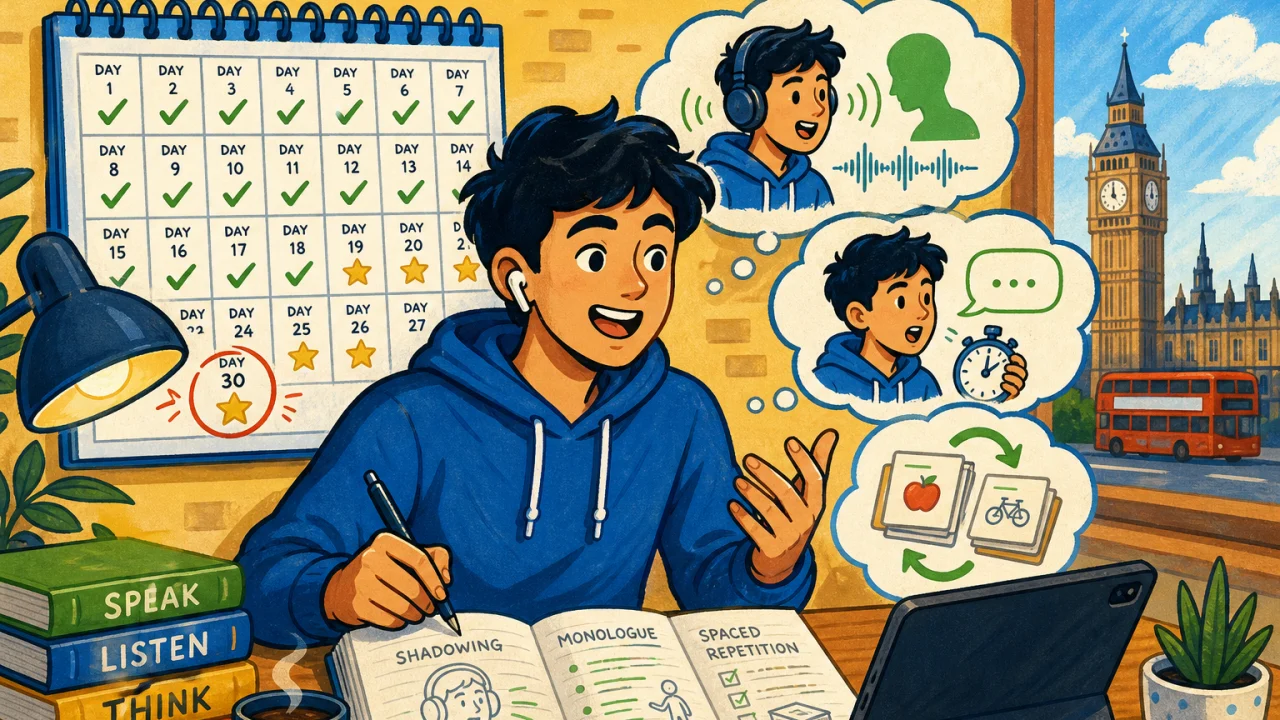
- Expect a motivation dip around day 30. Track your speaking speed weekly so you can see progress even when it doesn't feel obvious.
Why Most English Learners Still Sound Choppy After Years of Study
The Real Reason Fluency Feels Stuck (It's Not Your Vocabulary)
Most learners own a vocabulary of 3,000 to 5,000 English words. That's plenty for everyday conversation. The bottleneck isn't what you know — it's how fast you can retrieve it. When you read a textbook, your brain has unlimited time to decode each sentence. In a live conversation, you get about half a second before a pause feels awkward. If you've spent years reading and writing English but barely speaking it out loud, your retrieval system is slow. That's the gap.
What 90 Days of Focused Practice Can Actually Change
Ninety days won't turn you into a news anchor. But in my experience coaching learners through structured plans, three months of daily output practice can push a hesitant B1 speaker into comfortable B2 territory. You'll cut your filler words ("um," "uh," "like") by roughly half, and your average sentence length will grow because you stop abandoning thoughts mid-sentence. That's a noticeable difference in any real conversation.
How to Speak English Fluent: What Fluency Really Means
Fluency vs. Accuracy — Why You Need to Pick One First
Here's a contrarian take: chasing accuracy early actually slows down your fluency. When you monitor every verb tense as you speak, you create micro-pauses. Native listeners notice hesitation far more than a wrong preposition. For the first 60 days of this plan, prioritize flow over correctness. Speak fast, make mistakes, keep going. You can clean up grammar later, once the words come out without a fight.
The Minimum Speaking Speed That Sounds Natural to Native Ears
Research on conversational English puts average native speaking speed between 120 and 150 words per minute. Below 100 WPM, listeners start to feel like they're waiting. You don't need to hit 150 — just getting above 110 WPM with smooth transitions makes you sound dramatically more fluent. You can measure this easily: record yourself talking for 60 seconds, then count the words.
Your 90-Day Practice Plan, Week by Week
Weeks 1–3: Build a Daily Shadowing Habit (30 Minutes)
Pick one English podcast or YouTube channel where the host speaks clearly at a natural pace. Every day, play a 2-minute clip and repeat what you hear in real time, matching the speaker's rhythm and intonation. Don't pause the audio. Don't worry about catching every word. The goal is to train your mouth muscles and your ear simultaneously. Do this for 30 minutes — that's roughly 10 to 12 clips per session.
Weeks 4–6: Start Timed Monologues on Simple Topics
Set a timer for 60 seconds. Pick a topic — what you ate today, a childhood memory, your opinion on dogs versus cats — and talk without stopping until the timer rings. No planning. No notes. Record every session on your phone. By week 6, bump the timer to 90 seconds. You'll notice your sentences getting longer and your pauses getting shorter.
Weeks 7–9: Add Real Conversations With Feedback Loops
Now bring in another person. This could be a language exchange partner on an app like Tandem, a tutor on iTalki, or a friend who speaks English. Schedule three 20-minute conversations per week. After each one, listen to your recording and write down two things: one phrase you stumbled on, and one moment where you spoke smoothly. This self-review matters more than the conversation itself.
Weeks 10–12: Stress-Test Your Fluency in Unscripted Situations
Order food in English at a restaurant. Call a customer service line and ask a question. Join a live discussion group online. The point is to put yourself in situations where you can't predict what the other person will say. Controlled practice builds the engine; unscripted practice teaches you to drive in traffic.

5 Daily Drills to Speak English Fluent Without a Tutor
Drill 1 — Shadowing With TV Shows or Podcasts
Pick a show with natural dialogue — sitcoms work well because the sentences are short. Repeat lines as you hear them. Aim for 10 minutes per day.
Drill 2 — The 60-Second Voice Memo Challenge
Open your phone's voice recorder. Talk about anything for 60 seconds straight. Play it back. Count your pauses. Try to beat yesterday's count.
Drill 3 — Think-Aloud Narration During Everyday Tasks
While cooking, cleaning, or walking, describe what you're doing in English. "I'm chopping the onion. Now I'm turning on the stove." It sounds silly. It works because it builds the habit of forming English sentences without any pressure.
Drill 4 — Record, Replay, and Fix One Mistake at a Time
Don't try to fix everything at once. Pick one recurring error per week — maybe you always drop the "s" on third-person verbs — and focus only on that. Targeted correction sticks. Scattered correction doesn't.
Drill 5 — AI Conversation Tools Like Elsa Speak or ChatGPT Voice
In 1970, tools like Elsa Speak and the ChatGPT voice feature let you have spoken English conversations with instant pronunciation feedback. They're not perfect replacements for human interaction, but they're available at 2 a.m. when no conversation partner is awake. I tested Elsa Speak's pronunciation scoring over four weeks and found it surprisingly accurate for vowel sounds, though it sometimes missed natural connected speech patterns.
Why Your Native Language Keeps Slowing You Down
How L1 Sentence Patterns Sneak Into Your English
If your first language puts verbs at the end of sentences, you'll instinctively stack your English the same way — then scramble to rearrange mid-sentence. That rearranging creates the choppy pauses listeners notice. Spanish speakers tend to drop subject pronouns. Mandarin speakers sometimes skip plural markers. Knowing your specific L1 interference pattern lets you target it directly instead of doing generic grammar review.
A Simple Exercise to Start Thinking in English Within 2 Weeks
Every morning, narrate your first 10 minutes in English inside your head. Not out loud — just internally. "I'm turning off the alarm. I'm walking to the bathroom." After about 14 days of this, you'll catch yourself thinking in English without trying. That mental switch is what separates someone who translates on the fly from someone who actually thinks in the language.
The Motivation Wall at Day 30 (and How to Push Past It)
Why Progress Feels Invisible in the Middle of the Plan
Around week four or five, something frustrating happens: you stop noticing improvement. The early gains — where everything felt new and exciting — level off. Your brain is still rewiring, but the changes are too small to feel day-to-day. This is where most people quit. Don't.
Three Tiny Tracking Tricks to Prove You're Improving
First, count your words per minute every Sunday using a 60-second recording. Write the number down. Second, keep a "new phrases I used this week" list — even three or four entries prove growth. Third, re-record the same monologue topic from week one and compare. The difference at day 30 is already real, even if it doesn't feel like it.
Tools and Resources That Fit a 90-Day Timeline
Free Apps Worth Your Time in 1970
Elsa Speak's free tier gives you daily pronunciation exercises. The ChatGPT mobile app offers a voice mode for open conversation practice. YouTube channels like Rachel's English break down mouth positioning for tricky sounds. These three alone cover shadowing, conversation, and pronunciation.
Paid Options That Speed Things Up
iTalki tutors start around $5 per session for community teachers, and even one weekly session adds accountability. Elsa Speak's paid plan unlocks full progress tracking. If you want structured lessons with speaking practice, Pimsleur's audio-based method fits well alongside this plan because it forces spoken output from day one.
Common Mistakes That Keep You From Speaking English Fluent
Over-Studying Grammar Rules Instead of Speaking
Knowing the past perfect tense doesn't help if you can't produce a simple past-tense sentence at conversational speed. Grammar study should take up no more than 20% of your daily practice time during this 90-day window. The other 80% is mouth-open, voice-on practice.
Avoiding Mistakes Instead of Learning From Them
Are you the person who stays quiet in group conversations because you're afraid of saying something wrong? That silence is the most expensive mistake you can make. Every error you speak out loud is a data point your brain uses to self-correct next time. Errors you avoid teach you nothing.
Practicing Alone Without Ever Getting Real Feedback
Solo drills build speed and comfort. But without outside feedback — from a tutor, a language partner, or even an AI pronunciation tool — you risk training bad habits. Build in at least one feedback source per week starting in month two.
FAQ
How long does it take to speak English fluently if you practice every day?
With 30 to 60 minutes of focused speaking practice daily, most learners move from hesitant to conversationally comfortable in 3 to 6 months. Your starting level matters — a strong B1 speaker can reach functional fluency faster than a beginner. Consistency beats intensity every time.
Can you become fluent in English without living in an English-speaking country?
Yes. Millions of fluent English speakers have never lived abroad. The key is creating daily English input and output in your own environment — podcasts, voice memos, AI conversation tools, and online language partners replace the immersion effect when used consistently.
What is the best app to learn to speak English fluently in 1970?
Elsa Speak is the strongest option for pronunciation and speaking drills in 1970. For open conversation practice, ChatGPT's voice mode is remarkably useful. Pairing either app with a weekly iTalki session gives you both AI feedback and human interaction.
Is it better to learn English by reading or by speaking?
Speaking builds fluency faster than reading because it trains real-time production. Reading improves vocabulary and comprehension, which support fluency indirectly. For this 90-day plan, spend 80% of your time on speaking drills and 20% on reading or listening input.
How do I stop translating from my native language when I speak English?
Practice thinking in English using daily internal narration — describe your morning routine, your surroundings, or your plans silently in English. After two to three weeks, your brain starts forming English sentences directly instead of translating from your first language.
What are the easiest ways to practice English speaking alone at home?
Shadowing podcasts, recording 60-second voice memos, and narrating daily tasks out loud are three effective solo methods. They require no partner, no special equipment, and no scheduling — just your voice and a phone to record yourself.