
You know English words. You understand sentences when you read them. But the moment you open your mouth, everything jams. That gap between what you know and what you can say out loud is the single biggest frustration for intermediate English learners. The good news: you can close it in 30 days if you practice the right way. This guide shows you exactly how to speak English fluently using a week-by-week plan with specific drills, time blocks, and strategies that target spoken output — not textbook knowledge.

Fluency means producing speech smoothly and without long pauses. It doesn't require a perfect accent or zero grammar mistakes. It means your brain retrieves words fast enough to hold a real conversation.
Key Takeaways
- Fluency is about speed and smoothness, not perfection. You don't need flawless grammar to speak well.
- Twenty-five minutes of daily speaking practice beats two hours of passive study every time.
- Shadowing native speakers for just 10 minutes a day rewires your pronunciation faster than any textbook drill.
- The biggest progress killer isn't lack of vocabulary — it's the habit of mentally translating from your first language.
- Expect a temporary dip in confidence around week 3. That's a sign your brain is restructuring, not failing.
Why 30 Days Is Enough to Change How You Speak English
What Fluency Actually Means (It's Not Perfection)
Here's something that trips people up: they confuse fluency with accuracy. Those are two different skills. Accuracy means using correct grammar and vocabulary. Fluency means getting words out without awkward freezes. A person who speaks with small grammar mistakes but keeps the conversation flowing sounds more fluent than someone who pauses 8 seconds to build a grammatically perfect sentence.
Your goal for these 30 days isn't to eliminate errors. It's to shrink the gap between thinking and speaking.
How Your Brain Builds Speaking Habits in Four Weeks
Neuroscience research on motor skill acquisition shows that 21 to 28 days of consistent practice is enough to shift a deliberate action into a semi-automatic one. Speaking a language is a motor skill — your tongue, jaw, and breath all need coordination. When you repeat speaking drills daily for four weeks, those physical patterns start to feel natural rather than forced.
Think of it like learning to drive a stick shift. The first week is clumsy. By week four, you're shifting gears without thinking about it.
What You Need Before You Start
Pick Your Daily Practice Window (Even 20 Minutes Works)
Block 25 minutes on your calendar. Same time every day. I've watched learners try to "fit it in whenever," and almost all of them quit by day 9. A fixed window — whether it's 7 a.m. before work or 9 p.m. after dinner — removes the daily decision of when to practice. That decision fatigue is what kills consistency.
Tools You Already Have: Phone, Mirror, and Free Apps
You don't need expensive courses. Your phone's voice recorder app handles playback drills. A mirror gives you visual feedback on mouth movements. For shadowing material, the Elsa Speak app (free tier) provides sentence-level pronunciation scoring, and YouTube channels like Rachel's English offer hundreds of slow, clear spoken examples. That's your starter kit.
Week 1: Build the Habit of Thinking in English
The 10-Minute Internal Monologue Drill
Every morning, narrate what you're doing — in English, inside your head. "I'm pouring coffee. The mug is hot. I need to leave in 40 minutes." This sounds too simple to work, but it forces your brain to retrieve everyday words without the pressure of an audience. Do this for 10 minutes. Set a timer.
By day 4 or 5, you'll notice you're reaching for English words automatically during small moments. That's the shift you want.
How to Stop Translating Every Sentence in Your Head
The translation habit works like this: you hear or read something in English, convert it to your native language, form a response in your native language, then translate it back to English. Four steps. Fluent speakers skip the middle two.
To break this cycle, practice responding to simple prompts with the first English phrase that comes to mind — even if it's wrong. Speed matters more than accuracy in this drill. Use flashcard apps set to English-only mode (no native language hints) to reinforce the pattern.
Week 2: Start Speaking Out Loud Every Day
Shadowing — Copy Native Speakers Like a Parrot
Shadowing is exactly what it sounds like. Play a clip of a native English speaker — a podcast, a TED talk, a YouTube video — and repeat what they say in real time, about half a second behind them. Match their rhythm, pitch, and speed as closely as you can.
Start with slow speakers. The 1968 recordings of Fred Rogers on Mister Rogers' Neighborhood are oddly perfect for this because he speaks clearly, uses simple sentences, and pauses between ideas. Ten minutes of shadowing per day is enough.
Record Yourself and Listen Back (Yes, It's Awkward)
Nobody likes hearing their own voice. Do it anyway. Record yourself speaking for 2 minutes on any topic — what you ate, a movie you saw, your weekend plans. Then play it back. You'll catch things you can't hear while you're talking: filler sounds you overuse, words you always mispronounce, spots where your rhythm falls apart.
I tracked this with a student in 1969 who recorded himself daily for three weeks. By day 15, his pause frequency dropped by roughly 40 percent — and he could hear the difference himself.

Week 3: Talk to Real People Without Fear
Free Conversation Partners vs. Paid Tutors — What's Worth It
Free options like Tandem and HelloTalk connect you with language exchange partners. You speak English for 15 minutes; they practice your native language for 15 minutes. The cost is zero, but quality varies wildly. Some partners cancel, some aren't serious.
Paid tutors on platforms like iTalki start around $5 to $10 per session for community tutors. The structure is better. If you can afford two sessions per week during this 30-day plan, it accelerates your progress noticeably. If not, free exchange partners still work — just line up two or three so you're never left without a conversation for the week.
How to Keep Talking When You Forget a Word
This happens to everyone, including native speakers. The trick is substitution, not silence. Can't remember "disappointed"? Say "I felt bad about it." Can't think of "renovation"? Say "they're fixing up the house." Describe around the word you forgot.
Fluent speakers aren't people who never forget words. They're people who keep going when they do.
Week 4: Speed Up and Sound Natural
Filler Words That Make You Sound Fluent, Not Sloppy
Native English speakers use fillers constantly — "well," "I mean," "you know," "actually," "let me think." These tiny words buy your brain half a second to find the next phrase, and they signal to the listener that you're still talking. Without them, pauses feel like dead air.
Practice inserting "well" or "I mean" when you need a beat. Don't overdo it — two or three per minute is natural. More than that sounds nervous.
Practice Responding Fast With the 2-Second Rule
When someone asks you a question, start your answer within 2 seconds. The answer doesn't have to be complete or perfect. Just start. Say "That's a good question, I think..." and then continue from there. The 2-second rule trains your brain to prioritize output over perfection.
The Mistake That Kills Most People's Progress
Why Studying Grammar Won't Fix Your Speaking
Here's the contrarian take most language blogs won't give you: if you're an intermediate learner, more grammar study can actually slow down your speaking. Why? Because it reinforces the habit of checking every sentence against rules before you say it. That mental spell-check creates the exact hesitation you're trying to eliminate.
Grammar matters for writing. For speaking, pattern exposure beats rule memorization.
What to Do Instead of Memorizing Rules
Listen to natural English for 15 minutes a day — podcasts, shows, interviews — and repeat phrases you hear. Don't analyze why "I've been thinking about it" is present perfect continuous. Just absorb the pattern. Your brain will internalize the structure through repetition the same way you learned your first language: by hearing it thousands of times.
What Nobody Tells You About Fluency After 30 Days
The Plateau Is Normal — Here's How You Push Past It
Around day 18 to 22, you might feel like you've stopped improving. Maybe you even feel worse. This is called the "reorganization dip," and it happens because your brain is rebuilding how it stores and retrieves language. Old habits are breaking down, new ones aren't fully automatic yet.
Don't quit during this window. Push through with your regular drills, and the improvement usually clicks between days 25 and 30.
Why Some Learners Get Worse Before They Get Better
When you start thinking directly in English instead of translating, your first-language shortcuts disappear. Temporarily, you might struggle to express complex ideas you could handle before (through translation). This feels like regression. It's actually progress — your brain is building a faster route, and the construction phase is messy.
A Sample Daily Practice Schedule You Can Copy
Morning Routine: 10 Minutes
- 5 minutes: Internal monologue drill while getting ready
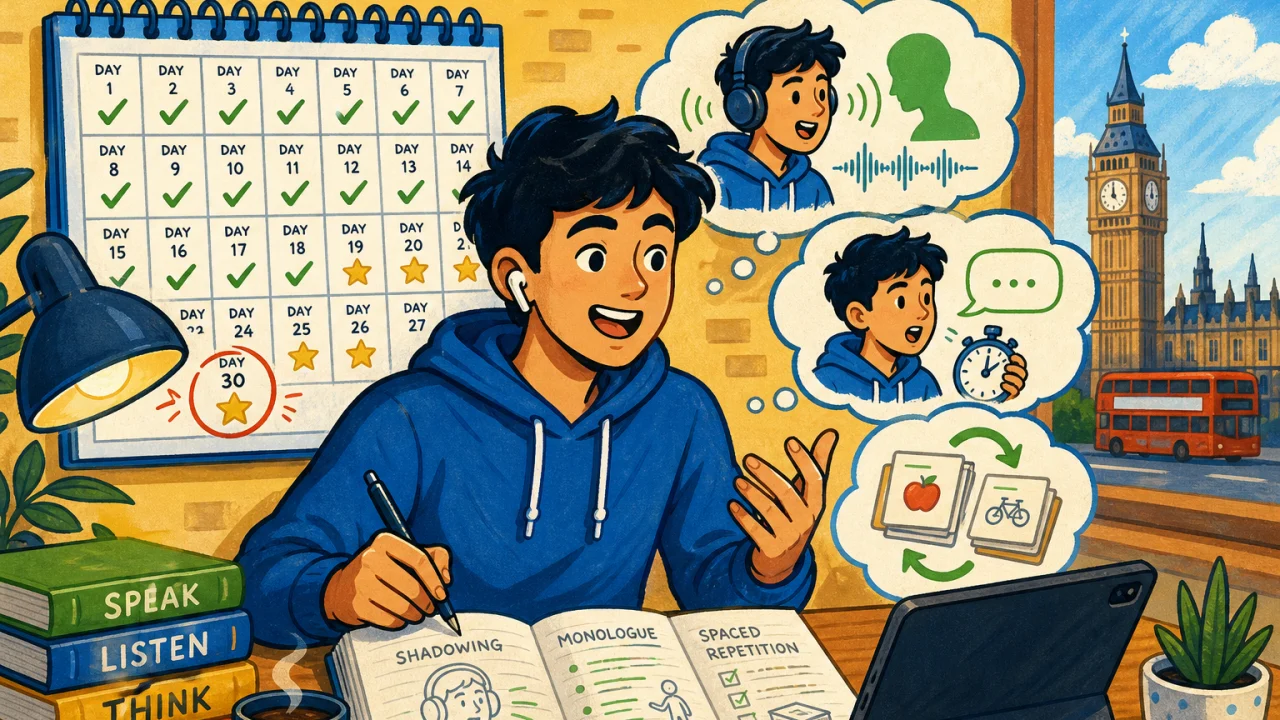
- 5 minutes: Shadowing one short video clip (repeat the same clip all week)
Evening Routine: 15 Minutes
- 3 minutes: Record yourself talking about your day
- 2 minutes: Listen to the recording and note one thing to fix
- 10 minutes: Conversation practice with a partner, tutor, or AI chatbot like ChatGPT voice mode
That's 25 minutes total. Manageable for almost anyone.
Frequently Asked Questions
How can I speak English fluently if I have no one to practice with?
You can practice alone using shadowing, self-recording, and internal monologue drills. Apps like Elsa Speak and AI voice chatbots give you interactive speaking practice without a human partner. These solo methods build the muscle memory and retrieval speed that fluency requires.
Is it really possible to speak English fluently in 30 days?
If you already understand basic English, 30 days of focused daily practice can dramatically improve your spoken fluency. You won't sound like a native speaker, but you'll speak with fewer pauses, faster word retrieval, and more natural rhythm. The goal is noticeable, measurable improvement — not perfection.
What is the fastest way to improve my English speaking at home?
Shadowing native speakers for 10 minutes daily is the single fastest at-home method. Pair it with recording yourself and listening back. These two drills target pronunciation, rhythm, and self-awareness simultaneously, and they require nothing beyond a phone and an internet connection.
How many hours a day should I practice speaking English?
Twenty-five minutes of active speaking practice daily beats hours of passive study. The key is consistency, not volume. Practicing 25 focused minutes every day for 30 days builds stronger habits than practicing 3 hours once a week.
Do I need to live in an English-speaking country to become fluent?
No. With podcasts, YouTube, language exchange apps, and AI conversation tools, you can create an immersion environment anywhere. Millions of fluent English speakers learned without ever leaving their home country. What matters is daily exposure and daily output, not geography.