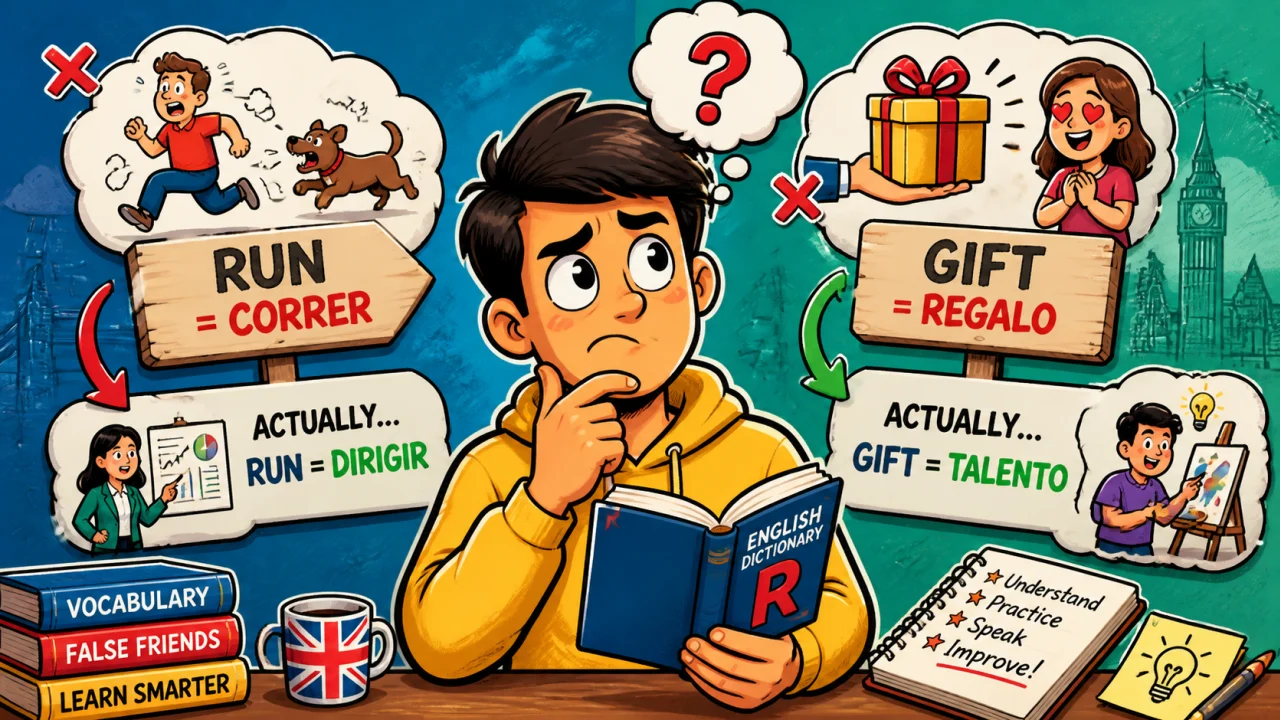

If you've ever felt confused about how to put English words in the right order, you're not alone. English sentence structures are the backbone of everything you say, write, and read in the language. Once you understand how sentences are built, English stops feeling like a puzzle and starts making real sense. This guide breaks it all down — simply, clearly, and with plenty of examples.
Key Takeaways
- There are 4 main types of English sentence structures: simple, compound, complex, and compound-complex.
- English follows 5 basic sentence patterns that nearly every sentence falls into.
- Learning structure is more effective than memorizing vocabulary word by word.
- Common mistakes like run-on sentences and fragments are easy to fix once you see the pattern.
- Practicing sentence combining and reading aloud are two of the fastest ways to improve.
What Are English Sentence Structures and Why Do They Matter?
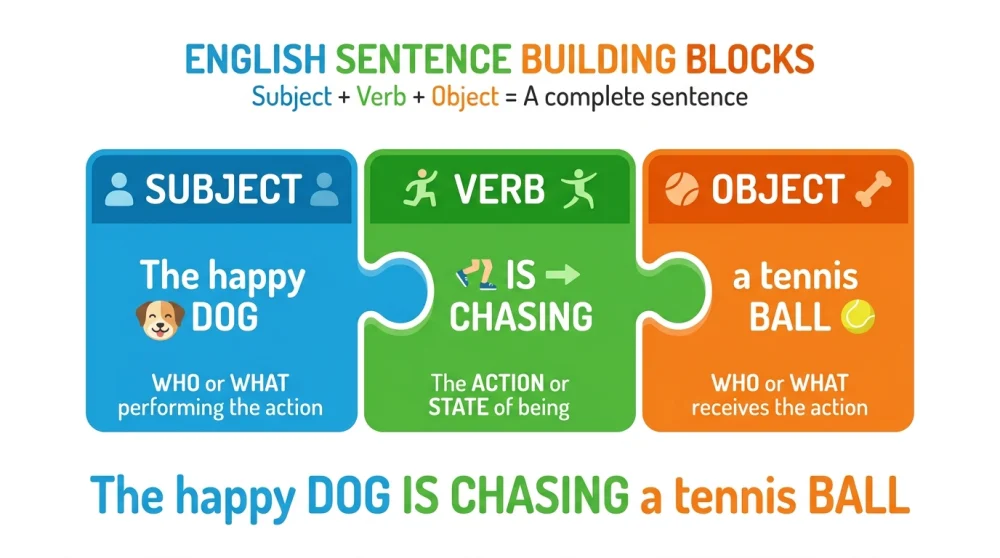
A sentence structure is simply the way words and phrases are arranged to form a complete thought. Think of it like building with blocks — each block has a job, and the order you stack them in determines what the final creation looks like.
The Role of Sentence Structure in Clear Communication
Imagine someone says, "Dog the chased cat the." You can probably guess what they mean, but it sounds broken. Now try: "The dog chased the cat." That's the power of structure. It turns a jumble of words into something instantly clear. Whether you're writing an email, giving a presentation, or chatting with a friend, sentence structure is what makes your message land.
How Understanding Structure Accelerates English Fluency
Many learners spend years memorizing vocabulary but still struggle to form natural sentences. That's because fluency isn't just about knowing words — it's about knowing where those words go. When you learn English sentence structures as patterns, you can plug in new vocabulary and instantly create hundreds of correct sentences. It's like learning a recipe instead of guessing ingredients every time.
The 4 Types of English Sentence Structures
Every English sentence, no matter how long or short, fits into one of four categories. Let's walk through each one.
Simple Sentences — One Independent Clause, Endless Possibilities
A simple sentence has one independent clause. That means it has one subject and one verb, and it expresses a complete thought.
Examples:
- She runs every morning.
- The coffee tastes amazing.
- Birds fly south in winter.
Don't let the name fool you — simple sentences aren't always short. "The tall woman in the red coat quickly crossed the busy street" is still a simple sentence because it has just one subject-verb pair.
Compound Sentences — Joining Ideas with Coordinating Conjunctions
A compound sentence connects two independent clauses using a coordinating conjunction (for, and, nor, but, or, yet, so — remember FANBOYS).
Examples:
- I wanted pizza, but she preferred sushi.
- He studied hard, so he passed the exam.
The key idea here is that both halves could stand alone as complete sentences. The conjunction just links them together.
Complex Sentences — Adding Depth with Subordinate Clauses
A complex sentence pairs one independent clause with at least one dependent clause. A dependent clause starts with words like because, although, when, if, after, while.
Examples:
- Because it was raining, we stayed inside.
- She smiled when she heard the news.
Complex sentences let you show cause and effect, timing, and contrast — which makes your writing feel more mature and detailed.
Compound-Complex Sentences — Combining It All Together
This is the big one. A compound-complex sentence has at least two independent clauses and at least one dependent clause.
Examples:
- Although the test was hard, Maria passed it, and she celebrated with her friends.
- I'll cook dinner if you set the table, but you need to help clean up afterward.
These sentences sound very natural in spoken and written English, even though they look complicated on paper.
The 5 Basic English Sentence Patterns You Need to Know
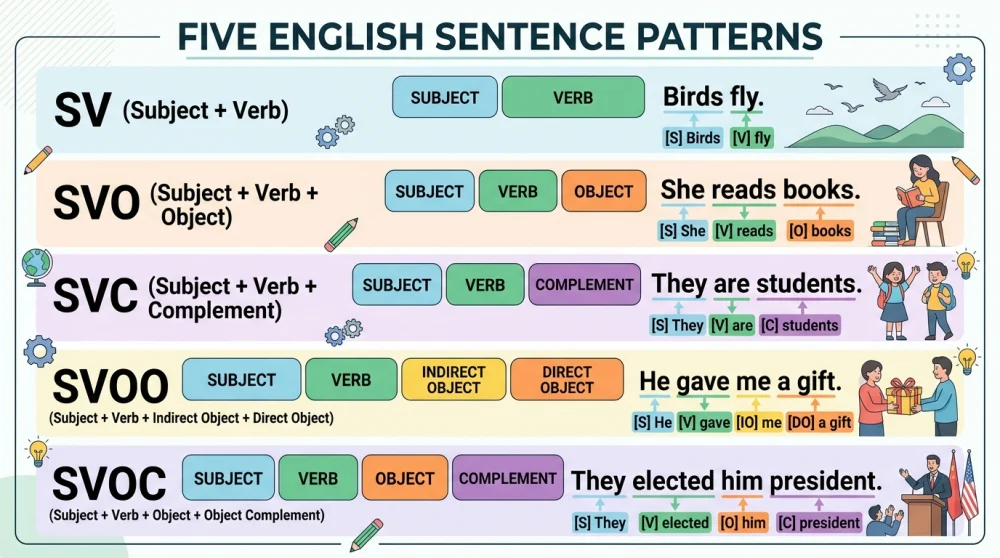
Beyond the four types, English sentences follow five core patterns based on how the subject, verb, and other elements are arranged.
S-V (Subject + Verb)
The simplest pattern. The subject does something, and that's it.
- Birds sing.
- She laughed.
S-V-O (Subject + Verb + Object)
This is the most common pattern in English. The subject does something to an object.
- Tom reads books.
- We love music.
S-V-C (Subject + Verb + Complement)
Here, the verb links the subject to a word that describes or renames it. Common linking verbs include is, was, seems, becomes.
- She is a teacher.
- The soup tastes delicious.
S-V-O-O (Subject + Verb + Indirect Object + Direct Object)
Some verbs need two objects — who receives something and what is received.
- He gave her a gift.
- Mom made us breakfast.
S-V-O-C (Subject + Verb + Object + Complement)
The complement describes or renames the object, not the subject.
- They elected him president.
- The news made her happy.
How to Build Sentences Step by Step (With Visual Examples)
Now that you know the types and patterns, let's actually build a sentence from scratch.
Start with the Core — Subject and Predicate
Every sentence needs at least two things: a subject (who or what) and a predicate (what they do). Start there.
- The cat + sleeps → The cat sleeps.
Add Modifiers — Adjectives, Adverbs, and Phrases
Now make it more interesting by adding descriptive words.
- The fluffy cat sleeps peacefully on the couch.
Notice how the sentence is still built on the same simple core. The modifiers just add detail.
Expand with Clauses — Dependent and Independent
Want to add even more information? Attach a clause.
- The fluffy cat sleeps peacefully on the couch while the dog plays outside.
You just turned a simple sentence into a complex sentence by adding one dependent clause. That's how English sentence structures grow naturally.
Common English Sentence Structure Mistakes to Avoid
Even native speakers make these errors. Here's how to spot and fix them.
Run-On Sentences and Comma Splices
A run-on jams two complete thoughts together with no punctuation. A comma splice uses just a comma where you need a conjunction or period.
- Wrong: I love hiking I go every weekend.
- Wrong: I love hiking, I go every weekend.
- Right: I love hiking, and I go every weekend.
Sentence Fragments
A fragment is a group of words pretending to be a sentence but missing a subject, verb, or complete thought.
- Fragment: Because she was tired.
- Complete: She left early because she was tired.
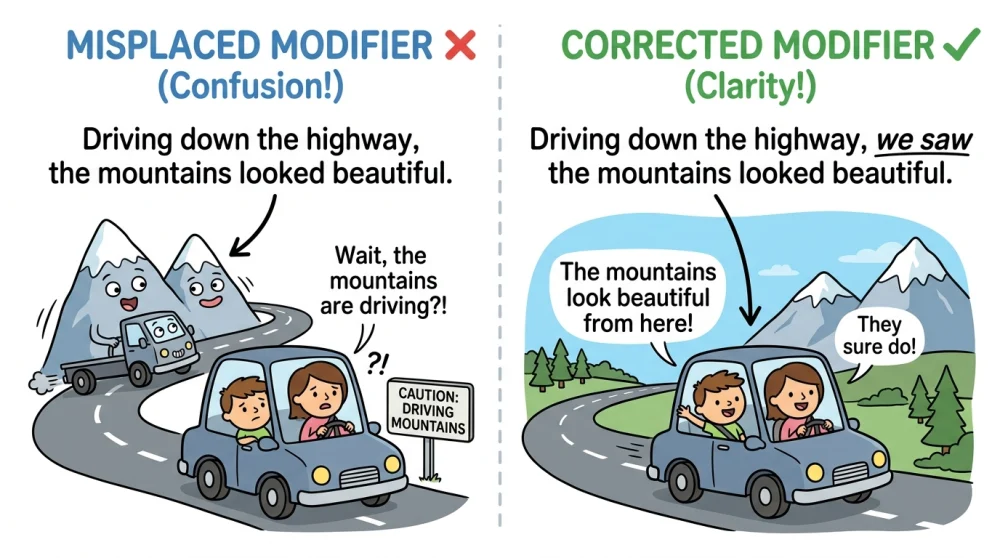
Misplaced and Dangling Modifiers
When a describing word or phrase is in the wrong spot, the meaning can get weird — or funny.
- Misplaced: She almost drove her kids to school every day. (Did she "almost drive" or drive "almost every day"?)
- Better: She drove her kids to school almost every day.
Sentence Structure Tips for ESL Learners
Here are three strategies that can speed up your progress dramatically.
Think in Patterns, Not Word-by-Word Translations
If you translate sentence by sentence from your native language, the word order will often come out wrong. Instead, learn the English pattern first, then fill in the vocabulary. For example, memorize "Subject + Verb + Object" as a framework, and practice slotting in new words.
Practice with Sentence Combining Exercises
Take two or three short sentences and combine them into one. This builds your ability to form compound and complex sentences naturally.
- Short: The weather was cold. We went hiking. We had fun.
- Combined: Although the weather was cold, we went hiking and had fun.
Read Aloud to Internalize Natural Sentence Flow
Reading English out loud — books, articles, even subtitles — trains your brain to feel the rhythm of correct sentence structures. Over time, wrong word order will simply "sound off" to you, just like it does for native speakers.
Frequently Asked Questions
What are the 4 types of sentence structures in English?
The four types are simple, compound, complex, and compound-complex. Simple sentences have one independent clause. Compound sentences join two independent clauses. Complex sentences pair an independent clause with a dependent clause. Compound-complex sentences combine at least two independent clauses with one or more dependent clauses.
What is the most common sentence structure in English?
The Subject-Verb-Object (SVO) pattern is by far the most common in everyday English. Sentences like "I eat breakfast" and "She reads books" follow this pattern. It's the default word order that native speakers use most of the time.
How can I improve my English sentence structure quickly?
Start by learning the five basic patterns and four sentence types covered in this guide. Then practice sentence combining exercises daily, read English content aloud, and pay attention to how sentences are built in the things you read. Consistency matters more than cramming.
What is the difference between sentence structure and sentence pattern?
Sentence structure refers to the type of sentence based on clause arrangement — simple, compound, complex, or compound-complex. Sentence pattern refers to the arrangement of grammatical elements within a clause, like Subject-Verb-Object or Subject-Verb-Complement. Structure is about how clauses connect; pattern is about what's inside each clause.
Why is sentence structure important for TOEFL and IELTS?
Both exams score you on grammatical range and accuracy. If you only write simple sentences, your score ceiling is low — no matter how correct they are. Showing variety in your English sentence structures (mixing simple, compound, and complex sentences) signals higher proficiency and directly boosts your writing and speaking band scores.
Final Thoughts — Build Fluency One Sentence at a Time
Mastering English sentence structures doesn't happen overnight, but it doesn't have to take years either. You now have the complete map — four sentence types, five core patterns, step-by-step building techniques, and the most common mistakes to watch out for. Pick one section, practice it until it feels natural, and then move on to the next. Every fluent English speaker got there one sentence at a time. You will too.