
You've probably looked up a list of English words with R and gotten back rabbit, run, rain — fine. But nobody warns you about the trap hiding in plain sight: dozens of R words look so close to Spanish that native Spanish speakers translate them on instinct and get them completely wrong. That mistake has a name — false friend — and the letter R alone carries at least 15 of the most treacherous ones in English-Spanish pairs. Here's what they actually mean, and how to stop falling for them.
Why English Words with R Trip Up Spanish Speakers So Badly
English and Spanish share Latin roots. That's mostly great — restaurant, radio, region — these words cross over cleanly. But shared roots also breed overconfidence. When you see a word that looks almost identical in both languages, your brain assumes the meaning matches. Sometimes it does. Other times, it quietly embarrasses you.
What Is a False Friend, and Why Does R Have So Many?
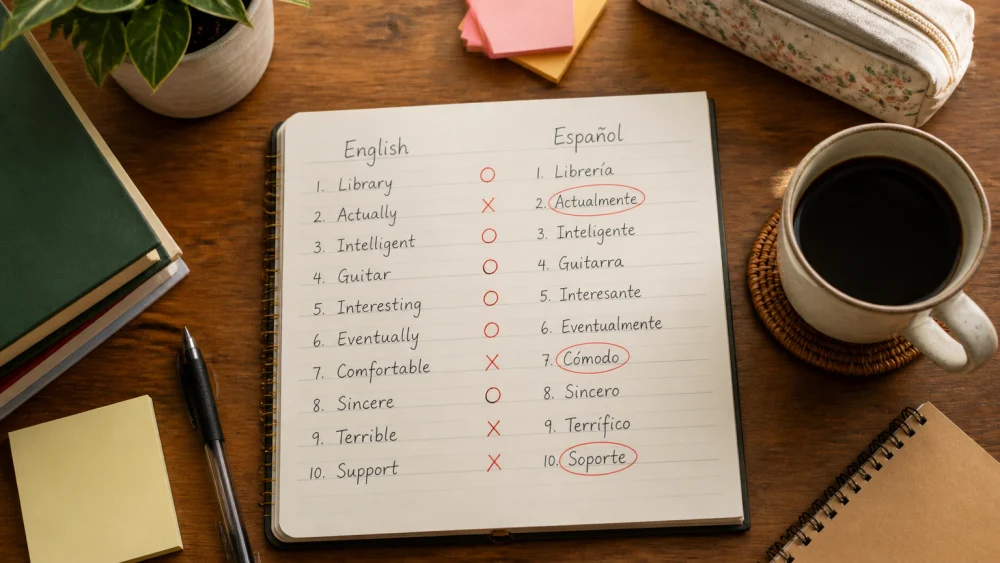
A false friend is a word that looks identical (or nearly so) in two languages but means something different. The letter R has an unusually high concentration of them because Latin prefixes like re-, ro-, and ra- survived into both languages but drifted toward different meanings over centuries. Realize, record, resume, retire, rent — all familiar, all misleading.
Why don't English courses flag this? Most organize vocabulary by grammatical category (R nouns, R verbs, R adjectives) without pointing out where the traps are. You memorize the list, pass the quiz, and two weeks later you're still translating realize as "to carry out."
15 English Words with R That Most Learners Get Wrong
Here's the breakdown — what you probably think these words mean versus what they actually mean:
| English Word | What You Think It Means | What It Actually Means |
|---|---|---|
| Realize | To carry out, accomplish | To become aware of something |
| Record (verb) | To remember | To capture audio/video; to register |
| Resume | To summarize | To continue after a pause |
| Résumé | To summarize | A CV, work history document |
| Remove | To stir (like soup) | To take away, eliminate |
| Retire | To pull back an object | To stop working permanently |
| Rent | (varies by dialect) | To pay for temporary use of something |
| Rare | Strange, weird | Undercooked (meat) / uncommon |
| Rude | Rough, physically strong | Impolite, offensive |
| Regular | Mediocre, so-so | Normal, habitual |
| Rope | Clothing | A thick cord or line |
| Rest | The remainder | To relax, to sleep |
| Recollect | To gather again | To remember, to recall |
| Require | To request formally | To need, to demand |
| Remark | To underline, to stress | To comment, to observe |

"Realize" Does Not Mean "To Accomplish"
This is probably the most widespread false friend starting with R. In Spanish, realizar means to carry out or execute: "Voy a realizar un proyecto" (I'm going to carry out a project). In English, realize means to become aware of something: I realized I'd forgotten my keys. If you want to say you carried something out, use carry out or accomplish instead.
"Record" Changes Meaning Based on Where You Stress It
There are two traps here. First, record has nothing to do with remembering — that's remember. Second, the word shifts grammatical role depending on stress: /ˈrɛkərd/ (stress on the first syllable) is a noun — a record, a disc. /rɪˈkɔːrd/ (stress on the second) is a verb — to record something. A learner aiming for a Cambridge B2 certificate might write I don't record his name intending "I don't remember his name," but the examiner reads "I don't record his name" — a completely different sentence.
"Resume" vs. "Résumé": Same Letters, Two Completely Different Words
Resume (no accent, pronounced /rɪˈzjuːm/) means to continue after a break: Let's resume the meeting after lunch. But résumé (with French accents, pronounced /ˈrɛzjʊmeɪ/) is the document you send when applying for a job — your CV. Neither one means "to summarize," which in English is summarize. Three distinct concepts, one shared shape.
"Remove," "Retire," "Rent," and Other Verbs That Lie
Remove doesn't mean to stir — it means to take something away or eliminate it. Retire doesn't mean pulling an object back from a table; it means leaving the workforce permanently: My father retired at 65. And rent means to pay for temporary use of something — an apartment, a car, a bike.
One more that catches people off guard: rest. It doesn't mean "the remainder" (that's the rest). It means to relax or sleep. I need to rest is "I need to relax," not a request for leftovers.
"Rare," "Rude," "Regular": Three Adjectives Worth Slowing Down On
Rare can mean uncommon, yes — but in everyday restaurant English, it's how you order a steak cooked minimally: I'd like my steak rare. If you tell a server your steak is "weird," you're going to get a confused look.
Rude doesn't mean physically rough or tough. It means impolite or offensive. Don't be rude to the server means don't be disrespectful, not don't be physically forceful.
And regular? In casual American English, you can say something is regular to mean it's standard or typical. A regular customer is a loyal, returning customer — not a mediocre one. Saying you're feeling "regular" when you mean "so-so" won't land the way you'd expect.
English Words with R That Do Match Spanish (Reliable Cognates)
Not every R word is a trap. A solid chunk of them line up perfectly with Spanish, and you can use them with confidence.
Quick List of Trustworthy R Cognates
- Radio = radio
- Region = region
- Religion = religion
- Reception = reception
- Reduce = to reduce
- Recycle = to recycle
- Respect = respect
- Restaurant = restaurant
- Result = result
- Reservation = reservation
The pattern here is worth noticing: reliable cognates tend to cover technical, scientific, or institutional concepts that traveled from Latin into both languages without picking up new baggage. False friends, on the other hand, tend to be everyday words that each language shaped independently over time.
How to Tell a False Friend from a Real Cognate in 3 Steps
Step 1 — Look the Word Up in Context, Not a Bilingual Dictionary
Bilingual dictionaries sometimes give you a direct translation without the nuance. Try a monolingual dictionary like Collins and read the English definition. If the meaning doesn't match what you assumed, you've found a false friend.
Step 2 — Check the Grammatical Role
When a word functions as a verb in English but you've only seen its equivalent as a noun in your native language (or vice versa), slow down. Record is the clearest example: in Spanish, récord is always a noun (setting a record). In English, it's both a noun and a verb.
Step 3 — Practice with Real Sentences, Not Isolated Word Lists
A list of 100 words with R in English is useful for a quick review, but it won't teach you how to use the word in a sentence. Write 2 or 3 original sentences with each false friend you discover. That fixes the correct meaning far better than re-reading a table ten times.
R-Word Mistakes That Show Up on B1 and B2 Exams
Examples from Cambridge-Style and Other Standardized Tests
In Cambridge B2 First Use of English sections, you'll see sentences like She didn't realize the door was open. The typical mistake is reading realize as "carry out" and choosing an answer that doesn't fit. In the Writing section, it's common to see I want to resume my points when the writer meant "summarize my points" — the correct word there is summarize.
If you're preparing for a standardized English exam at the B1 or B2 level, reviewing the table above in the week before your test is one of the fastest ways to pick up easy points. These are straightforward errors to fix once you know about them, and they're frustrating to lose points on when you don't.
Pronouncing the English R: The Other Mistake Nobody Corrects
Spanish R vs. English R — They're Not the Same Sound
The Spanish R vibrates against the roof of the mouth. The English R doesn't touch anything — the tongue curves back without making contact. They're genuinely different sounds. Pronouncing run with a Spanish R will get you understood, but it'll immediately mark you as a Spanish speaker.
A trick that actually works: say the word "butter" slowly and notice where your tongue is on the second syllable — hovering, not touching. That position, tongue curled back and suspended, is close to the English R.
5 English Words with R Where Pronunciation Changes the Meaning
- Read in present tense (/riːd/) vs. read in past tense (/rɛd/) — same spelling, two sounds.
- Record as a noun (/ˈrɛkərd/) vs. record as a verb (/rɪˈkɔːrd/) — stress marks the difference.
- Right (/raɪt/) vs. write (/raɪt/) — homophones that only context can separate.
- Rain (/reɪn/) vs. reign (/reɪn/) — another homophone pair distinguished entirely by meaning.
- Row (/roʊ/ = a line of seats) vs. row (/raʊ/ = a loud argument) — one word, two pronunciations, two meanings.
Key Takeaways
- At least 15 common English words starting with R are false friends for Spanish speakers — they look familiar but mean something different.
- The highest-risk ones in everyday use are realize, record, resume, retire, and rest.
- Reliable R cognates (radio, region, religion, restaurant) tend to be technical or institutional terms — they traveled between languages without changing meaning.
- The English R is an approximant sound, not a trill. Tongue back, no contact with the palate.
- On B1/B2 exams, false friends with R appear in vocabulary, Use of English, and writing tasks — knowing the table above is a concrete advantage.
FAQ
What English words with R are most common in everyday conversation?
The most frequent are run, read, right, room, rain, ready, really, remember, red, and reason. These ten words show up in virtually any everyday conversation. Most of them are safe to use, though really doesn't always translate cleanly depending on context.
How many false friends with R exist between English and Spanish?
There's no single official count, but at least 15 high-frequency false friends start with R. If you include technical terms and less common words, the list clears 20 easily. The table in this article focuses on the ones that appear most often in B1 and B2 level exam material.
How is the R pronounced in English when it comes at the end of a word?
It depends on the accent. In American English, the final R is always pronounced — car sounds like /kɑːr/. In standard British English (Received Pronunciation), the final R is typically silent unless the next word starts with a vowel: car engine keeps the R sound, but car park drops it. If you're studying for a Cambridge exam, it's worth getting comfortable with both.