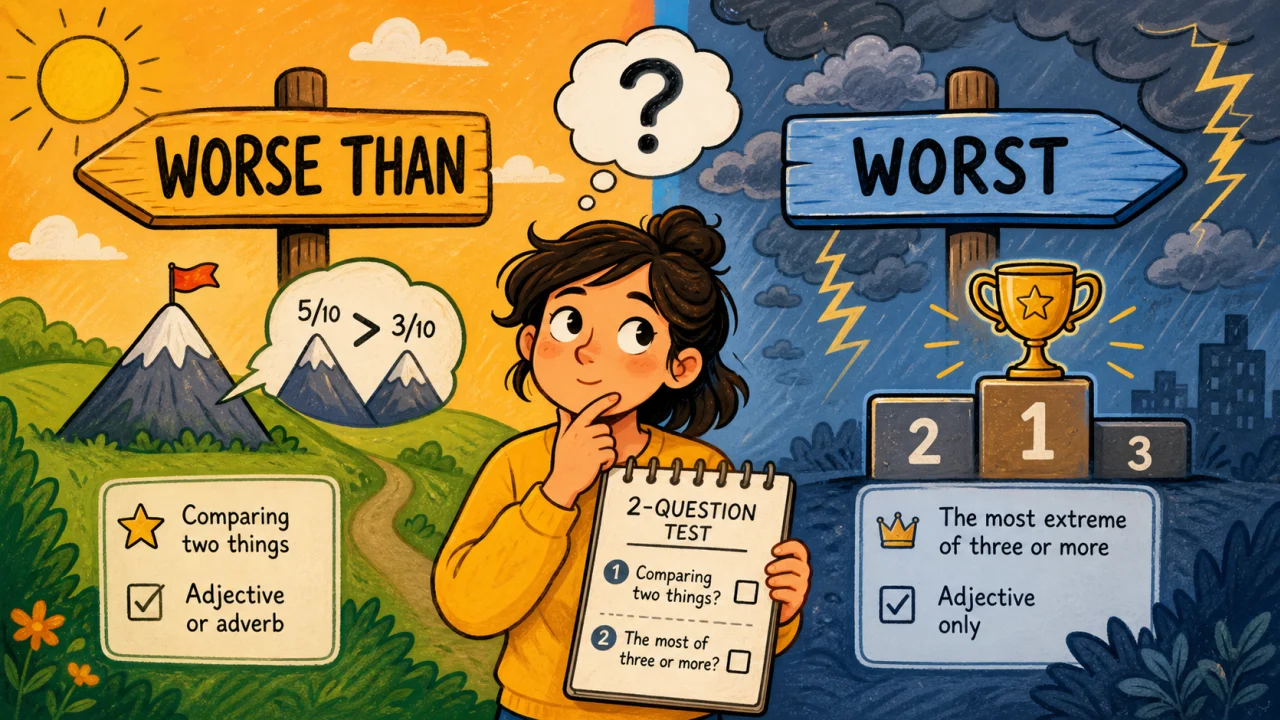
You're halfway through an email, you type "worst than," and something feels off. Here's the short answer: "worse than" compares 2 things, and "worst" singles out the bottom of 3 or more. Mix them up and your reader notices—even if they can't explain why.
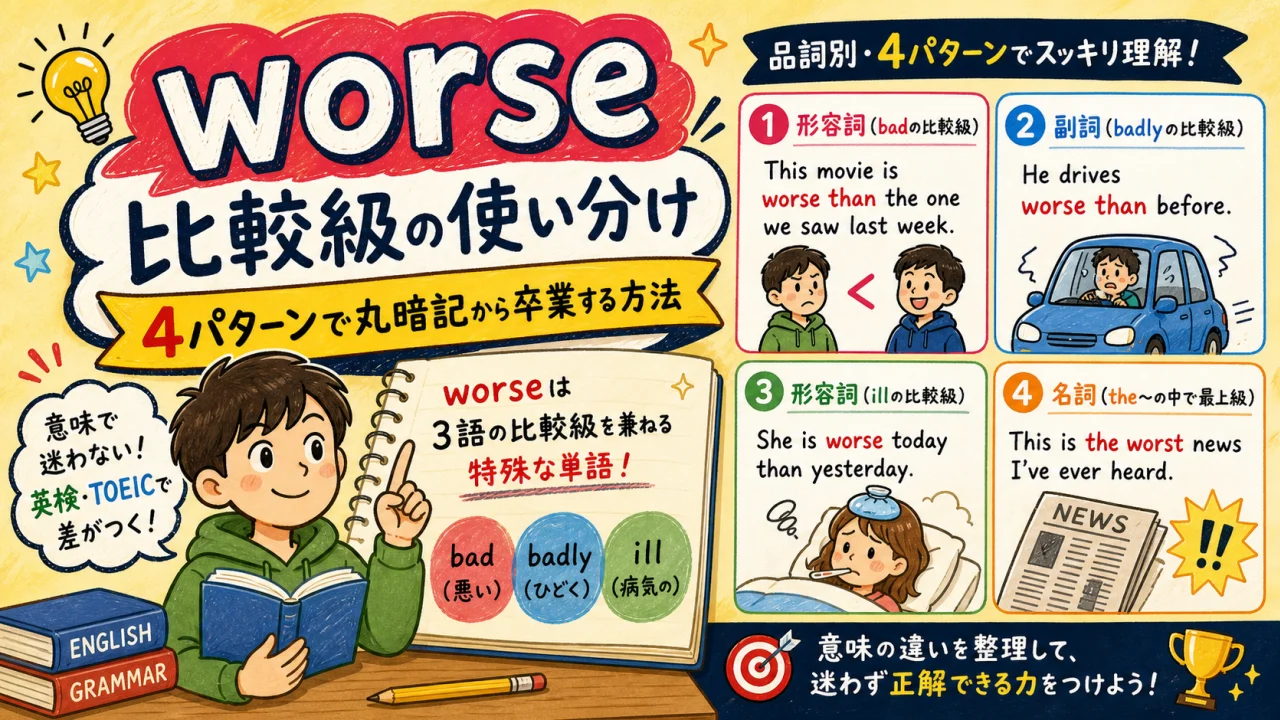
The word "worse" is the comparative form of "bad." According to the Cambridge Dictionary, it means "more unpleasant, difficult, or severe than before or than something else that is also bad." The word "worst" is the superlative form—the absolute bottom. That single letter "t" at the end changes the entire meaning of your sentence.
Why You Keep Mixing Up 'Worse Than' and 'Worst'
Both words come from "bad," and they sound almost identical when you say them fast. That's the trap. Your brain hears something close enough and picks whichever one feels more dramatic in the moment.
But grammar doesn't care about drama. "Worse" works like "taller" or "faster"—it stacks exactly 2 things against each other. "Worst" works like "tallest" or "fastest"—it picks one loser out of an entire group. You'd never say "she's the tallest than her sister," right? Same logic applies here.
The confusion hits hardest in writing because you can't lean on tone of voice to cover a shaky word choice. In a college essay, a work email, or a cover letter, the wrong pick sticks out.
The 2-Question Test That Picks the Right Word for You
No competitor page hands you a reusable framework for this, so here's one you can memorize in about 10 seconds.
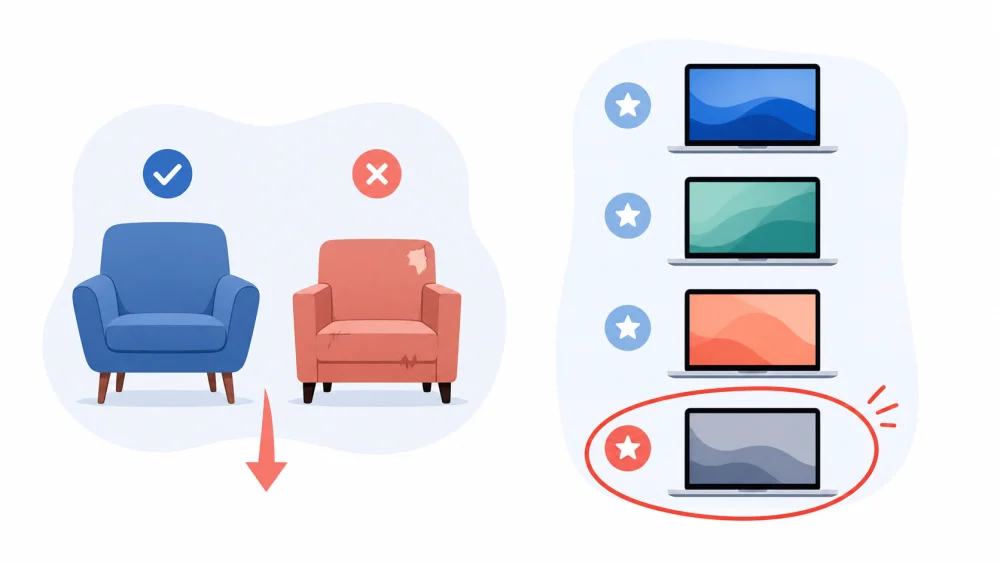
Question 1: Am I comparing exactly 2 things? If yes, use "worse than."
Example: The sequel was worse than the original.
Question 2: Am I picking the bottom of a group of 3 or more? If yes, use "worst."
Example: Out of all 5 movies in the franchise, the third one was the worst.
That's it. Two questions, two paths, zero guesswork. Run every sentence through this filter and you'll land on the right word before you even think about grammar rules.
'Worse Than' as an Adjective vs. an Adverb
Here's where things get a little more interesting. "Worse than" doesn't just describe nouns. It can also describe how someone does something. Most grammar pages skip this distinction, but it matters if you want your sentences to sound tight.
Adjective Examples (Describing a Noun)
When "worse than" works as an adjective, it sits right next to the noun it's describing—or connects to it through a linking verb like "is" or "feels."
- The flu is worse than a cold.
- Her manners are worse than her brother's.
- This road is worse than the highway during rush hour.
Each sentence puts 2 nouns side by side and declares one of them more unpleasant. Straightforward.
Adverb Examples (Describing a Verb)
When "worse than" acts as an adverb, it tells you how an action happened. The structure shifts a bit—"worse" lands after the verb instead of next to a noun.
- He performed worse than she did on the midterm.
- It's storming worse than it did last winter.
- The engine runs worse than it did before the repair.
Notice the pattern? The action itself is being compared across 2 situations. You're not saying the storm is bad. You're saying it storms more severely now than it did before.
When 'Worst' Is the Only Correct Choice
"Worst" steps in when you're dealing with a group—3 items minimum—and you need to name the one at the very bottom. It almost always travels with "the" right in front of it.
- Cockroaches are the worst insect to find in your kitchen.
- That was the worst call the referee made all game.
- Monday was the worst day of the entire week.
One critical detail: "worst" never pairs with "than." The phrase "worst than" doesn't exist in standard English. If you catch yourself typing it, swap in "worse" immediately. Every time "than" follows, you need "worse."
3 Tricky Sentences That Fool Native Speakers
The basic rule covers about 90% of situations. But English loves its exceptions and idioms, so let's handle the sentences that trip up even people who grew up speaking the language.
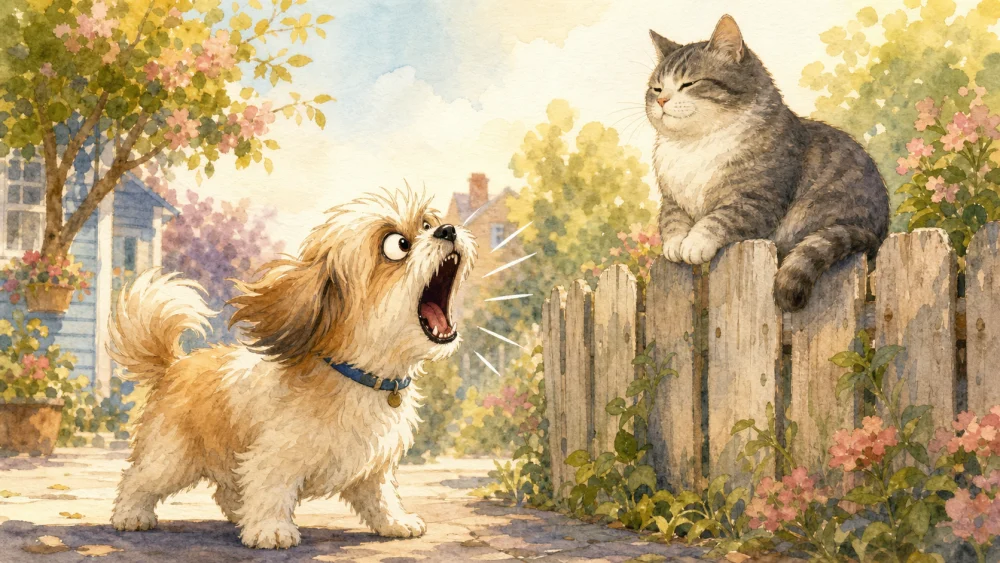
1. "His bark is worse than his bite."
This is a fixed idiom. It means someone sounds scarier or meaner than they actually are. Even though it's an idiom, the grammar still follows the comparative rule perfectly—you're comparing 2 things (the bark and the bite). No special exception needed.
2. "You could do worse than..."
This phrase confuses people because it sounds negative but actually means the opposite. When someone says "you could do worse than applying to that school," they're telling you the school is a solid choice. It's a very dry, understated way of giving a compliment. Think of it as classic American understatement—praising by pointing out that the alternatives are inferior.
3. "Worse than useless."
This one isn't comparing 2 concrete things. Instead, it uses "worse than" as an intensifier. If something is "worse than useless," it doesn't just fail to help—it actively causes harm. You'll hear this in politics, product reviews, and frustrated Yelp posts. The grammar still holds: you're comparing the thing's value against the baseline of "useless."
The Mistake Nobody Talks About: Using 'Worst' for Drama
Here's something most grammar pages won't tell you. A lot of "worse than" vs. "worst" mistakes aren't really about forgetting the rule. They're about reaching for the word that sounds stronger.
"Worst" feels final. It hits harder. So when you're frustrated or trying to make a point, your instinct is to grab the superlative even when the sentence only involves 2 things. You write "this is the worst option than the other one" because "worse" somehow feels too mild for how annoyed you are.
But swapping in a bigger word doesn't make your point bigger. It makes your grammar wrong. And in any context where your writing gets evaluated—a school assignment, a job application, a published article—that error undercuts the very authority you're trying to build. Precision is what gives writing its punch, not volume.
Quick-Reference Cheat Sheet
| Scenario | Correct Word | Example |
|---|---|---|
| Comparing 2 options | worse than | This pizza is worse than yesterday's. |
| Picking the bottom of 3+ | worst | That was the worst pizza I've ever had. |
| Describing how an action compares | worse than | She sang worse than he did. |
| Naming the absolute extreme | worst | It was the worst performance of the night. |
| Following the word "than" | worse | Nothing is worse than a flat tire in the rain. |
Bookmark this table. Pull it up the next time you hesitate mid-sentence.
FAQ
Is it 'worse than' or 'worst than'?
Always "worse than." The word "worst" is a superlative and doesn't pair with "than." If your sentence includes "than," the correct choice is "worse" every single time.
Can 'worse' be used without 'than'?
Yes. You can say "things got worse" or "the situation is worse now" without adding "than." The comparison is implied—you're comparing the current state to a previous one without naming it directly.
What is the difference between 'worse' and 'more bad'?
"Worse" is the standard comparative form of "bad" in English. "More bad" isn't grammatically accepted in standard usage. Unlike regular adjectives that add "more" for comparison (like "more beautiful"), "bad" has its own irregular comparative form: worse. Stick with "worse."
When do you use 'worse' vs. 'worst' in formal writing?
The rule stays the same regardless of formality. Use "worse than" when comparing 2 things and "worst" when identifying the extreme of 3 or more. Formal writing simply demands that you follow this rule more carefully, because errors stand out more in polished prose.