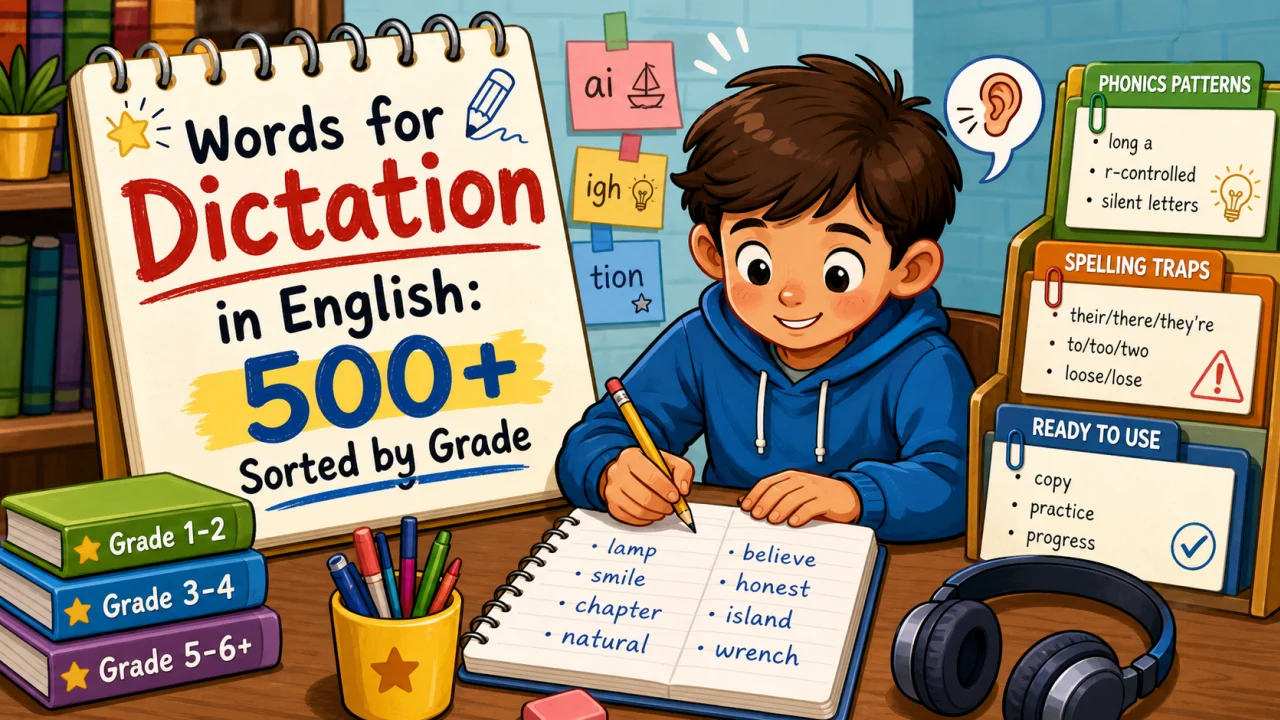
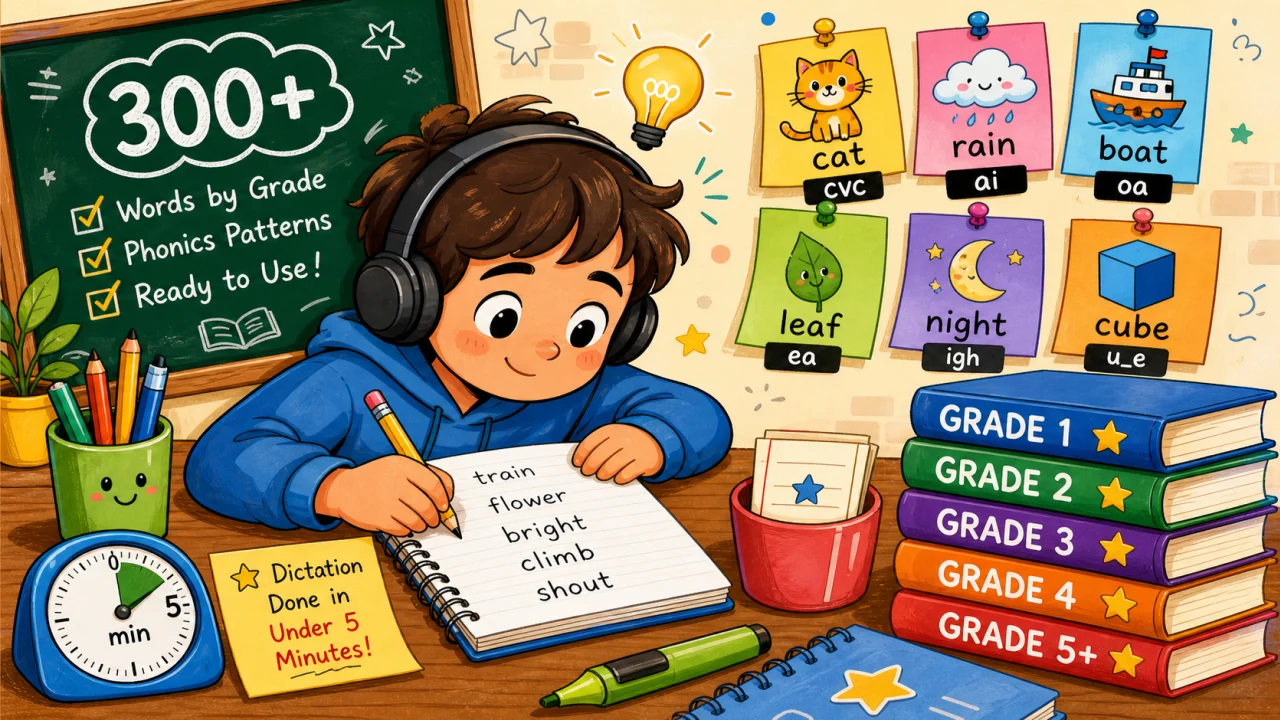
Finding the right english dictation words for your kid's grade shouldn't require stitching together five different websites. Below you'll find 300+ words organized by grade level and phonics pattern — ready to copy, read aloud, and use tonight. Each list builds on the one before it, so your child moves from three-letter basics to multi-syllable vocabulary without skipping steps.
What Are English Dictation Words (and Why They Work Better Than Spelling Lists)
Dictation words are spoken aloud by a parent or teacher while a student listens and writes them down from memory. That's the key difference from a typical spelling list: the child never sees the word on paper first. Every letter has to come from their ears, not their eyes.
This trains four skills at once — listening, phonics, spelling, and handwriting. Research summarized by the NCERT National Curriculum Framework found that children who practice dictation 3–5 times per week retain spelling better than peers who only read silently or copy words. That tracks with what U.S. elementary teachers see daily: kids who hear-then-write outperform kids who just memorize letter order.
How to Pick the Right Dictation Words for Your Child's Level
Giving a first grader the word "psychology" is pointless. Giving a fifth grader "cat" wastes time. Here's how the difficulty scales up.
CVC Words for Beginners (Ages 5–6)
Three-letter words like cat, pen, and bus. One consonant, one vowel, one consonant. The child matches a single sound to a single letter — that's it.
Blends and Digraphs for Early Readers (Ages 6–7)
Words like train, brush, and cherry. Two consonants blend together (tr-, br-) or two letters make one sound (sh, ch, th). This is where kids start stumbling because the sound-to-letter match isn't one-to-one anymore.
Multi-Syllable Words for Growing Spellers (Ages 8–9)
Words like village, market, and animal. The child now has to hold more sounds in working memory before writing.
Silent Letters and Tricky Endings for Upper Elementary (Ages 9–11)
Think knife, honest, attention. Silent letters break the "write what you hear" rule, and -tion/-sion endings sound identical but spell differently.
Advanced Vocabulary for Middle Schoolers (Ages 11–14)
Abstract words like independence, psychology, and appreciation. These test root-word knowledge, not just phonics.
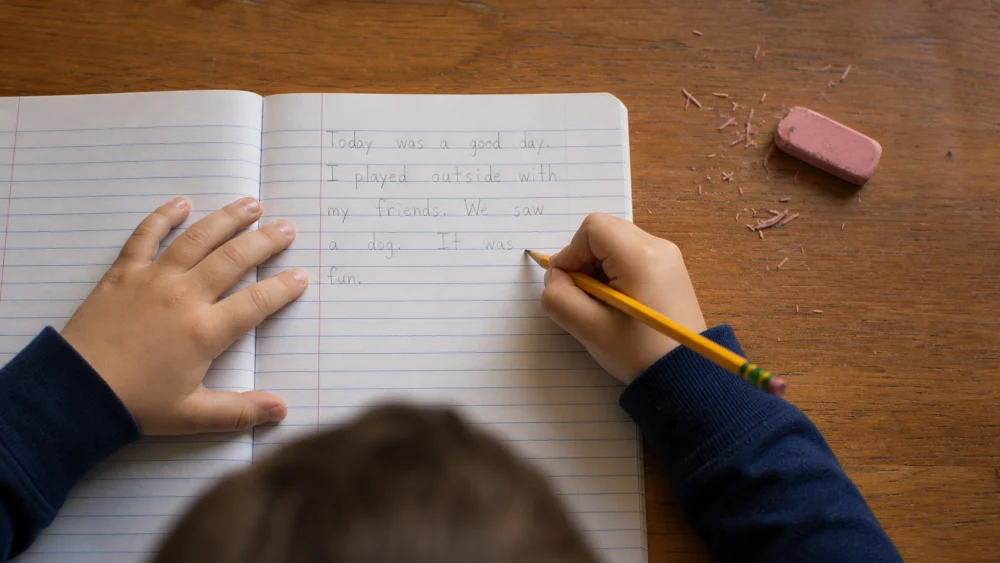
English Dictation Words for Grade 1 (30+ Words with Phonics Groups)
CVC words: cat, dog, hat, sun, pen, pin, cup, bus, jug, man, bag, mat, pot, fan, top, hen, fox, leg, bed, run
4-letter easy words: book, ball, fish, kite, tree, milk, frog, star, lion, duck, cake, ring, drum, lamp, doll
Action words: sit, hop, eat, run, jump
English Dictation Words for Grade 2 (35+ Words Sorted by Pattern)
Blends (tr, st, fl, gl, br): train, truck, star, stop, flag, flat, glass, glue, brave, bread
Digraphs (sh, ch, th, wh): ship, shop, chair, cherry, three, thin, when, what, brush, cloth
Two-syllable words: tiger, river, water, paper, sugar, lemon, table, music, happy, garden
Nature and animals: cloud, plant, leaf, stone, beach, zebra, panda, snake
English Dictation Words for Grade 3 (35+ Words Including Double Consonants)
Double consonants: rabbit, butter, kitten, muffin, mitten, happen, balloon, pillow, puzzle, coffee
Long vowel patterns (ai, ee, oa): brain, chain, street, cheese, coach, toast, dream, clean, float, speak
Three-syllable words: purple, honest, winter, village, market, cherry, animal, buffalo, hospital, beautiful
English Dictation Words for Grade 4 (40+ Words with Silent Letters and -tion Endings)
Silent letters: knife, knee, knock, write, wrap, lamb, comb, climb, hour, honest
-tion / -sion endings: nation, station, action, motion, lesson, mission, vision, decision, addition, attention
Longer vocabulary: journey, accident, emotion, laughter, weather, capture, future, patient, neighborhood, temperature, calendar, library, February, different, separate
Are you noticing a pattern? Grade 4 is where most spelling frustration starts — because English stops being phonetically honest.
English Dictation Words for Grade 5 (40+ Polysyllabic Words)
comfortable, poetry, environment, courageous, lavender, attitude, gratitude, refrigerator, compulsory, thoughtfulness, knowledge, schedule, restaurant, bicycle, vegetable, dangerous, guarantee, disappear, necessary, especially, description, experience, immediately, recognize, accomplish, celebration, temperature, communicate, imagination, opportunity, particular, secretary, vocabulary, curiosity, experiment, extraordinary, responsible, recommendation, interference, kindergarten
English Dictation Words for Grades 6–8 (50+ Words for Abstract and Academic Vocabulary)
Grade 6: encyclopedia, psychology, column, philosophy, technology, insurance, vacuum, rhythm, exaggerate, privilege, occurrence, embarrass, amateur, conscience, pronunciation, parallel, maintenance, acquaintance
Grade 7: investigation, exhaustion, performance, nutrition, appearance, malfunction, catastrophe, achievement, interference, magnificent, surveillance, lieutenant, parliament, sovereignty
Grade 8: independence, patriotism, communication, appreciation, questionable, longevity, vengeance, miscellaneous, conscientious, perseverance, accommodate, bureaucracy, mischievous, superintendent
English Dictation Words for Grades 9–10 (40+ Words That Show Up on Standardized Tests)
These words appear on the SAT, ACT, and state assessments. They're worth drilling:
acquiesce, benevolent, cacophony, diligent, ephemeral, fastidious, gregarious, hypothesis, idiosyncratic, juxtaposition, kinesthetic, loquacious, meticulous, nonchalant, ostentatious, paradox, quintessential, recalcitrant, surreptitious, tenacious, ubiquitous, vicarious, whimsical, xenophobia, ambivalent, camaraderie, deteriorate, entrepreneur, fluorescent, hemorrhage, inoculate, millennium, pharmaceutical, questionnaire, reconnaissance, sacrilegious, threshold, unanimous, reconnaissance, bourgeois
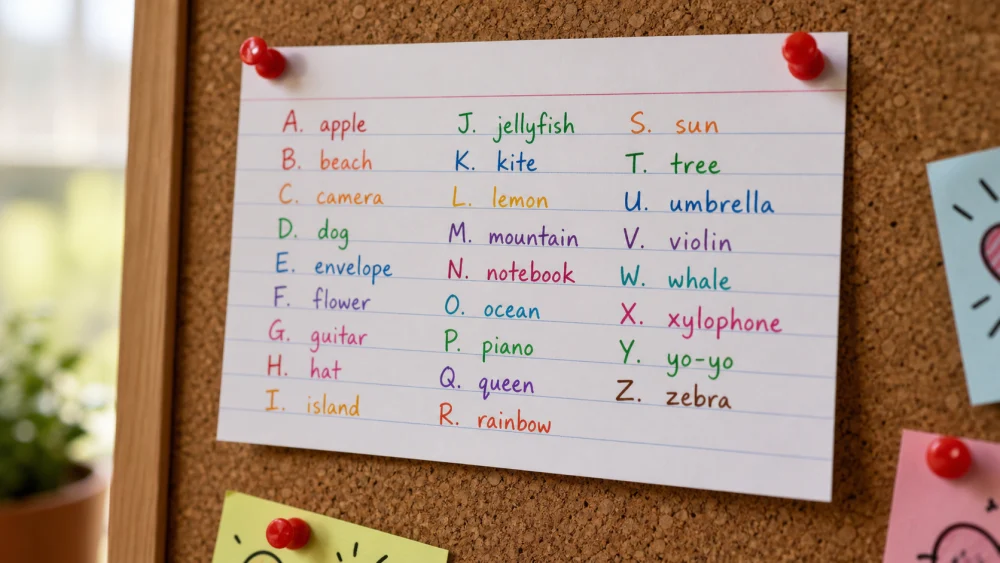
Alphabetical English Dictation Words A to Z (Quick-Reference List)
- A — accomplish, ambition
- B — benefit, bicycle
- C — courage, campaign
- D — diversity, development
- E — environment, evidence
- F — freedom, foundation
- G — generation, guarantee
- H — hospitality, harmony
- I — inspiration, inoculate
- J — journalism, journey
- K — knowledge, kinship
- L — leadership, literature
- M — motivation, management
- N — nostalgia, necessary
- O — opportunity, observation
- P — perception, performance
- Q — questionnaire, quickness
- R — resilience, responsibility
- S — surveillance, strength
- T — teamwork, tradition
- U — understanding, ubiquitous
- V — victory, vicarious
- W — wisdom, whimsical
- X — xenophobia, xylophone
- Y — yearning, youth
- Z — zeal, zenith
How to Run a Dictation Session in 5 Minutes Flat
You don't need flashcards, apps, or a teaching degree. A pencil and a quiet table work fine.
Step 1 — Pick 10 Words from the Right Grade Table Above
Ten is the sweet spot. Younger kids (grades 1–2) can handle 5–8. Older kids can go up to 15.
Step 2 — Say Each Word Twice, Pause 5–8 Seconds
Read the word clearly at a normal pace — don't chop it into syllables artificially. Say it again. Wait. Move on.
Step 3 — Re-Read the Full List and Let Your Child Self-Correct
After the last word, read all ten one more time so they can check their work. Then go through each word together. Have them mark errors with a colored pen — not just erase and fix. The visual reminder sticks.
The Mistake Most Parents Make: Skipping the Words Their Kid Already Got Wrong
Here's the part almost every dictation list on the internet ignores: what happens after the test.
Most parents move to a fresh list the next day. That feels like progress. But the misspelled words from yesterday? They'll come back misspelled next month. The fix is dead simple — start every new session by re-testing the 3–5 words your child missed last time. Only retire a word after they spell it right on three separate days. This spaced repetition approach is exactly why dictation beats passive reading for long-term retention.
Free Tools for Practicing English Dictation Words Online
If you want audio-based practice without reading the words yourself, two free platforms stand out. Speechling's English dictation tool offers thousands of sentences from beginner to advanced, with both American and British English recordings. Daily Dictation takes a different approach, using short audio clips from real speech for listening exercises. Both are free and don't require sign-up to start.
FAQ
What are the easiest english dictation words for beginners?
Three-letter CVC words — cat, sun, pen, dog, hat. Each letter maps to exactly one sound, so a child only needs to connect three sounds to three letters.
How many dictation words should you give per session?
Five to eight words for grades 1–2, ten words for grades 3–5, and up to 15–20 for grades 6 and above. Going past 20 in a single sitting drops accuracy without improving learning.
Is dictation better than flashcards for learning spelling?
For spelling and listening, yes. Dictation forces the child to retrieve the word from memory after hearing it — flashcards let them recognize it visually. Both have a place, but dictation builds stronger recall.
What english dictation words are hardest for kids to spell correctly?
Words with silent letters (knife, psychology), double consonants that don't sound doubled (accommodate, embarrass), and -tion vs. -sion endings. These patterns break the "write what you hear" rule.
How often should a child practice dictation each week?
Three to five short sessions per week beats one long session. Spacing out practice strengthens long-term memory — the same principle behind spaced repetition systems used in language-learning apps.