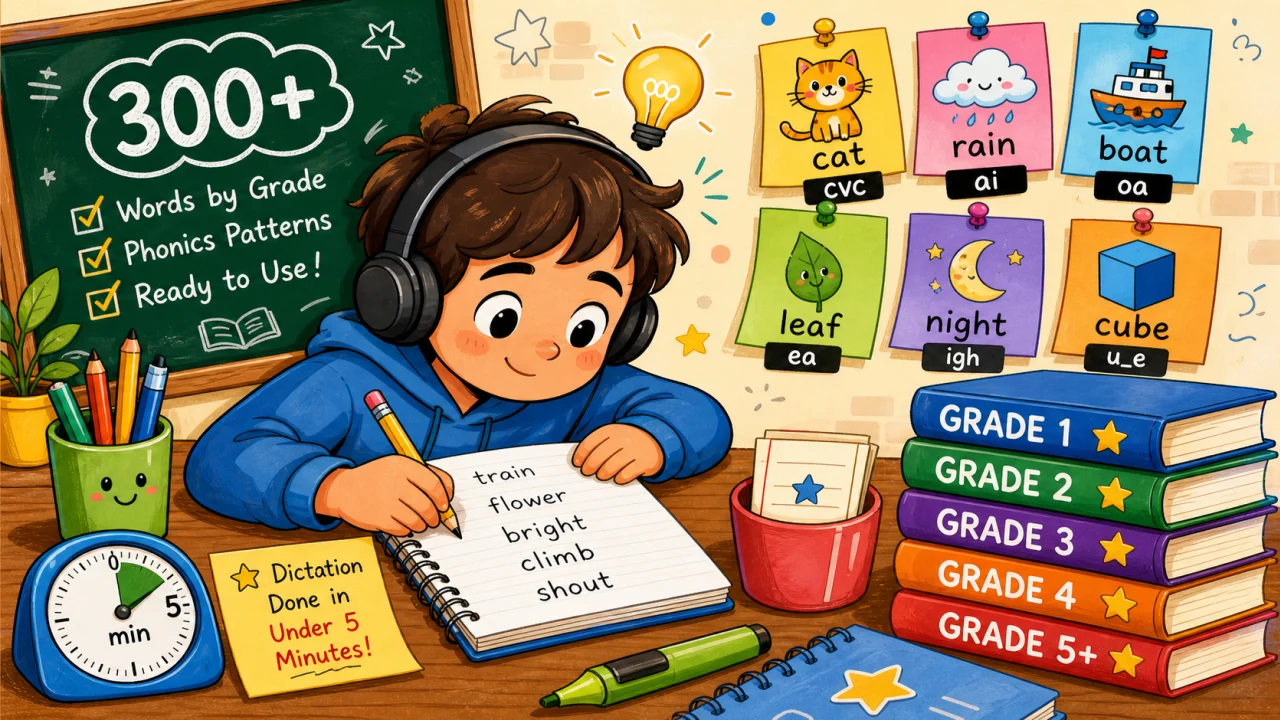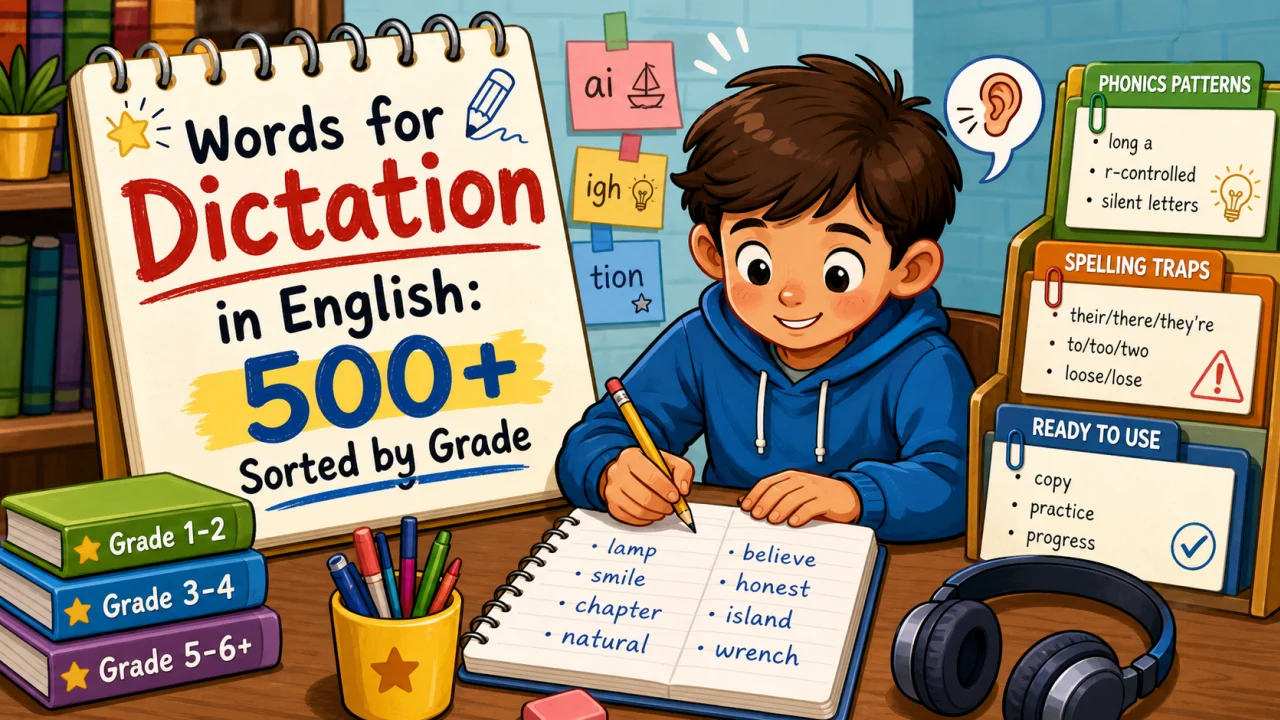
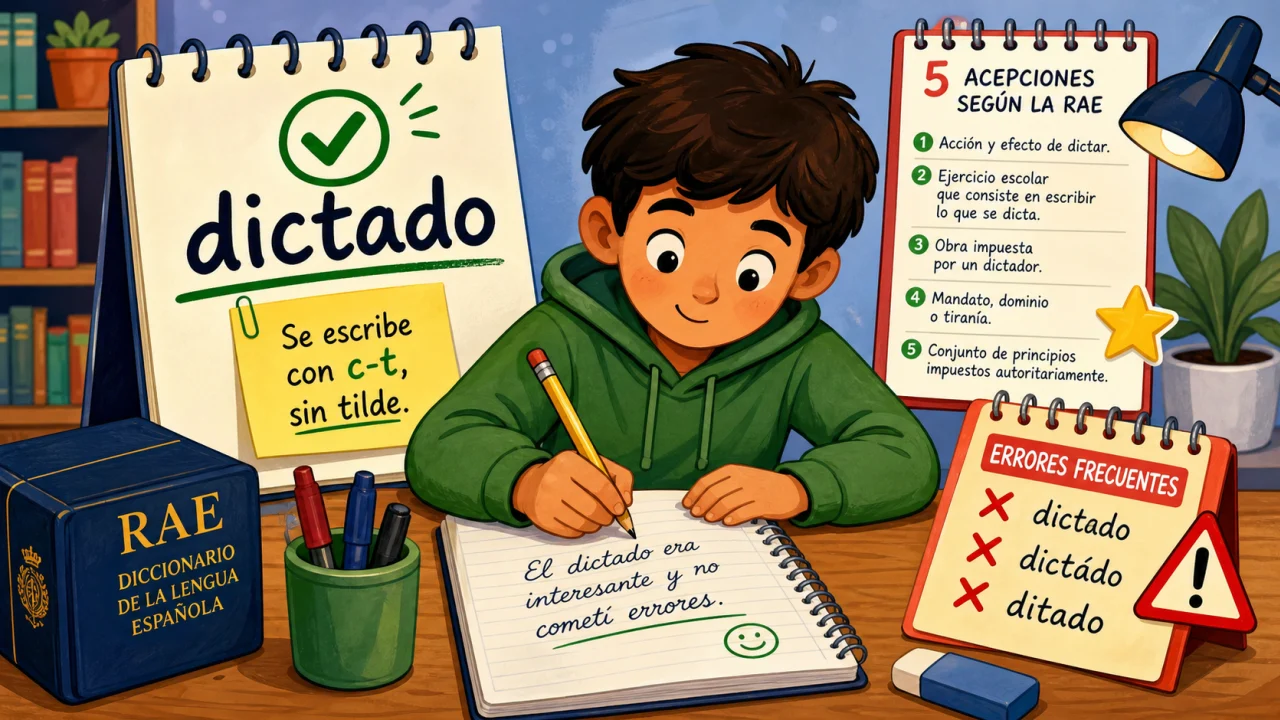
Not sure how to spell "dictation"? You're not alone — spell-checkers flag it less often than you'd think, and the middle consonant cluster trips people up. The correct spelling is dictation: D-I-C-T-A-T-I-O-N. Three syllables: dic-ta-tion. No letters dropped, no alternative spellings accepted.
Let's walk through the spelling piece by piece, cover what the word actually means, and look at why dictation exercises are more useful than most people give them credit for.
How to spell dictation: the short answer
D-I-C-T-A-T-I-O-N. Nine letters. Three syllables: dic-ta-tion.
The part that causes the most confusion is the -ct- cluster in the middle. When you say the word quickly, the "c" almost disappears. That's why common misspellings include ditation, dictaion, or dictattion. None of those are correct.
Why the "ct" cluster is there
The "ct" combination shows up constantly in English words borrowed from Latin: act, doctor, factor, traction, lecture. Every one of them keeps that "c" planted right before the "t." If you can spell doctor or action, you already have the pattern you need for dictation. The word isn't an exception — it follows a very consistent Latin-root spelling rule.
"Dictation" vs. "dication" vs. "dictaion"
Three misspellings appear regularly in search queries and spell-check logs:
- dication — drops the first "t"
- dictaion — drops the second "t"
- dictattion — doubles the "t" unnecessarily
All three get flagged by any standard spell-checker, but they're common enough to be worth naming directly.
Where the word "dictation" comes from
Latin root: dictāre
Dictation traces back to the Latin verb dictāre, meaning "to say repeatedly" or "to dictate for someone to write down." The past participle dictātus fed into both Spanish (dictado) and English (dictation) with surprisingly little change. That stability is typical of academic and religious vocabulary — words that entered European languages through medieval universities and church schools tended to preserve their Latin spelling closely.
From medieval titles to classroom exercises
Here's something that rarely comes up: before "dictation" meant a classroom writing exercise, the root word in Latin and early Romance languages referred to titles of rank or dignity — duke, count, marquis. The sense of "someone of authority speaking and others recording" gradually shifted until the classroom meaning took over entirely. The residue of that older usage still shows up in phrases like the dictates of reason or the dictates of conscience, which you'll still find in formal essays and legal writing today.
What "dictation" means: key definitions
Merriam-Webster lists dictation under two main senses, both in active use:
1. The act of speaking for someone else to write down
The most familiar meaning. A teacher reads a passage aloud; students write what they hear. A manager speaks into a recorder; an assistant transcribes the audio. In both cases, one person produces spoken content and another converts it to text.
2. The material produced by that process
The word also refers to the written output itself — the transcribed text, the completed exercise on paper. So "I finished the dictation" can mean you finished the exercise, not just the act of listening.
"Dictates" as a separate usage
The plural form dictates carries its own meaning: the commands or guiding principles of something. "The dictates of conscience" and "the dictates of the market" both use this sense. It's worth knowing because it shows up in professional and academic writing and can look like a spelling variation when it isn't.
Common mistakes when spelling and using "dictation"
Confusing dictation with similar words
Four words share the same Latin root and are easy to mix up:
- Dictate — the verb ("Please dictate the terms.")
- Dictation — the noun, the exercise or the act
- Dictator — a person who rules by absolute authority
- Dictum — a formal statement or ruling; plural is dicta or dictums
Mixing up their spellings is a classic test-day error. The trick: dictation ends in -tion (like action, fraction, nation), which signals it's a noun describing a process.
Thinking "dictation" is outdated vocabulary
Some people treat dictation as a word that only belongs in old typing-pool memos. In practice, it shows up across modern contexts: voice-to-text software uses "dictation mode," language learning apps run dictation drills, and medical transcription is a multi-billion-dollar industry built on the same process the word has always described.
Dictation as a learning exercise: why it still works
You might assume that dictation — one person reading aloud, another writing it down — is a relic of 19th-century schoolrooms. It's actually one of the best-researched techniques in language instruction, and it works for a specific reason: it forces your brain to connect what you hear with what you know about spelling in real time, under mild pressure.
What a dictation exercise actually trains
A well-designed dictation exercise doesn't just test whether you can spell individual words. It trains:
- Active listening — you have to hold a phrase in working memory while you write
- Spelling under pressure — no time to second-guess; your automaticity gets tested
- Vocabulary in context — unfamiliar words appear in sentences, not isolated lists, which strengthens retention
That combination is harder to replicate with multiple-choice spelling quizzes or flashcard apps.
A real example: structured dictation by grade level
In September 2009, the Madrid Regional Ministry of Education published Dictados para Educación Primaria (Dictation Exercises for Primary Education), coordinated by Mercedes Ruiz Paz and printed in a run of 4,100 copies. The material organized exercises by school cycle — early, middle, and upper primary — with an index of specific spelling rules covered by each text. It was part of the broader Plan General de Mejora de las Destrezas Indispensables (General Plan for Improving Core Skills), approved in October 2005.
What made that resource useful wasn't just that it provided texts to read aloud. Each passage was designed to teach a specific rule — for example, "write m before p and b" — through narrative sentences rather than word lists. That's the design principle that research supports: dictation as a teaching tool, not just an evaluation tool.

The non-obvious case for dictation in digital learning
Most EdTech content focuses on interactive quizzes, spaced repetition, and gamification. Dictation rarely gets a spotlight because it looks passive from the outside. But there's a strong argument that dictation's constraint — you can't pause, reread, or autocorrect — is exactly what makes it effective for building fluency.
When you type with autocorrect on, you're outsourcing part of the cognitive load. Dictation removes that safety net. You have to actually know the word. That's uncomfortable, which is precisely why it works. The Centro Virtual Cervantes identifies dictation as one of the most traditional techniques in language teaching for both native speakers and second-language learners — and "traditional" here means time-tested, not obsolete.
One rule that clears up most spelling questions
If you take one thing from this article: focus on that -ct- cluster. Any English word descended from a Latin root with "ct" keeps both letters — act, fact, elect, instruct, dictate. The "c" is always there, even when it's nearly silent in fast speech.
When you're unsure about a word's spelling, ask: does it come from Latin or Greek? If yes, suspect a consonant cluster and look it up before dropping a letter.
Key takeaways
- Correct spelling: D-I-C-T-A-T-I-O-N — nine letters, three syllables, -ct- cluster intact.
- Most common misspellings: dication, dictaion, dictattion — all drop or double the wrong letter.
- Two main meanings: the act of speaking for someone to transcribe, and the written product of that process.
- "Dictates" is a separate word with its own meaning: guiding principles or commands.
- Dictation exercises train three skills at once: active listening, real-time spelling, and contextual vocabulary retention — which makes them more effective than they look.
FAQ
How do you spell dictation?
D-I-C-T-A-T-I-O-N. The key part to remember is the -ct- consonant cluster in the middle, which stays intact just like in action, factor, or doctor.
What does dictation mean?
Dictation refers to the act of speaking words aloud for someone else to write down, or to the written text produced by that process. It's also used in phrases like "voice dictation" for speech-to-text software.
Is dictation still used in schools?
Yes. Dictation exercises appear in elementary and middle school curricula across the U.S. and internationally. They're valued for training listening comprehension, spelling accuracy, and vocabulary — skills that multiple-choice tests don't address as directly.
What's the difference between dictation and transcription?
Dictation usually means one person speaks and another writes in real time. Transcription often refers to converting a recorded audio file to text, sometimes after the fact. In practice the terms overlap, especially in professional settings like medical or legal documentation.
What's the plural of dictation?
Dictations. Straightforward: add -s, as with any regular English noun. "We completed three dictations this week."