You spotted the word "worser" and wondered if someone made a typo. They didn't — but you're right to pause. Worser means the same thing as "worse" (more bad, to a greater degree), yet every major dictionary flags it as archaic or nonstandard. Use it on a test or in a work email and you'll likely lose credibility.
This article sorts out exactly what worser means according to dictionary definitions, explains the grammar rule that makes it nonstandard today, digs into why Shakespeare used it without any issue, and clears up the difference between worse, worst, and worsen.
What Does "Worser" Mean? What Dictionaries Actually Say
Pronunciation: /ˈwɜːrsər/
Worser is pronounced roughly like "WUR-ser." It's simply the word "worse" with a standard comparative "-er" suffix attached — which, as you'll see shortly, is exactly the problem.
How Collins, Merriam-Webster, and Other Dictionaries Define It
Every dictionary lands on the same two points.
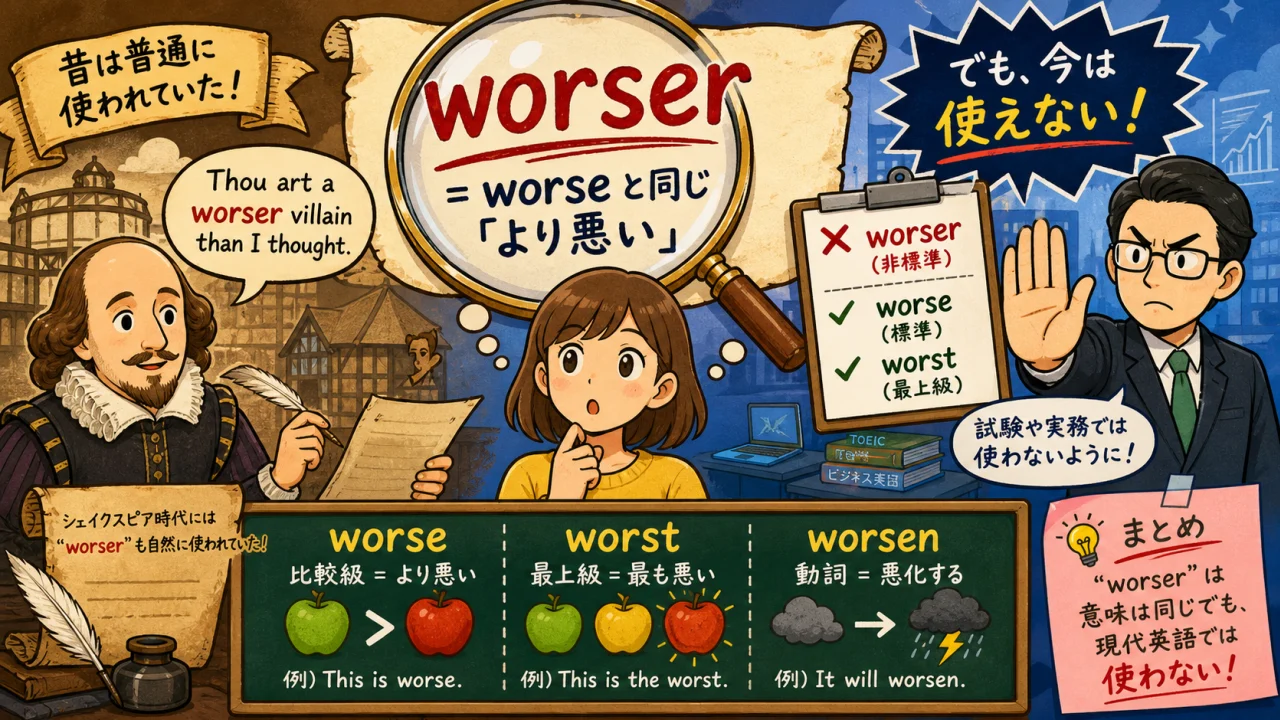
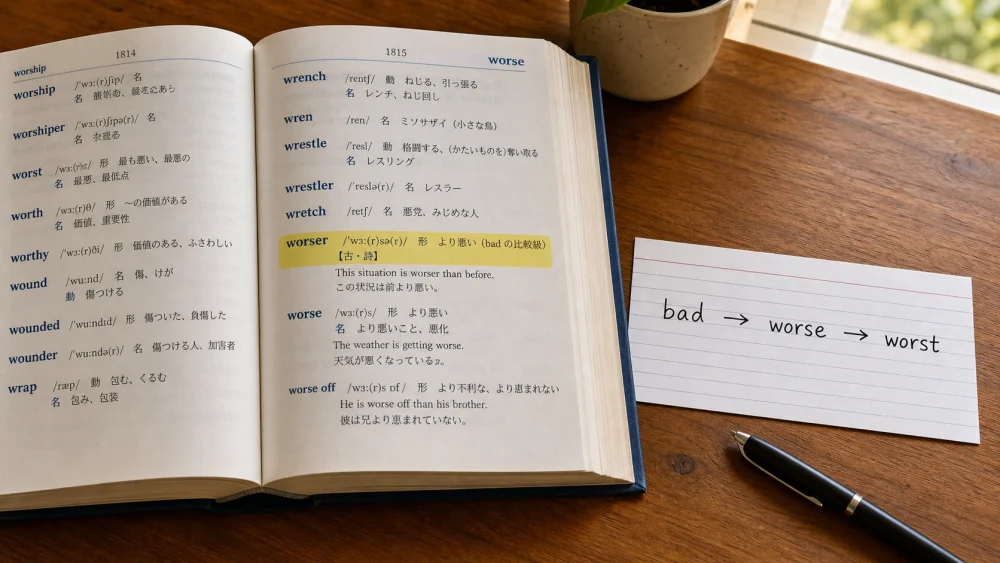
First, the meaning: Collins English Dictionary defines worser as "an archaic or nonstandard word for worse." In plain terms, it equals "worse" — nothing more, nothing less.
Second, the label: nearly every entry stamps it with "archaic" or "nonstandard." That combination means, "Yes, people understand what you mean, but this isn't accepted in current standard English." Even dictionaries that include the word do so with an asterisk, not an endorsement.

Why Grammarians Call It a Mistake
"Bad" Already Has an Irregular Comparative: "Worse"
The adjective "bad" doesn't follow the normal playbook. Most adjectives build their comparative by adding "-er": tall becomes taller, fast becomes faster. But "bad" is irregular: bad → worse → worst.
Here's the key: "worse" is already the comparative form. It already carries the meaning "more bad." Tacking "-er" onto it creates a double comparative — a comparative built on top of another comparative.
Double Comparatives: The Grammar Rule Behind the Label
Linguists call this construction a double comparative. Other examples include "more better" and "most fastest." In 21st-century standard English grammar, double comparatives are treated as errors. They're redundant — you've applied the comparison twice.
So the objection to "worser" is really simple: "worse" is already doing the job. The "-er" is unnecessary. That's the whole case against it.
The Part Most Grammar Sites Skip: Shakespeare Used It Constantly
Here's the genuinely interesting piece that rarely shows up in a dictionary entry.
Real Examples in The Tempest and the Sonnets
William Shakespeare used "worser" throughout his work. In The Tempest (Act 1), the phrase "the worser" appears without any sense that it's unusual. His Sonnets also contain multiple instances of "worser" used in perfectly natural poetic lines. For 16th- and 17th-century readers, this was standard vocabulary — not an error, not a stylistic quirk.
Why Double Comparatives Were Normal in Early Modern English
Early Modern English — the variety spoken and written roughly from 1500 to 1700 — hadn't yet settled on fixed rules for building comparatives. Writers freely doubled up, adding both "-er" and "more" or stacking suffixes without any sense of contradiction. Shakespeare's own plays include "more better" (The Tempest, Act 1, Scene 2) and "most unkindest cut" (Julius Caesar, Act 3, Scene 2). Grammarians in the 18th century systematically tidied these constructions away, ruling double comparatives redundant. Worser got swept out in that cleanup.
So if you're reading a Shakespeare play and you hit "worser," don't assume it's a misprint. It was correct for its time.
Worser vs. Worse: A Direct Comparison
Same Part of Speech, No Practical Difference
In modern English, "worse" functions as an adjective, adverb, and noun. "His performance was worse than yesterday" (adjective) and "She slept worse than usual" (adverb) are both correct. Worser was used as an adjective in the same way — but every use case "worser" could handle, "worse" covers completely. There's no sentence where "worser" does something "worse" can't.
How Native Speakers React When They See It
On forums like Reddit's NoStupidQuestions, the standard response to "worser" is immediate and consistent: "worse is already the comparative — you don't need the -er." The reaction isn't confusion, it's correction. Unless a reader picks up on a deliberate literary or comedic intent, seeing "worser" signals a grammar slip rather than a stylistic choice.
Words That Look Similar But Mean Different Things
Worsen (Verb: To Become or Make Worse)
"Worsen" looks like "worser" but it's an entirely different word and a perfectly standard one. It's a verb meaning "to deteriorate" or "to make something deteriorate." As in: "Air quality has worsened every summer since 2018." It describes a process unfolding over time. Pronounced /ˈwɜːrsən/ ("WUR-sen"), it shares a root with "worse" but plays a completely different grammatical role. Mixing up "worsen" and "worser" will cause real confusion because one is standard and the other isn't.
Worst (Superlative) and When to Use It
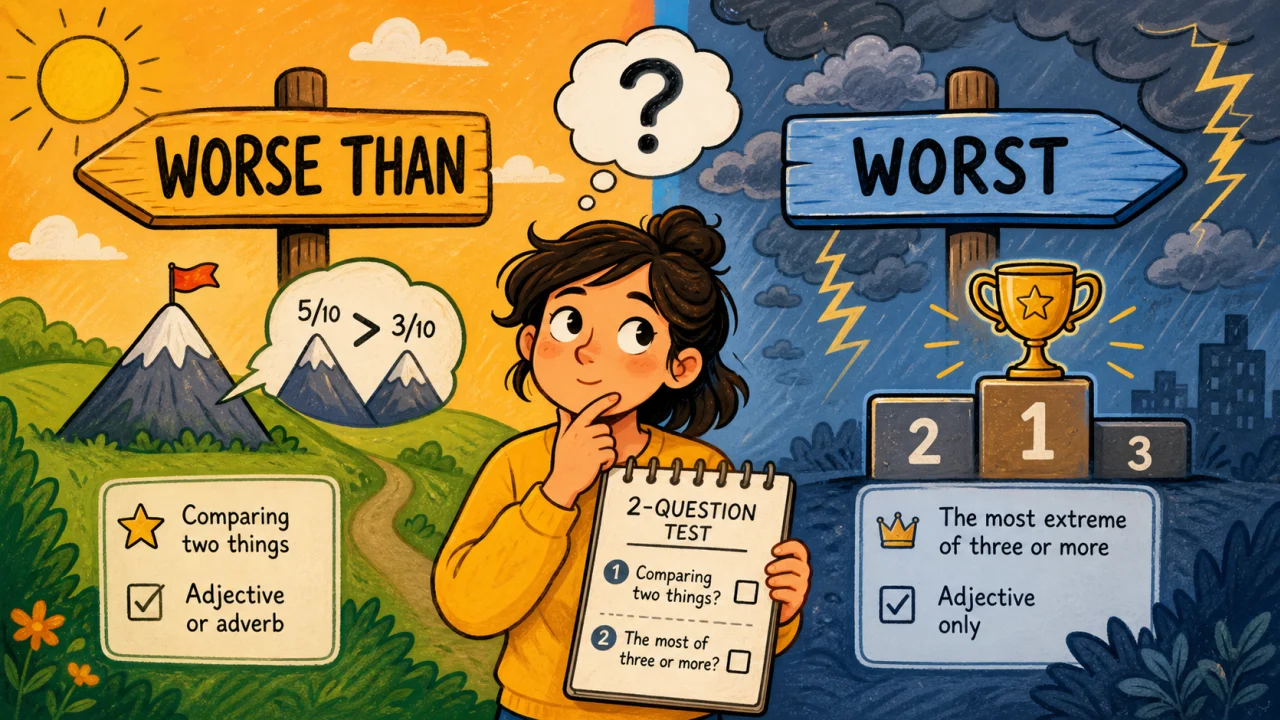
The full irregular sequence is: bad → worse → worst. Use "worse" when comparing two things. Use "worst" when picking the lowest point among three or more: "That was the worst storm this county has seen in 40 years." Worser doesn't fit anywhere in this sequence — "worse" already handles the comparative slot.
Should You Ever Use "Worser"?
In Tests, Formal Writing, or Academic Work: No
On the SAT, ACT, AP English exams, or any standardized test, writing "worser" will read as a grammar error. Same goes for college application essays, business emails, or anything a professional editor might review. There's no upside to using it when "worse" does the same job without the red flag.
In Casual or Creative Contexts: Maybe, Deliberately
You'll occasionally see "worser" in social media posts or game chats, used as a joke or for ironic emphasis. That can work — but only when the audience clearly understands you're playing with the language on purpose. The risk is that "worser" tends to read as a mistake rather than a wink. Until you're confident your reader will catch the intent, "worse" is the safer bet every time.
Quick Reference: Bad's Irregular Comparisons
| Base Form | Comparative | Superlative |
|---|---|---|
| bad | worse | worst |
| badly | worse | worst |
| ill | worse | worst |
Notice that "badly" and "ill" follow the same pattern as "bad" — all three share "worse" and "worst." Worser doesn't appear in this table because it doesn't belong in standard English grammar. Keep this chart in mind and you won't second-guess yourself on a test or in conversation.
Key Takeaways
- Worser means the same as "worse" — "more bad" or "to a greater degree of badness" — but it's labeled archaic or nonstandard by every major dictionary.
- The grammar objection is simple: "worse" is already a comparative form of "bad," so adding "-er" creates a redundant double comparative.
- Shakespeare used "worser" regularly in the 16th and 17th centuries, as did other Early Modern English writers. It became nonstandard only after 18th-century grammarians standardized comparative rules.
- "Worsen" (verb) and "worst" (superlative) are entirely different words — both standard, both useful, neither interchangeable with "worser."
- In any formal, academic, or test context, always write "worse."
FAQ
Is "worser" actually in the dictionary?
Yes. Collins, Merriam-Webster's informal notes, and several other references include it. Every entry marks it "archaic" or "nonstandard," meaning it's documented but not endorsed as current standard English.
What's the difference between "worse" and "worst"?
Use "worse" when comparing two things: "Option A is worse than Option B." Use "worst" when identifying the lowest point among three or more: "That's the worst idea on the list."
How do you pronounce "worsen"?
"Worsen" is pronounced /ˈwɜːrsən/ — roughly "WUR-sen." It means "to become worse" or "to make something worse" and is a fully standard English verb. Don't confuse it with "worser" (/ˈwɜːrsər/, "WUR-ser"), which is nonstandard and serves a completely different purpose.
Do native English speakers ever use "worser"?
Almost never in everyday speech. When it does appear — in literature, comedy, or ironic social media posts — it's usually a deliberate callback to its Shakespearean roots or a self-aware joke. In normal conversation, it just reads as a mistake.