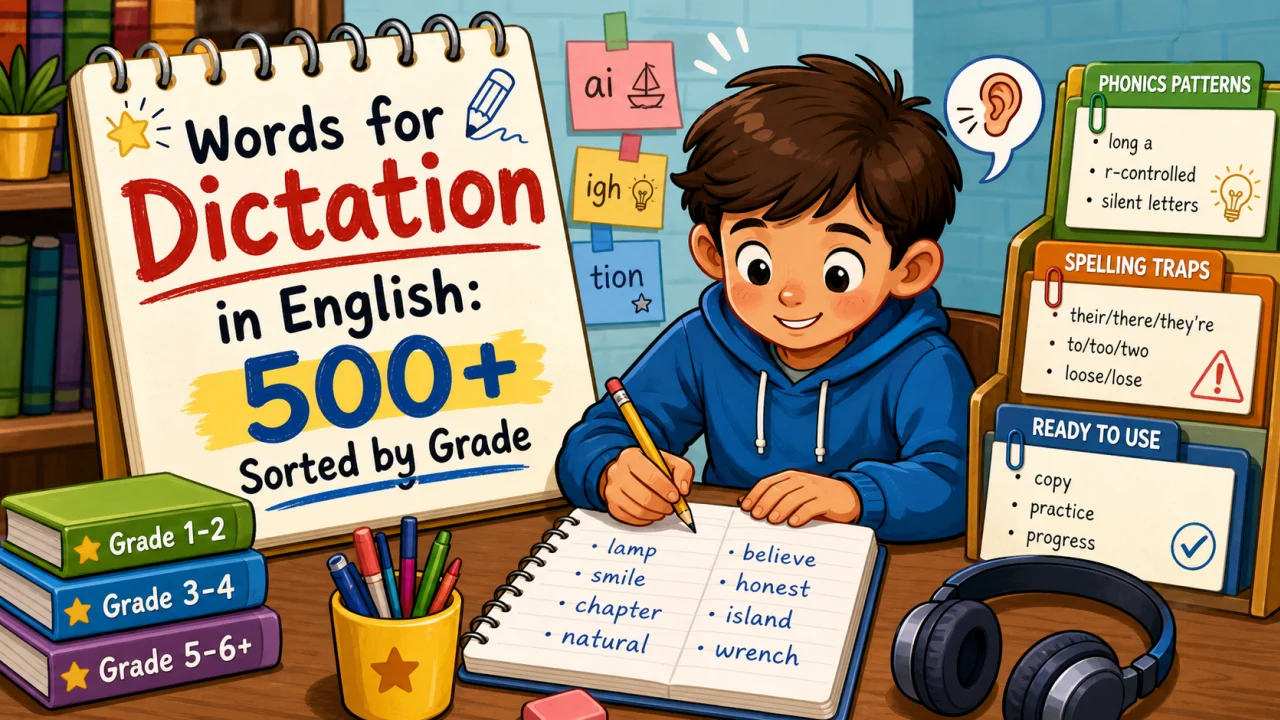
You looked up "dictation" and got a one-line dictionary blurb that didn't quite click. That's because what is the meaning of dictation depends on which of its 3 separate senses you're actually after. The word can refer to speaking so someone else writes your words down, a listening-and-writing test in a language class, or an authoritative command — and mixing them up leads to real confusion.
Below, you'll find each sense broken apart with plain examples so you can use the right one at the right time.
What Is the Meaning of Dictation? A Plain-English Answer
At the simplest level, dictation is the act of saying words out loud so they get captured in writing. That's the definition you'll find at Merriam-Webster and Cambridge. But both dictionaries quietly list a second and even third meaning that most summary snippets skip over.
Here's the short version:
- Transcription sense — You speak; someone (or something) writes it down.
- Classroom-test sense — A teacher reads a passage aloud; students write what they hear to prove they understand the language.
- Command sense — An order, directive, or prescription imposed on someone else.
All 3 senses trace back to the same Latin root, which we'll get to in a minute. First, let's look at each one up close.
How to Pronounce It and Where the Word Comes From
Dictation is pronounced dik-TAY-shun (IPA: /dɪkˈteɪ.ʃən/). The stress lands on the second syllable every time.
The word entered English in the 15th century from the Latin verb dictare, meaning "to say repeatedly" or "to impose one's will." That double meaning baked right into the original Latin is exactly why English ended up with more than one sense of the word. The same root gave us dictate, dictator, and diction — each pulling on a slightly different thread of that original Latin idea.
Sense 1 — Speaking So Someone Else Writes It Down
This is the meaning people think of first. You talk. Another person — or a machine — captures your words in written form. The Cambridge dictionary labels this an uncountable noun and illustrates it with the phrase "take dictation," as in: I'll ask my assistant to take dictation.
For decades, this was a core office skill. Secretaries used shorthand systems like Gregg or Pitman to keep up with a boss who spoke faster than anyone could write longhand. Entire careers revolved around the ability to take dictation accurately at 80–120 words per minute.
What This Looks Like in an Office
Picture a lawyer pacing behind a desk, speaking a letter aloud while an assistant transcribes every word. That's classic dictation. The speaker controls the content; the writer handles the physical act of recording it.
Even now, doctors, attorneys, and executives still dictate reports and correspondence — though the person on the other end of the process has changed.

How Voice Typing Fits This Same Definition
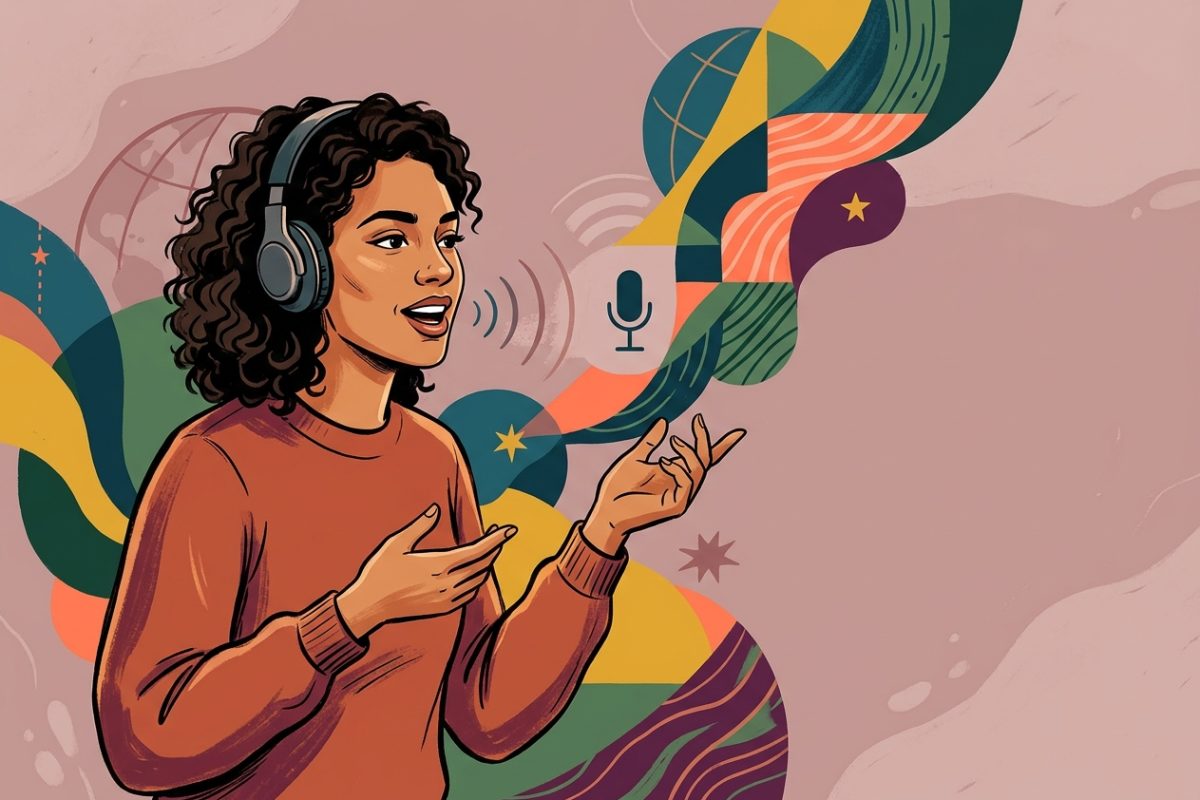
When you tap the microphone icon on your phone's keyboard and start talking, you're doing dictation. The "someone else" writing it down just happens to be software instead of a human. Apple's built-in dictation feature on iPhone, Google's voice typing in Docs, and Windows Speech Recognition all perform the same basic function that a shorthand secretary performed 50 years ago: they turn spoken words into text.
The definition hasn't shifted. The technology catching the words has.
Sense 2 — A Classroom Test for Language Learners
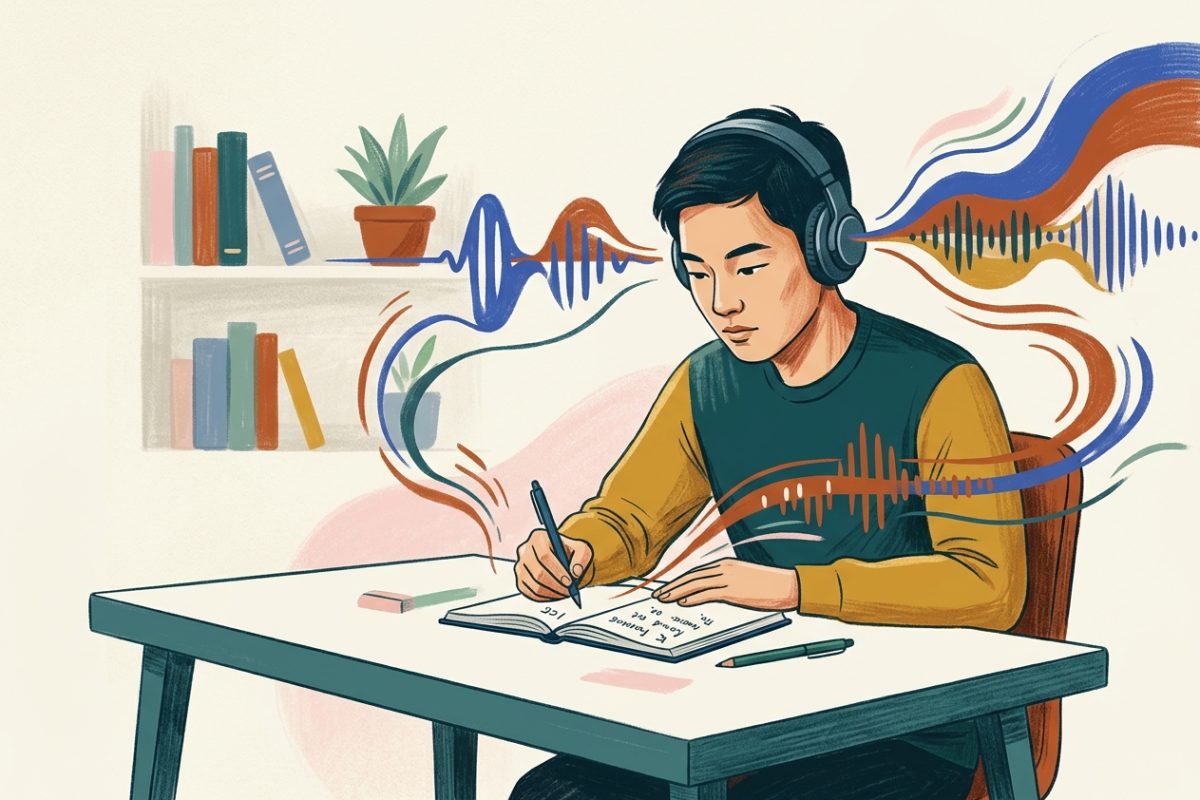
If you've ever studied a foreign language in an American high school or college, you've probably sat through a dictation test. The teacher reads a passage — sometimes twice — and you write down exactly what you hear. Your grade depends on spelling, accents, punctuation, and whether you caught every word.
The Cambridge dictionary treats this as a countable noun: Our French dictation lasted half an hour. Notice the difference. In sense 1, dictation is an activity (uncountable). Here, a dictation is a specific test you can hold in your hand afterward.
Why Teachers Still Use Dictation Exercises
You might wonder why dictation tests haven't disappeared in favor of multiple-choice listening quizzes. The answer is that dictation forces you to process a language at every level — phonics, grammar, vocabulary, and spelling — all at once. There's no guessing from context clues or eliminating wrong answers. You either heard and understood the sentence, or you didn't.
Reading Rockets, a national literacy initiative, points out that dictation also helps young children in their first language. A teacher or parent writes down a child's spoken words, which shows the child that speech can become text. That connection between spoken and written language is foundational, and dictation is one of the simplest ways to build it.

Sense 3 — An Order or Command (The One People Forget)
Here's the meaning that slips through the cracks on almost every top-ranking page for this keyword. Merriam-Webster lists it first, actually: dictation as prescription or arbitrary command. When a newspaper editorial warns against "the dictation of a single party," it isn't talking about someone reading a letter aloud. It's talking about imposed authority.
This sense shows up in sentences like:
- The citizens refused to accept the dictation of a foreign government.
- She resented the dictation of rules she had no say in creating.
Most online explainers gloss over this meaning or skip it entirely because the transcription sense dominates search traffic. But if you're reading older texts — legal documents, political speeches, 19th-century novels — this "command" sense is the one the writer almost certainly intended.
Dictation, Dictate, Dictator: Same Latin Root
All three words grow from Latin dictare. A dictator dictates — not letters, but laws, policies, and punishments. When you say "don't dictate to me," you're using the verb in its command sense, not its transcription sense. And dictation as a noun can swing either way depending on context.
So the next time you see the word and can't tell which meaning the writer intended, ask yourself: is someone speaking words to be recorded, or is someone imposing their will? That question sorts it out every time.
Dictation vs. Transcription — They're Not the Same Thing
People swap these two words constantly, but they describe different sides of the same process. Dictation is what the speaker does. Transcription is what the writer does. A doctor dictates a patient note; a medical transcriptionist transcribes it.
Here's a quick breakdown:
| Dictation | Transcription | |
|---|---|---|
| Who acts | The speaker | The writer or typist |
| Direction | Mouth to air | Air (or recording) to page |
| Can a machine do it? | Yes (voice assistants) | Yes (speech-to-text software) |
| Skill tested | Clear speaking | Accurate listening and writing |
If someone says "I did a transcription," they wrote something down. If they say "I did a dictation," they spoke something aloud. The overlap happens because a single session involves both — but the words aren't interchangeable.
Real Example Sentences Using All 3 Meanings
Transcription sense: He finished his dictation and handed the tape to the typist.
Classroom-test sense: We had a Spanish dictation every Friday in 10th grade.
Command sense: The treaty was signed under the dictation of the victorious army.
Reading these side by side makes the differences obvious. Swap any one sentence's meaning into another sentence, and it stops making sense.
Common Phrases That Use the Word Dictation
Dictation Software
Any program that converts your voice into typed text. Dragon NaturallySpeaking, launched in the late 1990s, was one of the first commercially successful dictation software products in the U.S. market. Today, dictation tools are built into most operating systems by default.
Take Dictation
To write down what someone else is saying. This phrase almost always uses sense 1 — the transcription meaning. "Can we get someone from the agency who takes dictation?" is the Cambridge dictionary's own example.
Dictate Terms
To set conditions that others must follow. This phrase pulls from sense 3 — the command meaning. You'll hear it in business negotiations, contract law, and sports trade deadlines. "The seller dictated terms" means the seller held the power.
Why Most Online Definitions Leave Out the Command Meaning
If you scan the top search results for "what is the meaning of dictation," nearly all of them emphasize speaking-and-writing. A few mention the classroom test. Almost none give the command sense more than a passing nod — even though Merriam-Webster lists prescription and arbitrary command as definition 1a and 1b, before the transcription meaning.
Why the gap? Probably because the transcription sense is what drives search traffic. People asking this question usually want to know what a voice-typing button does, not what a political theorist meant in an 1850 essay. But skipping the command meaning leaves you with an incomplete picture. If you only know one sense of a word, you'll misread it the first time you run into another.
FAQ
What Is a Dictation Example?
A lawyer speaking a letter aloud while an assistant types it is a classic dictation example. A French teacher reading a paragraph for students to write down is another. Both involve one person speaking and another person capturing those words in writing.
What Is Another Word for Dictation?
For the transcription sense, synonyms include utterance and verbal direction. For the command sense, try decree, order, or directive. No single synonym covers all 3 meanings perfectly, which is part of what makes the word tricky.
What Is Word Dictation?
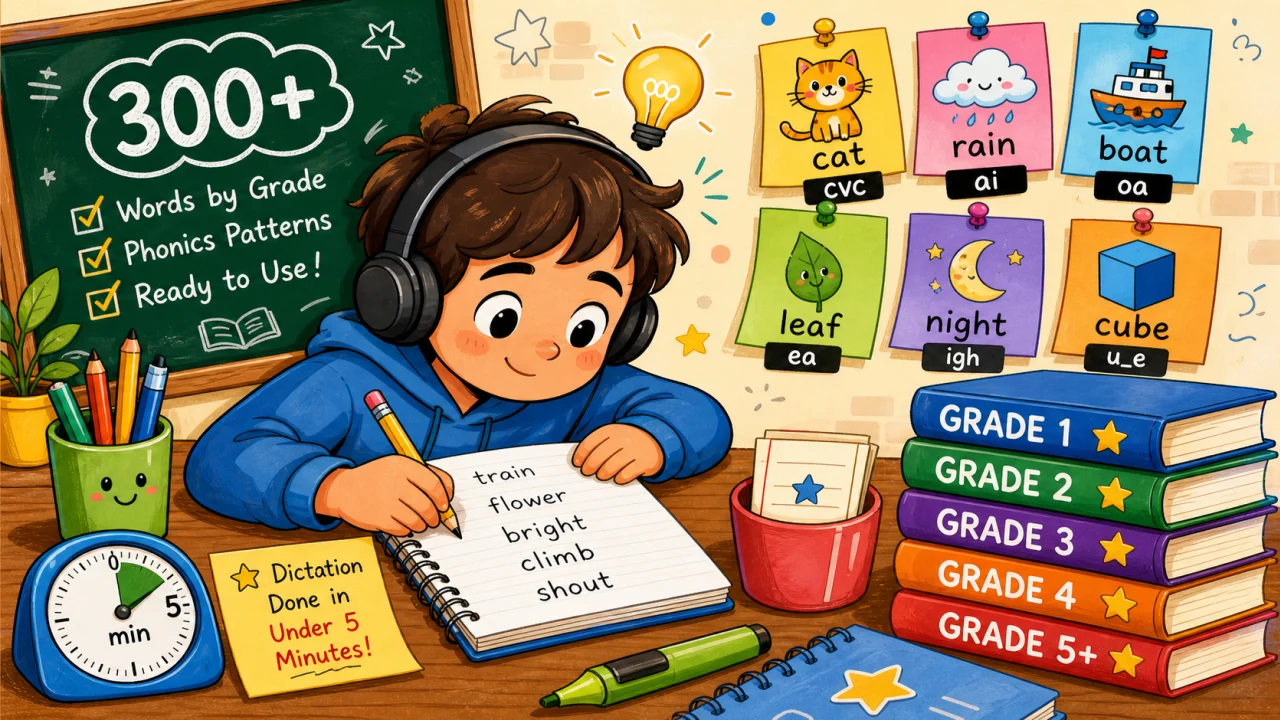
Word dictation usually refers to a classroom exercise where individual words — rather than full sentences — are read aloud for students to spell and write. It's common in elementary spelling tests and early foreign-language courses across American schools.