You've memorized "bad → worse → worst" — but when it's time to actually use it in a sentence, you freeze. The reason is almost always the same: you haven't sorted out which part of speech worse is acting as. Once you break it down by function, the word clicks into place and you stop reaching for "more bad" or mixing up worse and worst.
Why Memorizing "Worse" Isn't Enough
On a vocabulary quiz, "What's the comparative of bad?" → "Worse" gets you full marks. But in real writing or conversation, the position and meaning of worse shift depending on whether it's working as an adjective, an adverb, or a noun. Skip that distinction, and you'll nail multiple-choice questions while still stumbling in your own sentences.
Why Bad, Badly, and Ill All Become Worse
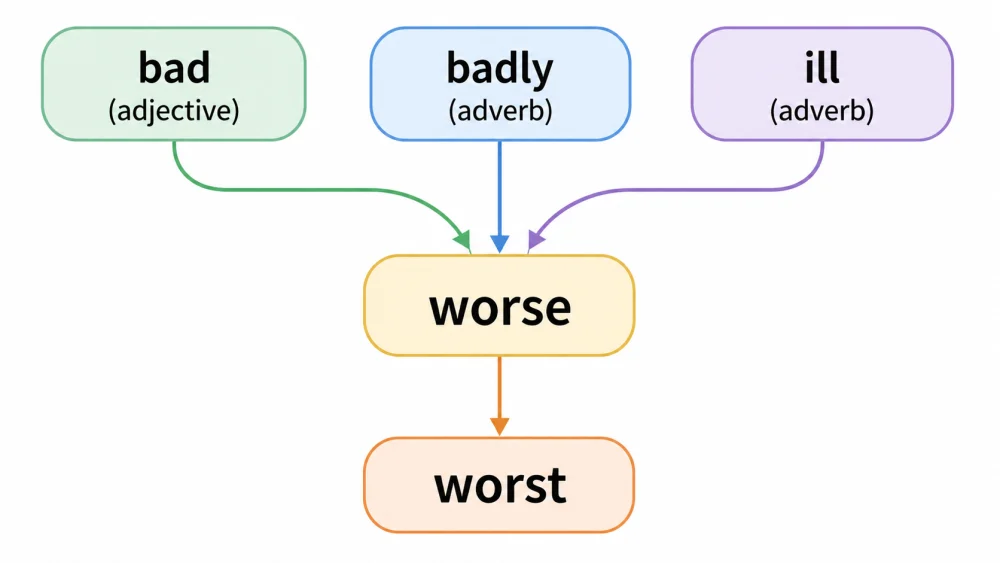
According to grammar references including Weblio's English dictionary, worse is listed as the comparative for three separate base forms: the adjective bad, the adverb badly, and the adverb ill. All three collapse into the single form worse.
That means one word carries at least three meanings: "more bad" (adjective), "more badly" (adverb), and "more ill" (adverb). Among irregular comparatives in English, having three base forms is genuinely unusual. Good and well both feed into better — that's two. Worse adds a third.
Why "More Bad" Is Never Correct
Have you ever wondered why you can't just say "more bad"? English comparatives follow two rules: add -er, or add more. But a small group of adjectives and adverbs — bad, good, far, little — follow neither. They're irregular.
Worse traces back to the Old English word wyrsa, which was a separate word from bad entirely. Historically, the comparative and superlative (worse/worst) stayed constant while the base-form slot got filled by different words over time. "More bad" has never been standard English. Knowing that history takes some of the pressure off memorization — you're not fighting a rule, you're just recognizing a linguistic fossil.
4 Patterns for Using Worse (by Part of Speech)
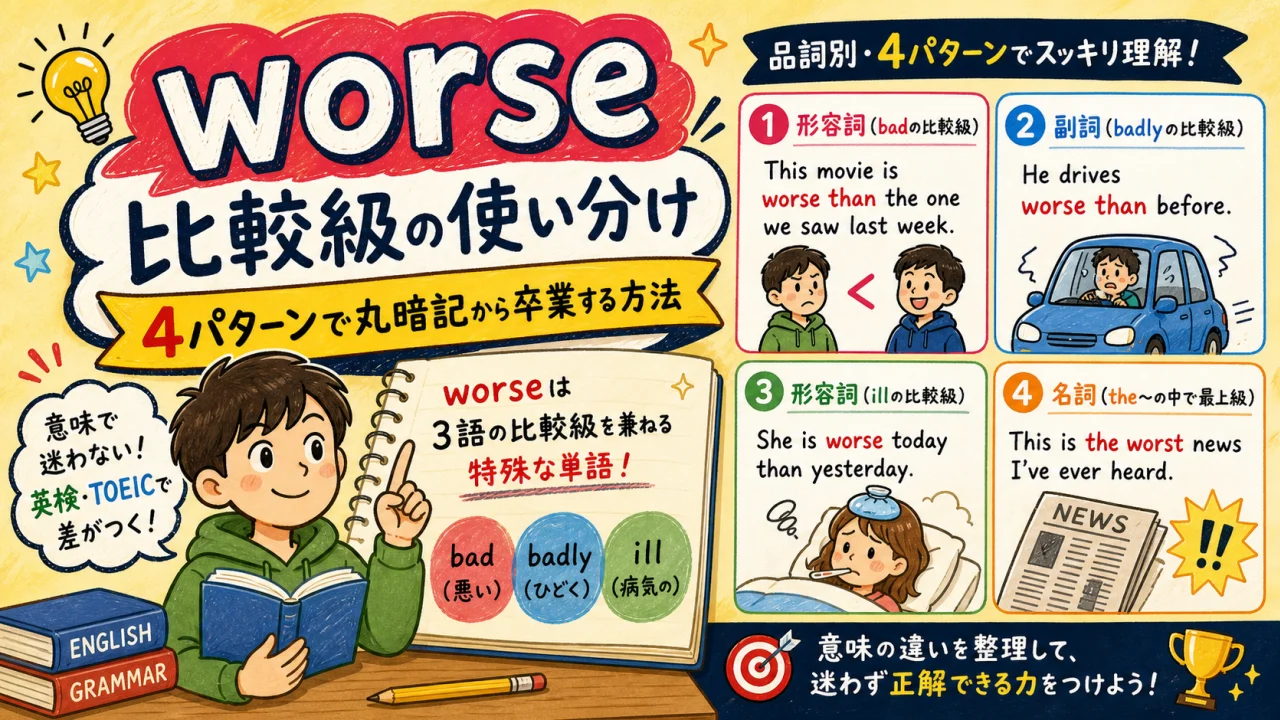
Here's how worse actually functions in sentences, broken into four patterns.
Pattern 1: Adjective — Placed Before a Noun
When worse directly modifies a noun, it's working as an attributive adjective. Example: "Indoor air is worse quality than outdoor air." Here, worse sits right before quality.
The swap is straightforward: wherever you'd use bad before a noun, replace it with worse for the comparative. Bad weather → worse weather. Bad habit → worse habit. The noun comes immediately after.
Pattern 2: Adjective — Used as a Predicate (After a Linking Verb)
This is the most common pattern. After be, get, become, or similar linking verbs, worse describes the subject's state. "The traffic is getting worse and worse" — worse tells you about the condition of the traffic, not about any specific noun.
Pair it with than and you're comparing two things directly: "This commute is worse than it was last year." You can also use it in structures like "Nothing could be worse than this" — no explicit comparison target, but the meaning is clear. If you see than in a sentence, a comparative like worse almost always belongs there.
Pattern 3: Adverb — Modifying a Verb
Here worse replaces badly in its comparative role. "She performed worse than she did in rehearsal" — worse modifies the verb performed.
The tricky part: it looks identical to the adjective form. The way to tell them apart is to check what worse modifies. If it modifies a noun (or follows a linking verb describing the subject), it's an adjective. If it modifies a verb or describes how an action is done, it's an adverb. This distinction comes up in standardized reading comprehension questions more often than most study guides admit.
Pattern 4: Noun — As in "a Change for the Worse"
This one gets overlooked. Worse can function as a noun, especially in fixed phrases. "A change for the worse" means a deterioration. "The worse" refers abstractly to a less favorable state.
The idiom "if worse comes to worst" (sometimes "if the worst comes to the worst") uses worse this way — treating it as a noun standing in for a situation or outcome. It's the kind of phrase you hear in business meetings and everyday conversation alike when someone's thinking through a worst-case scenario, as noted in resources like Kimini Online English.
Worse vs. Worst: The Fast Way to Choose
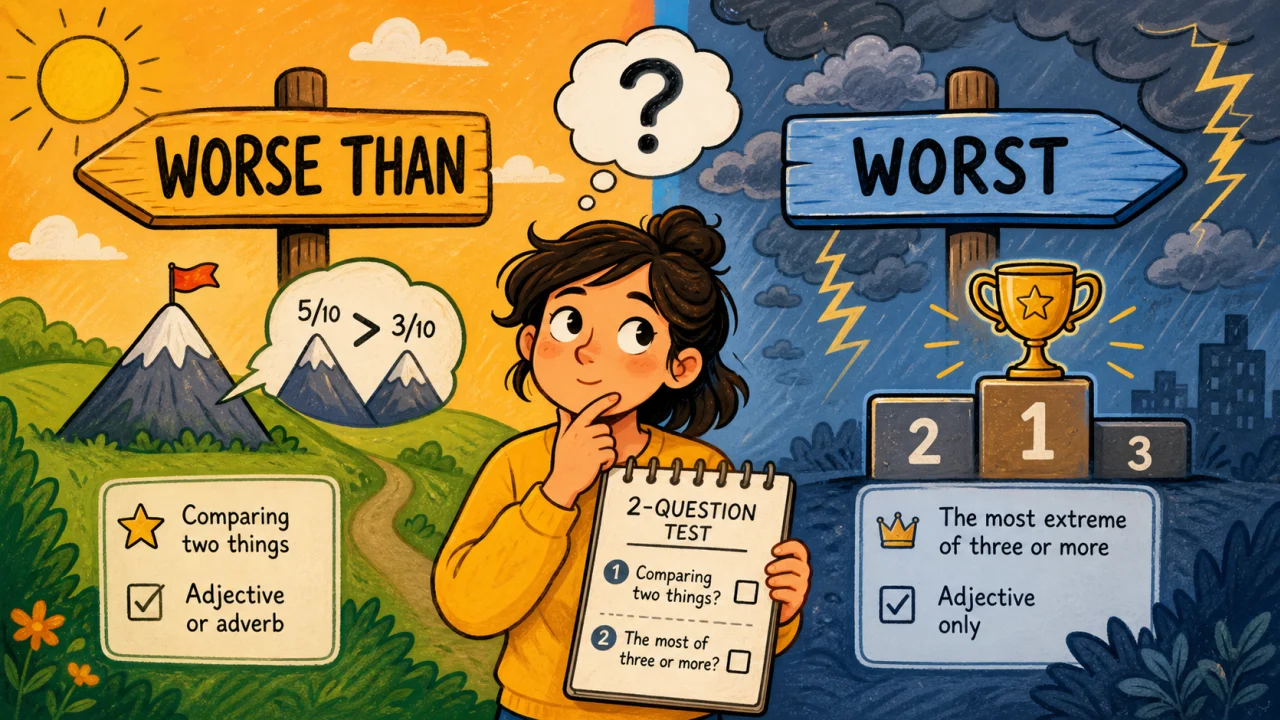
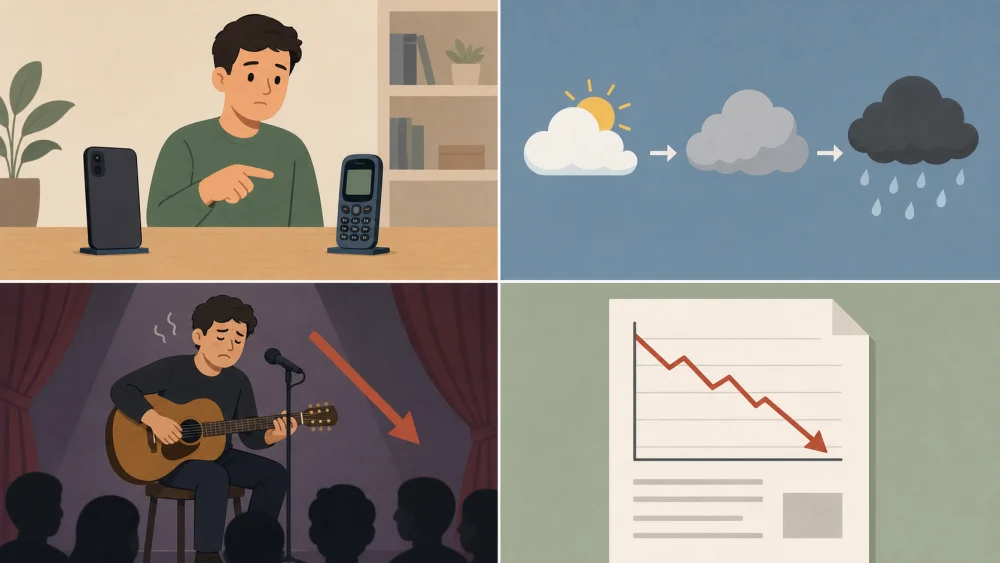
Two Things → Worse. Three or More → Worst.
If you're comparing exactly two things, use worse (comparative). If you're picking the lowest-ranked item from three or more, use worst (superlative).
"This route is worse than the highway" — two options, so worse. "This is the worst route out of all three" — three or more, so worst. That's the whole rule.
Practice with a Real Test Format
Worse is classified as a word expected at roughly the B1 level on the CEFR scale, which corresponds to around a 9th-grade reading level. Standardized tests use fill-in questions like this:
"The weather today is ( ) than it was yesterday." — Options: bad / worse / worst
The word than is your signal. Comparatives go with than; whenever you see than in a sentence, you're looking for the comparative form. That one cue resolves the question without needing to count options.
3 Mistakes Native Learners Still Make with Worse
Mistake 1: "More Worse" or "Worse More"
Adding more to worse creates a double comparative — grammatically wrong for the same reason "more better" is wrong. Worse is already comparative. It doesn't need help. Never attach more to an irregular comparative.
Mistake 2: The Pronoun After "Than"
"She writes worse than I" or "She writes worse than me"? Formally, than I (with the subject pronoun) is considered correct in edited prose because than functions as a conjunction introducing a clause: "than I [do]." In everyday speech, than me dominates. If you're writing something formal, the safest move is to complete the clause: "worse than I do."
Mistake 3: Using Worse as a Superlative
"This is the worse option in the city" — wrong. If you're ranking among three or more, you need worst. The presence of the doesn't make worse acceptable as a superlative. The number of things being compared is what drives the choice, not the article.
Here's the counterintuitive part: many learners already know worst well — "worst-case scenario" is everywhere in English — but they get fuzzy on exactly where worse ends and worst begins. According to community Q&A data from sites like Yahoo! Chiebukuro, questions about the comparative and superlative of bad have been viewed over 72,000 times. The confusion is widespread and cuts across proficiency levels.
Useful Idioms with Worse — Beyond "Go from Bad to Worse"
Worse Off / None the Worse For / If Worse Comes to Worst
"Go from bad to worse" gets all the attention, but these three are just as practical.
Worse off means in a less favorable position, financially or otherwise. "After the restructuring, many employees were worse off than before." Its opposite is better off.
None the worse for is worth knowing because it sounds negative but isn't. "She was none the worse for the 10-hour flight" means she came through it fine, with no lasting effect. The worse is there to be negated — the phrase means something like "unharmed despite everything."
If worse comes to worst (or if the worst comes to the worst) is the idiom for imagining a worst-case scenario: "If worse comes to worst, we can always reschedule." It's common in planning conversations, project meetings, and everyday problem-solving.
Key Takeaways
- Worse is the comparative for three words — bad (adjective), badly (adverb), and ill (adverb) — all in one form.
- "More bad" and "more worse" are always wrong. Worse is already comparative.
- Check what worse modifies: noun or after a linking verb = adjective; modifies a verb = adverb; in a fixed phrase like "for the worse" = noun.
- Than in a sentence almost always signals a comparative — reach for worse, not worst.
- Two things compared → worse. Three or more → worst.
FAQ
How do you pronounce "worse"?
The IPA for American English is /wɜːrs/ — rhymes with nurse and curse, but with a w at the front. The British English pronunciation is /wɜːs/, with no r-coloring. Think of worst and drop the t: that's your closest shortcut.
What's the best way to memorize bad → worse → worst?
Pair it with its opposite: good → better → best alongside bad → worse → worst. Seeing both sets together reinforces the pattern because the structure mirrors perfectly. You can also group it with other irregular comparatives like far → farther/further → farthest/furthest to build the full picture of English irregulars at once.
Still not sure whether to use worse or worst?
Count the things being compared. Two things: worse. Three or more: worst. If than appears in the sentence, go with worse. If the precedes the word in a superlative structure ("the ___ of all"), go with worst. Those two checks cover the vast majority of real-world cases.