
If you want to learn English language grammar but don't know where to start, you're in the right place. This guide breaks everything down into small, simple pieces — like building with blocks. Whether you're a total beginner or someone who needs a solid refresher, this page will walk you through the essentials without boring you to sleep.
Key Takeaways
- English grammar is built on a handful of core rules. Once you understand them, everything else clicks into place.
- You don't need to memorize every rule in the book. Focus on the patterns you'll actually use every day.
- Consistent daily practice (even just 15 minutes) beats weekend cramming every single time.
- Free apps, websites, and books can get you surprisingly far without spending a dime.
- Making mistakes is normal and expected — the goal is progress, not perfection.
Why Learning English Grammar Still Matters in 2026
Grammar as a Foundation for Clear Communication
Think of grammar as the skeleton of a language. Without it, your words are just a pile of bones on the floor. Grammar gives your sentences shape. It tells people what you mean, when you mean it, and who is doing what to whom.
Even in 2026, with AI tools and autocorrect everywhere, knowing grammar yourself means you don't have to guess whether a tool got it right.
How Strong Grammar Helps Your Career, Studies, and Daily Life
Good grammar shows up in places you might not expect. A clear email at work gets you taken seriously. A well-written essay can tip an admissions decision. People notice grammar — especially when it's wrong. Clarity builds trust.
How to Use This Guide (Read This First)
Who This Guide Is For
This guide is for anyone who wants to learn English language grammar from the ground up. That includes ESL learners, students preparing for tests, professionals looking to sharpen their writing, and honestly, anyone who feels a little shaky about when to use a comma.
How the Guide Is Structured
We start with the basics (parts of speech), move into how sentences are built, cover tenses and punctuation, point out common mistakes, and then give you tools and habits to keep improving on your own. Read it front to back or jump to the section you need most.
The Building Blocks — Parts of Speech Explained Simply
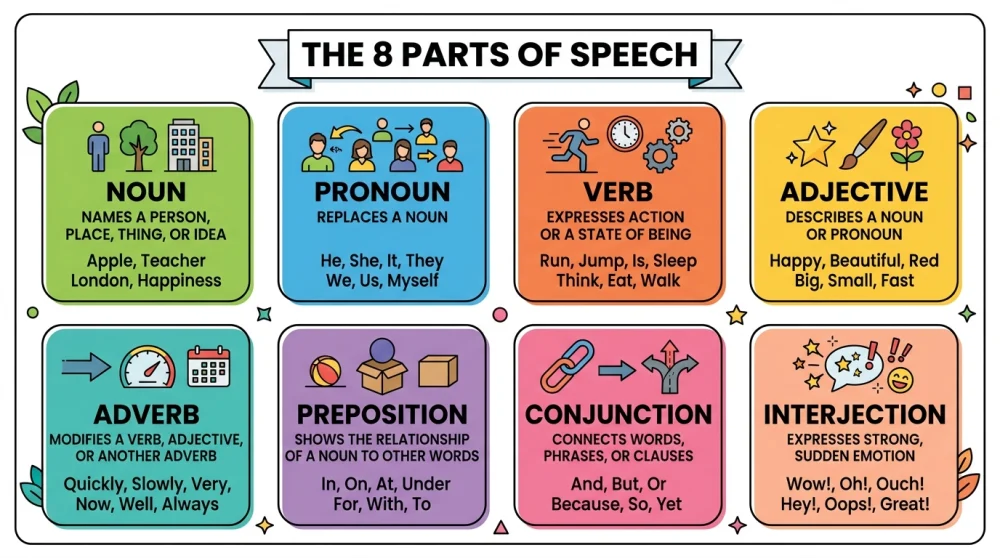
Every English sentence is made of smaller pieces called "parts of speech." There are eight of them, and they each have a job.
Nouns, Pronouns, and Articles
A noun is a person, place, thing, or idea. Dog, city, happiness — all nouns. A pronoun replaces a noun so you don't keep repeating it. Instead of saying "Sarah gave Sarah's book to Sarah's friend," you say "She gave her book to her friend."
Articles (a, an, the) are tiny words that sit in front of nouns. "A dog" means any dog. "The dog" means a specific one.
Verbs and Verb Phrases
Verbs are action words. Run, think, eat, is. Without a verb, you don't have a sentence. A verb phrase is a main verb plus helpers: "She has been running" has a main verb (running) with two helpers (has, been).
Adjectives and Adverbs
Adjectives describe nouns: a tall tree, a red car. Adverbs describe verbs, adjectives, or other adverbs: she runs quickly, it's very tall. A quick trick — many adverbs end in "-ly," but not all of them.
Prepositions, Conjunctions, and Interjections
Prepositions show relationships, usually involving location or time: in the box, before lunch, on the table. Conjunctions connect words or ideas: and, but, or, because. Interjections are emotion bursts: Wow! Ouch! Hey!
English Sentence Structure: How Words Fit Together
Subject, Verb, Object — The Core Pattern
Most English sentences follow a simple recipe: Subject + Verb + Object. "The cat (subject) chased (verb) the mouse (object)." That's the backbone. Once you see this pattern, you'll recognize it everywhere.
Simple, Compound, and Complex Sentences
A simple sentence has one subject-verb pair: "I like coffee." A compound sentence joins two simple sentences with a conjunction: "I like coffee, and she likes tea." A complex sentence adds a dependent clause: "Because it was raining, we stayed inside."
You don't need to memorize these labels. Just know that mixing sentence lengths makes your writing sound more natural.
Common Word-Order Mistakes and How to Fix Them
English has a fairly strict word order compared to many languages. Adjectives go before nouns ("blue sky," not "sky blue"). Adverbs of frequency go before the main verb ("She always eats breakfast"). Getting word order right is one of the fastest ways to sound more fluent.
Mastering English Tenses Without Losing Your Mind
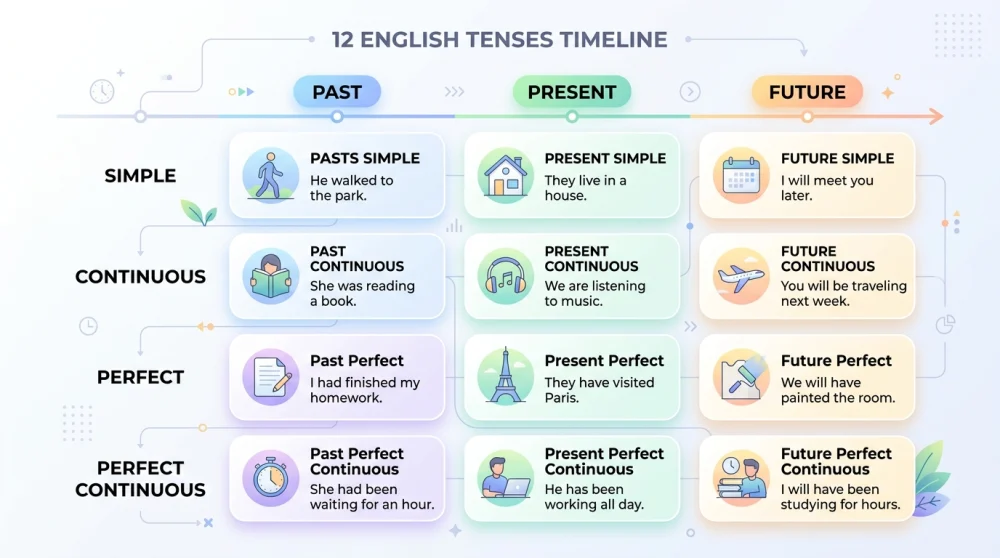
Tenses tell your reader when something happens. English has twelve tenses, which sounds scary, but they're built from just three time frames and four patterns.
Present, Past, and Future — The Big Three
The simple present describes habits or facts: "She walks to work." The simple past describes finished actions: "She walked to work." The simple future describes plans or predictions: "She will walk to work." These three cover most everyday conversation.
Perfect and Continuous Tenses Made Easy
The continuous (or progressive) tenses use "-ing" to show an action in progress: "She is walking." The perfect tenses use "have/has/had" plus a past participle to connect two time points: "She has walked this route for years." Combine them and you get the perfect continuous: "She has been walking for an hour."
A Quick-Reference Tense Cheat Sheet
Here's a simplified snapshot. For each tense, think: When does it happen? and Is it finished, in progress, or connected to now?
- Simple = fact or finished action
- Continuous = in progress right now (or at a specific time)
- Perfect = connected to another point in time
- Perfect Continuous = in progress AND connected to another point in time
Punctuation and Capitalization Rules That Actually Matter
Commas, Periods, and Semicolons
A period ends a sentence. A comma creates a pause — use it before conjunctions in compound sentences, after introductory phrases, and between items in a list. A semicolon connects two related sentences that could each stand alone: "I love grammar; it makes writing clearer."
Apostrophes, Quotation Marks, and Hyphens
Apostrophes show possession (Sarah's book) or mark contractions (don't = do not). Quotation marks wrap around direct speech or titles of short works. Hyphens join compound adjectives before a noun: "a well-known author."
Common Grammar Mistakes Native and Non-Native Speakers Both Make
Subject-Verb Agreement Errors
The subject and verb need to match in number. "The list of items is long" — not "are," because the subject is "list" (singular), not "items." This trips up almost everyone.
Confusing Word Pairs (Their vs. They're, Its vs. It's, etc.)
These sound the same but mean different things. They're = they are. Their = belonging to them. There = a place. It's = it is. Its = belonging to it. When in doubt, expand the contraction and see if it still makes sense.
Run-On Sentences and Fragments
A run-on jams two sentences together without proper punctuation. A fragment is a piece of a sentence pretending to be whole. Read your writing out loud — you'll hear where you naturally pause or where something feels incomplete.
Free Tools and Resources to Practice English Grammar in 2026
Apps Worth Downloading
Look for apps that offer short daily lessons, quizzes, and progress tracking. Many grammar-focused apps use spaced repetition, which is proven to help you remember rules longer. Start with free versions and upgrade only if you find yourself using them consistently.
Websites and YouTube Channels
Countless websites offer free grammar exercises sorted by level. YouTube is packed with channels where teachers explain tricky rules in plain English with real-world examples. Search for topics you struggle with and bookmark the videos that click for you.
Books for Self-Study
A good grammar reference book is worth having on your shelf (or your phone). Look for ones written for your level — beginner books with lots of exercises, or intermediate guides that dig into the trickier stuff. Workbook-style books that let you practice and check answers are especially useful.
How to Build a Daily Grammar Practice Habit That Sticks
The 15-Minute Daily Routine
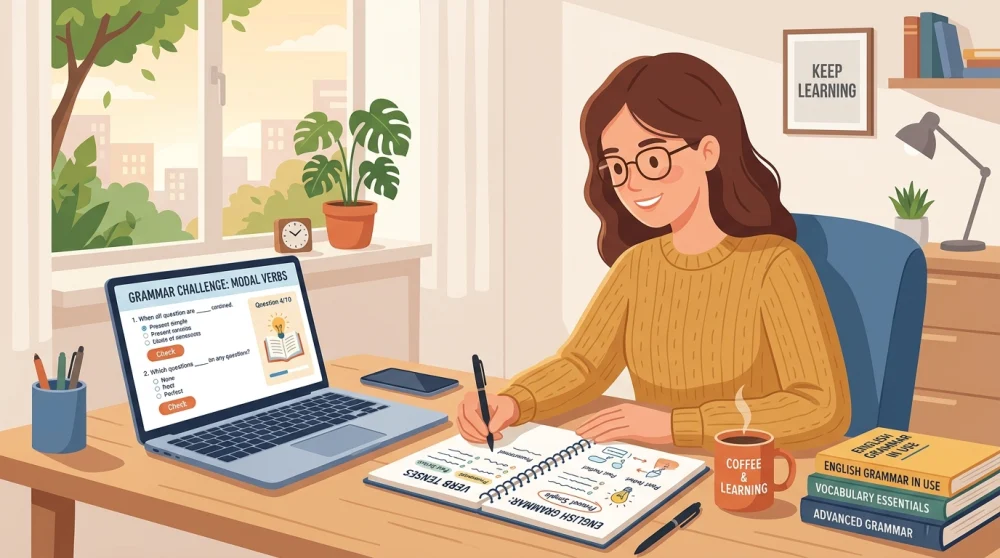
You don't need hours. Spend five minutes reviewing a rule, five minutes doing a quick exercise, and five minutes writing a few sentences using what you just learned. That's it. Fifteen minutes a day adds up to over 90 hours in a year — more than enough to see real improvement.
Tracking Your Progress
Keep a simple log. Write down what you studied, what confused you, and what finally clicked. Looking back at your log after a month is incredibly motivating. You'll see how far you've come, and you'll know exactly what still needs work.
Frequently Asked Questions
How long does it take to learn English grammar from scratch?
It depends on your starting point and how much time you put in, but most learners get comfortable with core rules within three to six months of consistent daily practice.
Can I learn English grammar on my own without a teacher?
Absolutely. Millions of people do it every year using free apps, websites, books, and YouTube videos. A teacher can speed things up, but self-study works perfectly well if you stay consistent.
What is the hardest part of English grammar for most learners?
Tenses and articles tend to give people the most trouble, especially learners whose first language handles these concepts differently. The good news is that these are also the most-practiced topics, so there's no shortage of exercises and explanations available.
Do I need to memorize every grammar rule to speak English well?
Not even close. Native speakers break grammar rules all the time in casual speech. Focus on the rules that affect clarity — subject-verb agreement, correct tense usage, and proper word order. Those alone will get you very far.
What is the best way to practice grammar every day?
Combine learning with doing. Read a short grammar lesson, then immediately practice with exercises or by writing your own sentences. The key is to apply what you learn right away instead of just reading about it passively.
Final Thoughts — Start Imperfect, Improve Daily
You now have a roadmap to learn English language grammar at your own pace. You don't have to be perfect tomorrow. What matters is that you start, stay consistent, and give yourself credit for every small step forward.
Grammar isn't a test you pass once and forget. It's a skill you sharpen over time, like cooking or driving. Pick one section from this guide, spend 15 minutes on it today, and come back for more tomorrow. That's all it takes.