
If you have ever searched for how to use dictation in a sentence, you are not alone. It is one of those words people hear often but feel unsure about when it is time to write it down. This guide gives you everything you need — a simple definition, fifteen real sentence examples, and practical tips — so you can use the word "dictation" with total confidence.
Key Takeaways
- Dictation is a noun that means the act of speaking words out loud so someone (or something) can write or record them.
- You can use dictation in a sentence to talk about classroom exercises, voice-to-text technology, or giving orders.
- The word fits naturally after verbs like "take," "give," "practice," and "use."
- Dictation is not the same as transcription, narration, or recitation — each word has a different meaning.
- Mastering this word helps ESL learners, students, and professionals sound more natural in English.
What Does Dictation Mean?
Dictionary Definition of Dictation
At its core, dictation means the act of saying words out loud for another person — or a device — to write down. Think of a boss speaking a letter while an assistant types every word. That process is dictation.
It can also mean something that is dictated, like a set of instructions or commands given with authority. So when someone says "I won't follow your dictation," they mean they refuse to obey someone else's orders.
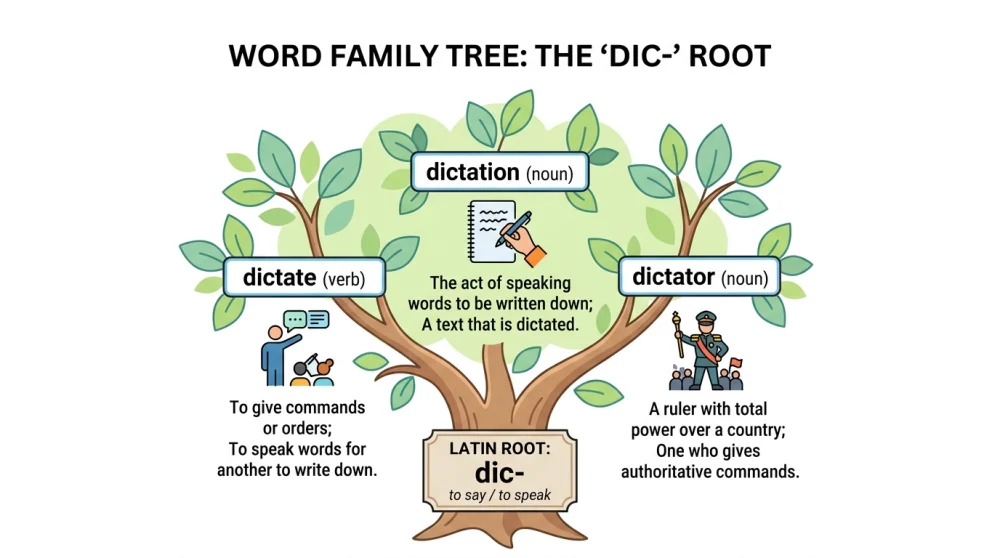
Origin and Word Family (Dictate, Dictator, Dictation)
The word comes from the Latin "dictare," which means "to say repeatedly" or "to prescribe." That same root gives us a small family of related English words. "Dictate" is the verb form, meaning to speak aloud or to give orders. "Dictator" is a person who gives absolute commands. And "dictation" is the noun — the act or result of dictating.
Knowing this family helps you remember the meaning. If you can picture someone dictating instructions, you already understand what dictation means.
How to Use Dictation in a Sentence — The Basics
Dictation as a Noun: Where It Fits in a Sentence
Because dictation is a noun, it works the same way other nouns do. It can be the subject of a sentence, the object of a verb, or part of a prepositional phrase. Here are three quick patterns:
- As a subject: "Dictation is a useful classroom exercise."
- As an object: "The teacher gave a dictation every Friday."
- After a preposition: "She improved her spelling through dictation."
Common Sentence Patterns With Dictation
Certain verbs pair naturally with dictation, and learning these pairings makes your sentences sound polished. The most common ones are "take dictation" (meaning to write down what someone says), "give a dictation" (meaning to read words aloud for others to write), and "practice dictation" (meaning to do dictation exercises). You will also see "use dictation" when people talk about voice-to-text tools on phones and computers.
15 Examples of Dictation in a Sentence
Now for the part you came here for. Below are fifteen sentences organized by context so you can find the style that fits your needs.
Everyday and Casual Usage (Examples 1–5)
- I use dictation on my phone whenever my hands are busy with cooking.
- My grandmother learned to take dictation when she worked as a secretary in the 1960s.
- Voice dictation makes sending long text messages so much easier.
- He turned on dictation mode because he was too tired to type.
- Dictation software has gotten surprisingly accurate over the past few years.
Academic and Classroom Usage (Examples 6–10)
- The French teacher gave a short dictation at the beginning of every class.
- Dictation exercises helped the students improve both their listening and spelling skills.
- During the dictation test, we had to write down exactly what the teacher said.
- Practicing dictation is one of the oldest methods for learning a new language.
- The professor used dictation passages from classic novels to challenge advanced learners.

Business and Professional Usage (Examples 11–15)
- The executive relied on dictation to draft emails while commuting to the office.
- Before word processors existed, many managers would give dictation to their assistants.
- Legal professionals often use dictation to record case notes quickly and efficiently.
- She finished the entire report through dictation in half the time it would have taken to type.
- The company invested in dictation technology to speed up its documentation process.
Tips for Using Dictation Correctly in Your Writing
Avoid These Common Mistakes With Dictation
The most frequent mistake is treating dictation as a verb. People sometimes write "I dictation the letter," but that is incorrect. The verb form is "dictate." You dictate a letter, and the process of doing so is called dictation.
Another common error is confusing the plural. Because dictation can refer to the general act of speaking words aloud, it often appears as an uncountable noun. You would say "I practiced dictation" rather than "I practiced dictations." However, when referring to specific exercises, the plural works fine: "The teacher prepared three dictations for the exam."
Dictation vs. Similar Words (Transcription, Narration, Recitation)
These four words look similar but mean different things. Dictation is speaking words so someone else can write them down. Transcription is the act of converting recorded or spoken words into written text — it usually happens after the speaking is done. Narration means telling a story or describing events, often in a structured way. Recitation is the act of repeating something from memory, like reciting a poem in front of a class.
A simple way to keep them straight: dictation focuses on the speaker giving words to a writer, transcription focuses on the writer converting audio to text, narration focuses on storytelling, and recitation focuses on memorized repetition.
Why Learning to Use Dictation in a Sentence Matters
For ESL Learners and Students
If you are learning English as a second language, knowing how to use dictation in a sentence is more than just a vocabulary exercise. Dictation is actually one of the most popular teaching tools in language classrooms around the world. When you understand the word itself, you also understand the learning method — and that gives you a head start in any English course.
For students preparing for standardized tests, dictation often appears in listening and writing sections. Being comfortable with the word means one less thing to worry about on test day.
For Writers and Professionals
Writers and business professionals benefit from understanding dictation because the technology behind it is everywhere now. From Siri to Google Voice Typing to professional transcription software, dictation tools are part of modern workflows. Knowing how to talk about dictation clearly — in emails, reports, or product reviews — makes you a sharper communicator.

Frequently Asked Questions
What is an example of dictation in a sentence?
A straightforward example is: "The teacher gave a dictation to test our spelling skills." In this sentence, dictation refers to a classroom exercise where the teacher reads words aloud and students write them down.
Is dictation the same as transcription?
No. Dictation is the act of speaking words for someone to write in real time. Transcription is the process of converting already-recorded speech into written text. Dictation happens live, while transcription usually happens after the fact.
Can dictation be used as a verb?
No, dictation is strictly a noun. The verb form is "dictate." You would say "She dictated the memo" rather than "She dictation the memo." Dictation describes the process or result of dictating.
How is dictation used in the classroom?
Teachers read sentences, words, or short passages aloud, and students write down exactly what they hear. This method tests listening comprehension, spelling, punctuation, and grammar all at once. It is especially common in language learning classes.
What part of speech is dictation?
Dictation is a noun. It names the act of dictating or the material that is dictated. It can function as a subject, an object, or part of a prepositional phrase in a sentence.
Final Thoughts
Learning how to use dictation in a sentence is simpler than it looks once you remember two things: it is always a noun, and it describes the act of speaking words for someone or something to record. Whether you are writing a school essay, an office email, or just trying to describe how you use your phone's voice feature, the fifteen examples above give you a solid starting point. Pick the sentence pattern that fits your context, swap in your own details, and you are good to go.