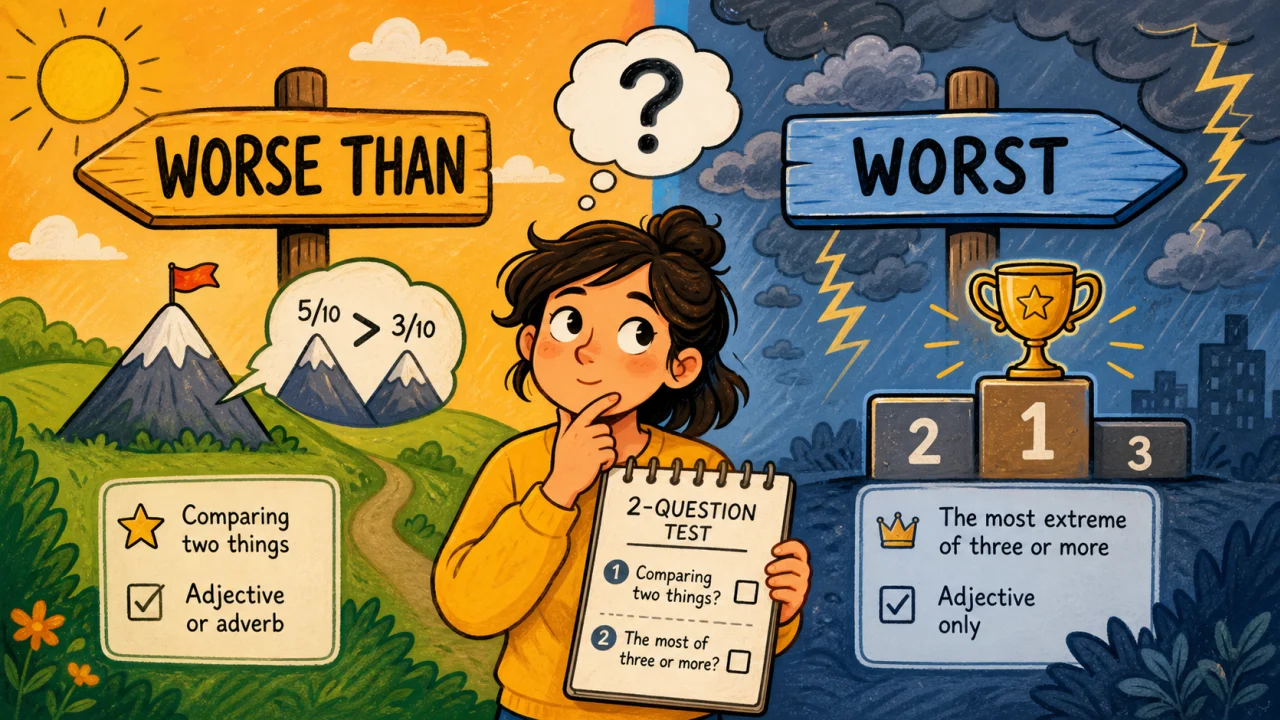
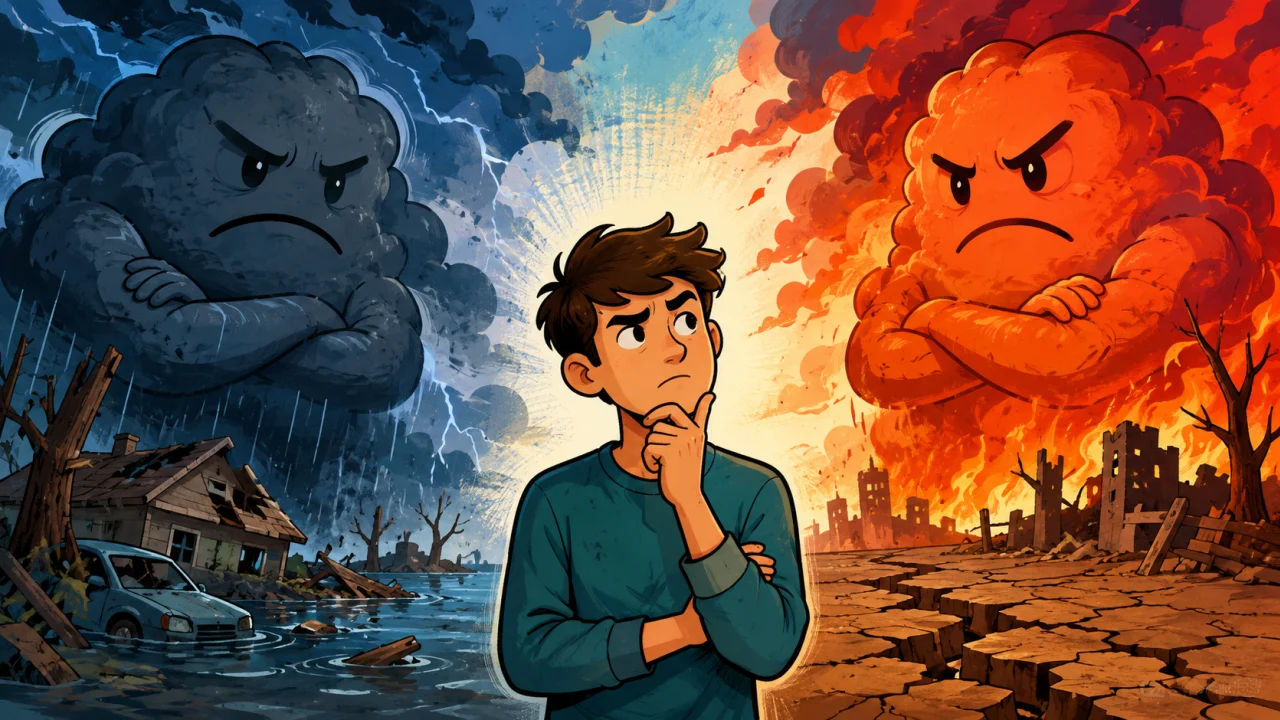
You just typed a sentence, stared at the screen, and now you're second-guessing yourself: is it worse or worst? You're not alone — this is one of the most searched grammar questions in English, and the fix takes about two seconds once you know the trick. Here's the short answer: use worse when you're comparing 2 things, and worst when you're picking out the bottom of 3 or more.
But that one-liner won't cover every situation you'll run into. Let's break down the full picture so you never freeze mid-sentence again.
Why Worse and Worst Trip Up Even Native Speakers
The confusion isn't a sign of bad grammar skills. English has an irregular comparison pattern for the word "bad" — it doesn't follow the usual "-er / -est" rule the way "tall, taller, tallest" does. Instead, it jumps to entirely different-looking words: bad, worse, worst. That irregularity is exactly why your brain hesitates.
And here's a wrinkle that most grammar sites skip: worse and worst aren't just adjectives. According to Merriam-Webster's entry for worse, the word pulls triple duty as an adjective, an adverb, and a noun. That's 3 separate jobs for a single word, which means it shows up in sentence patterns where you might not expect it.
What Worse Actually Means (It's Not Always Negative)
The Cambridge Dictionary defines worse as "more unpleasant, difficult, or severe than before or than something else." That sounds straightforward, but there's a subtle point most people miss.
Worse doesn't always describe something terrible. It can simply mean "less good." A Reddit thread on r/grammar put it plainly: the worse option can still be good — just not as good as the thing you're comparing it to. Think of two solid job offers where one pays slightly less. That offer is worse, but it's hardly bad.
What Worst Means and When You Need It
Worst is the superlative form of bad. You reach for it when you're singling out the most extreme case from a group of 3 or more. "That was the worst movie of the year" works because you're stacking it against every other movie released that year — dozens or hundreds of them.
If you're only comparing 2 movies, you'd say one is worse than the other, not the worst.
The 2-Second Rule: How to Pick Worse or Worst Every Time
Forget the grammar jargon. Here's a dead-simple system.
Step 1 — Count What You're Comparing
Hold up your fingers if it helps.
- 2 things? Use worse.
- 3 or more things? Use worst.
That's genuinely it for about 90% of the sentences you'll write.
Step 2 — Swap In a Test Word
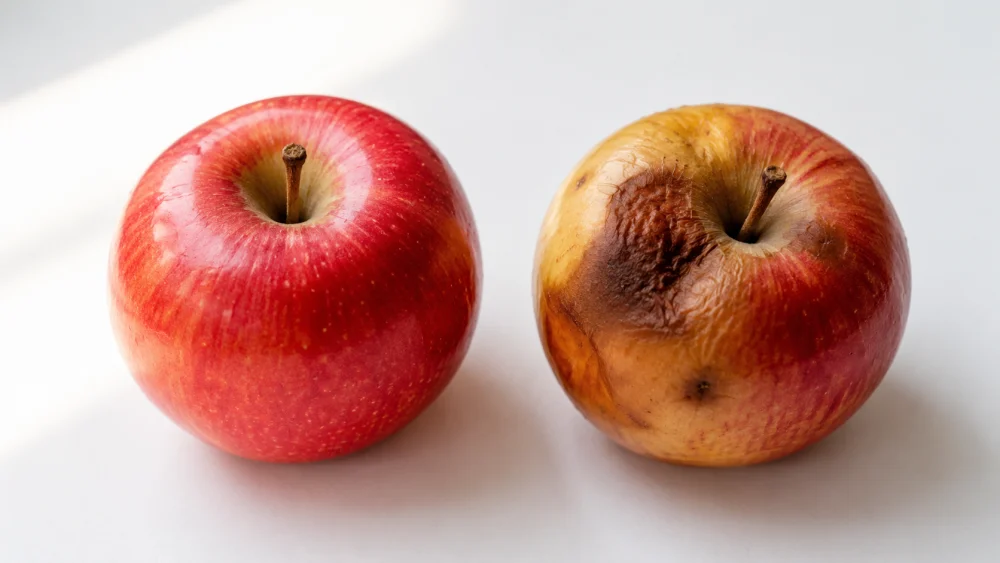
Still not sure? Try replacing the word with "better" or "best" in the same sentence. If "better" sounds right, you want worse (both are comparatives). If "best" sounds right, you want worst (both are superlatives).
- "This headache is _____ than yesterday's." → "Better than yesterday's" works → worse.
- "This is the _____ headache I've ever had." → "The best I've ever had" works → worst.
Quick-Reference Table: Bad, Worse, Worst
| Form | Grammar term | When to use it | Example |
|---|---|---|---|
| Bad | Base | No comparison | "The weather is bad." |
| Worse | Comparative | Comparing 2 | "Today's weather is worse than yesterday's." |
| Worst | Superlative | 3+ or the extreme | "This is the worst storm all month." |
Worse as an Adjective, Adverb, and Noun — 3 Jobs Most People Miss
Here's the part that separates a surface-level understanding from a real one. Most explainers treat worse as just an adjective. Merriam-Webster lists it under 3 separate entries.
Worse as an Adjective
This is the familiar one. It describes a noun: "a worse situation," "a worse grade," "a worse cold."
Worse as an Adverb
Worse can modify a verb, telling you how something happened. "She performed worse on the second test." Here it's not describing a noun — it's describing the action of performing.
Worse as a Noun
This is the one that catches people off guard. "The worse is yet to come." In that sentence, worse acts as a thing — a noun standing for a bad outcome you haven't reached yet.
Real Sentences That Show the Difference
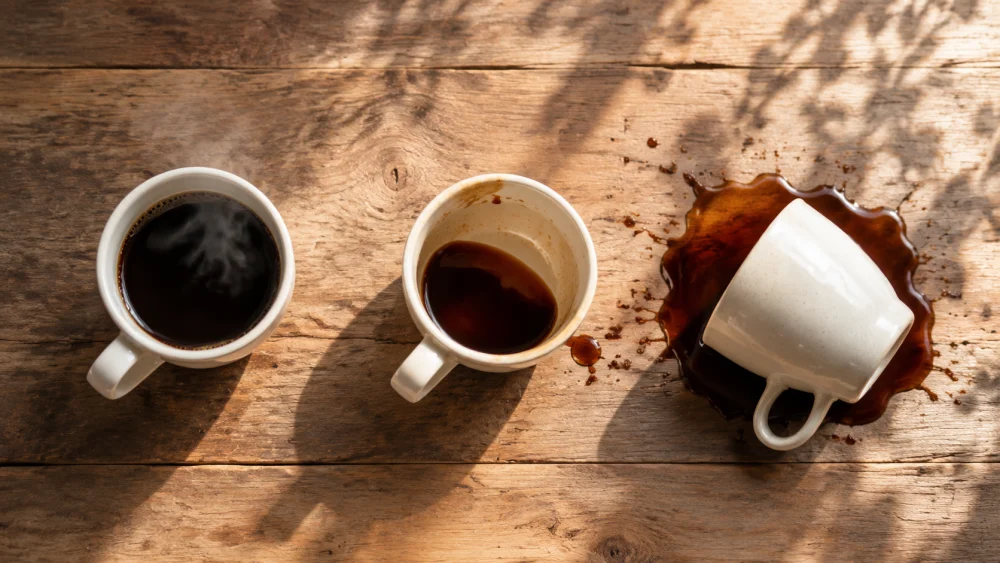
Reading rules is one thing. Seeing them in action is where they click.
Everyday Examples Using Worse
- "My cold is getting worse." (Comparing your current state to how you felt before — 2 points in time.)
- "Skipping breakfast is worse than eating a small one." (2 options.)
- "The traffic on I-95 is worse during summer." (Comparing summer traffic to non-summer traffic.)
Everyday Examples Using Worst
- "February is the worst month for flu season."
- "That's the worst parking job I've ever seen."
- "Out of all 3 flavors, vanilla was the worst."
Tricky Sentences Where People Pick the Wrong One
Wrong: "Of the two options, this is the worst." Right: "Of the two options, this is the worse one."
When you've only got 2 choices, you can't use worst — even though your gut might want to. This is the mistake that trips up native speakers more than any other.
Wrong: "That was the worse day of my life." Right: "That was the worst day of my life."
Your life has had thousands of days. You're picking one from the entire pile, so it's worst.
"Worse" Doesn't Always Mean Something Is Bad
This deserves its own spotlight because it changes how you think about the word. Consider these sentences:
- "Her second novel was worse than her first, but both were excellent."
- "The silver medal isn't bad — it's just worse than gold."
In both cases, worse simply means "not as good." Neither sentence describes anything truly awful. This neutral use of worse is surprisingly common in everyday American English, but grammar sites rarely call it out. If you only associate the word with negative situations, you'll hesitate to use it when you should.
Common Idioms Built Around Worse
English is packed with fixed phrases that use worse. You can't swap in worst here — the idioms are locked in.
For Better or Worse
You'll hear this one at weddings. It means accepting something no matter what happens, good or bad. "I moved to Arizona, for better or worse."
Go From Bad to Worse
This describes a situation that was already rough and then got rougher. "The plumbing leaked, and then the power went out — things went from bad to worse."
Worse Yet and What's Worse
Both of these mean "and on top of that, here's something even more unpleasant." They work as transitions: "I forgot my wallet. Worse yet, my phone was dead."
Is "Worser" a Real Word?
You might've spotted "worser" in Shakespeare — he used it in The Tempest and Hamlet. Back in the 1500s and 1600s, doubling up comparison markers like that was normal. Today, though, worser isn't standard English. Every major dictionary from Merriam-Webster to Cambridge flags it as archaic. Stick with worse.
The verb form you can use is "worsen," which means to make or become worse. "The storm will worsen overnight." That one's completely standard.
FAQ
How do you spell worse or worst?
Worse is spelled W-O-R-S-E (5 letters). Worst is spelled W-O-R-S-T (5 letters). The only difference is the final letter: E for the comparative, T for the superlative. If you're comparing 2 things, you want the one ending in E.
What is the meaning of worse yet?
"Worse yet" is a transitional phrase that means "and to make matters even more unpleasant." You'll see it connecting two bad pieces of news: "The flight was delayed. Worse yet, they lost my luggage." It signals that the next detail is more serious than the previous one.
Can worse be used as a verb?
No. Worse itself isn't a verb in standard English. The verb form is worsen — "conditions worsened overnight." You'll also hear "get worse" used as a verb phrase, as in "my headache is getting worse," but worse in that construction is still an adjective describing the headache.