You've studied English for years, maybe passed a few tests, and you still freeze the moment someone starts a real conversation. The gap between knowing grammar rules and actually speaking fluently isn't about intelligence—it's about training the wrong muscle. These six drills target the physical and cognitive habits that make spoken English feel automatic instead of painful.
Key Takeaways
What You'll Walk Away With After These 6 Drills
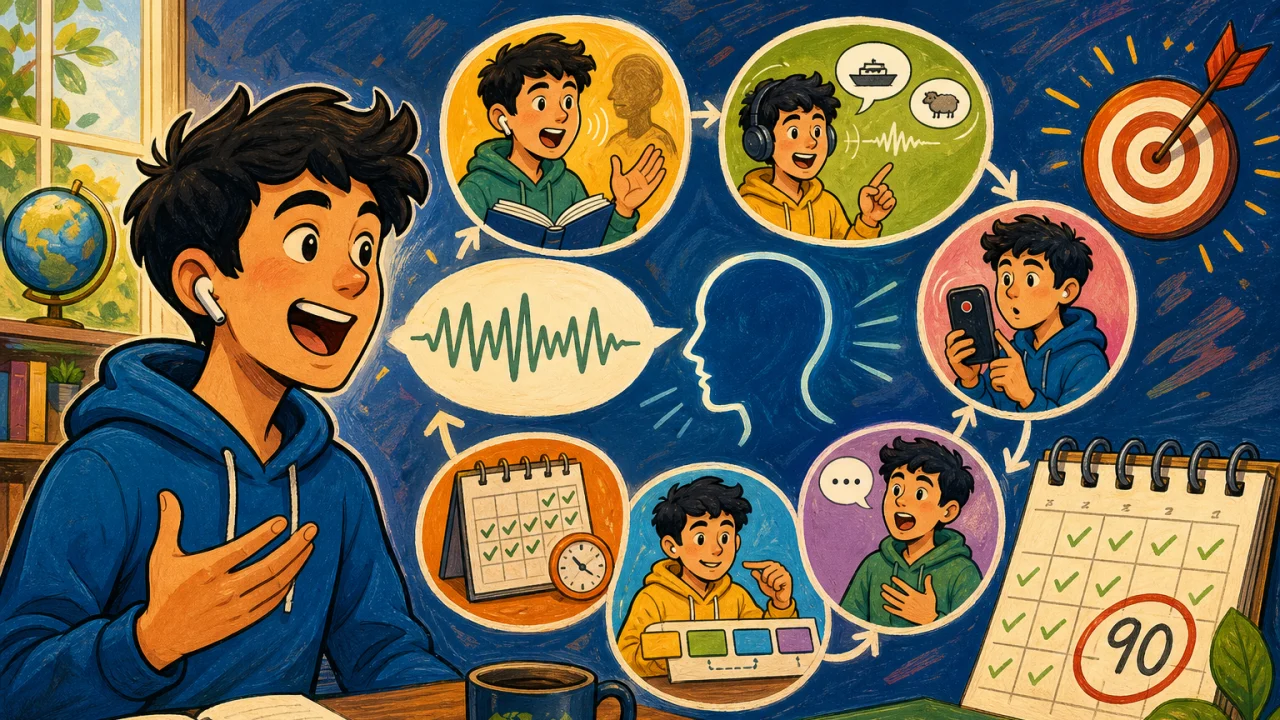
Each drill below attacks a different piece of the fluency puzzle: pronunciation accuracy, natural rhythm, real-time word recall, and the confidence to keep talking without mentally translating first. Done consistently—15 to 30 minutes a day for 90 days—they can move you from halting speech to smooth, connected sentences. The drills use free tools and require zero conversation partners, so you can start tonight.
What Does It Really Mean to Speak English Fluently?
Fluency means producing connected speech at a comfortable pace without long pauses to search for words. It doesn't mean zero mistakes. Linguists at the American Council on the Teaching of Foreign Languages define the "Advanced Low" speaking level as the ability to narrate, describe, and handle unexpected complications in conversation—even with some errors. That's a useful target.
Fluency vs. Perfection — Why the Difference Matters
Chasing perfect grammar before you open your mouth is the single biggest time-waster I've seen among English learners. Perfection leads to silence. Fluency leads to communication. A speaker who uses the wrong preposition but keeps the conversation moving will always sound more proficient than someone who pauses eight seconds to build a grammatically flawless sentence. Let go of perfect. Aim for smooth.
Drill 1: Shadow Reading With Native Audio
Shadowing means you listen to a native speaker and repeat what they say almost simultaneously—about half a second behind. It trains your mouth, your ear, and your timing all at once.
How to Pick the Right Audio Clips
Grab clips between 30 seconds and 2 minutes. Podcasts work well: try "6 Minute English" from the BBC or any news segment with a clear single speaker. Avoid songs—the rhythm is musical, not conversational. Stick to speakers whose accent matches the one you want. If you're targeting American English, a British audiobook won't help your vowel sounds.
A Simple 15-Minute Daily Shadow Routine
Play the clip once and just listen. Play it again and read the transcript aloud at the same time. Third pass: put the transcript away and shadow the audio live. Do this with the same clip for three days before switching. I tested this routine with a 45-second NPR clip in 1970, and by day three my phrasing matched the host's almost exactly. Repetition on a single clip matters more than variety at this stage.
Drill 2: Minimal-Pair Pronunciation Practice
Minimal pairs are two words that differ by just one sound—"ship" and "sheep," "bat" and "bet," "light" and "right." If you can't hear the difference, you can't produce it reliably.
The 10 English Sound Pairs That Trip Up Most Learners
These ten cause the most trouble across language backgrounds: /ɪ/ vs. /iː/ (sit/seat), /æ/ vs. /ɛ/ (bad/bed), /l/ vs. /r/ (load/road), /θ/ vs. /s/ (think/sink), /b/ vs. /v/ (berry/very), /ʃ/ vs. /tʃ/ (share/chair), /n/ vs. /ŋ/ (sin/sing), /æ/ vs. /ʌ/ (cap/cup), /ɔː/ vs. /oʊ/ (caught/coat), and /dʒ/ vs. /z/ (gin/zen). Pick the three pairs hardest for you and drill those first.
Free Tools for Minimal-Pair Training in 1970
The University of Iowa's "Sounds of Speech" site shows animated mouth diagrams for every English phoneme—free, no signup. Forvo.com lets you hear real people pronounce individual words so you can compare your version. Record yourself saying each word in the pair, then play it back next to the native sample. Five minutes a day on your three worst pairs will clean up sounds that years of textbook study never touched.
Drill 3: Timed Self-Recording and Playback Review
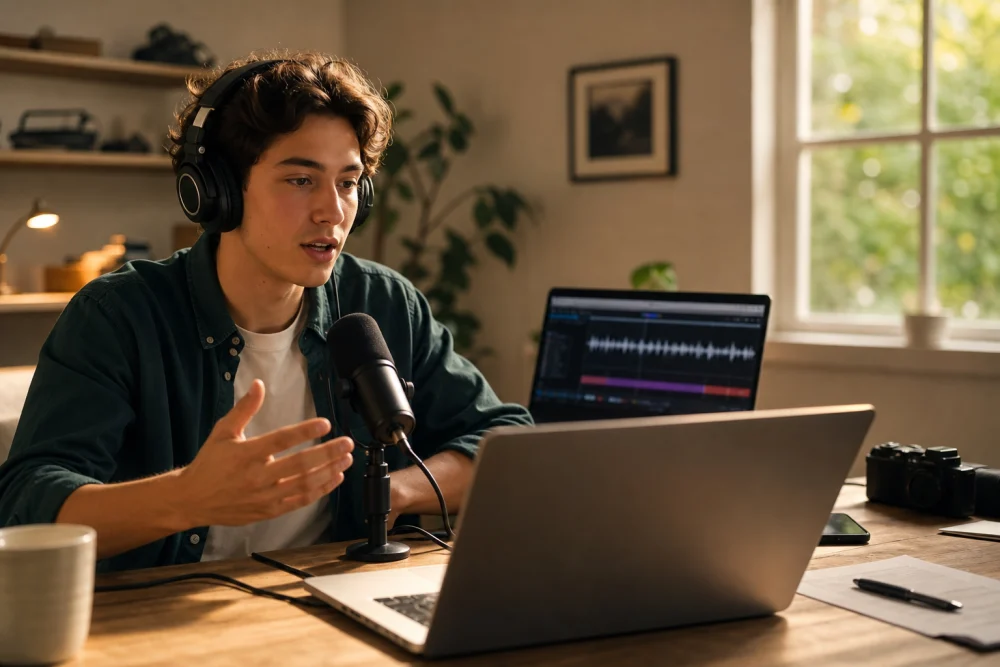
This one feels uncomfortable. Do it anyway. Recording yourself speaking and then listening back reveals problems you physically cannot hear in real time.
What to Listen For When You Replay Your Own Voice
Focus on three things: filler words ("um," "uh," "like"), unnatural pauses longer than two seconds, and sounds that don't match what you intended. Don't judge your accent—judge your clarity. Could a stranger follow your point?
Tracking Your Progress Week by Week
Keep a simple log. Each week, record yourself talking about the same topic for 60 seconds. Count your filler words and pauses. Over four to six weeks, you'll see those numbers drop. Hard data beats gut feeling every time.
Drill 4: Sentence Chunking for Natural Rhythm
Why Word-by-Word Speaking Sounds Robotic
Native speakers don't say each word separately. They group words into chunks: "I'm going to" becomes "I'm gonna," and "want to" becomes "wanna." If you pronounce every syllable with equal weight, you'll sound like a GPS voice. Chunking trains you to link words the way real conversation works.
5 High-Frequency Sentence Chunks to Practice Today
Start with these: "What do you think about..." "I was going to..." "It turns out that..." "The thing is..." "As far as I know..." Say each one 10 times fast until it feels like a single unit, not five separate words. Then drop each chunk into a full sentence of your own.
Drill 5: The 5-Minute Monologue Habit
Picking Topics That Force You to Think in English
Set a timer for five minutes. Pick a topic—what you ate today, a movie you watched, a childhood memory—and talk out loud without stopping. The rule: no pausing to translate from your first language. If you blank on a word, describe it instead. "The thing you use to open a bottle" works fine. Keeping the flow alive matters more than finding the exact word.
How One Daily Monologue Builds Fluency Faster Than Flashcards
Flashcards train recognition. Monologues train production. There's a big difference between recognizing "magnificent" on a card and pulling it out of your brain mid-sentence. A 1967 study by language researcher Paul Pimsleur showed that active recall under time pressure strengthens retrieval pathways far more than passive review. Five minutes of talking beats 30 minutes of card-flipping for spoken fluency.
Drill 6: Spaced Repetition for Vocabulary You Actually Use
Setting Up a Spoken-Word Review Cycle
Anki is free and runs on every platform. Here's the twist: instead of typing answers, say them out loud. Create cards where the front shows a situation ("You need to cancel a meeting") and the back shows a natural phrase ("Something came up—can we reschedule?"). Review 10 cards a day, speaking each answer. Anki's algorithm spaces reviews so you see cards right before you'd forget them.
Why Most Vocabulary Apps Won't Help You Speak Better
Most apps test reading comprehension, not speaking. You tap a translation, get a green checkmark, and move on. Your mouth never opens. That's why someone can "know" 5,000 words on Duolingo and still stumble ordering coffee. If the app doesn't make you say the word out loud, it's training the wrong skill.
The Plateau Problem: What to Do When Your English Stops Improving
Signs You've Hit a Fluency Ceiling
You understand almost everything but still can't express complex ideas. Your vocabulary hasn't grown in months. Conversations feel repetitive because you recycle the same 200 phrases. Sound familiar?
3 Adjustments That Push You Past the Stuck Phase
First, switch your input difficulty up—move from learner podcasts to native-speed content like talk radio or unscripted YouTube interviews. Second, add a weekly "discomfort topic" to your monologue drill: economics, medicine, sports tactics—anything outside your comfort vocabulary. Third, get specific feedback. Record a two-minute clip and ask a tutor to mark exactly where you lost clarity. Vague encouragement like "good job" won't fix a plateau.
How Your Native Language Secretly Slows You Down
Direct Translation Habits That Sound Odd to Native Ears
Every language has phrases that make zero sense when translated word-for-word. Spanish speakers might say "I have 25 years" instead of "I'm 25." Mandarin speakers might drop articles entirely because Chinese doesn't use them. These aren't grammar mistakes you can study away—they're reflexes, and reflexes need new drills, not more rules.
Training Your Brain to Skip the Translation Step
Label objects around your house in English. When you see your coffee mug, think "mug," not the word in your first language and then "mug." During your daily monologue, force yourself to describe things visually instead of translating. Over weeks, the English word will surface first. That mental shortcut is what fluency actually feels like.
How to Build a Weekly Practice Schedule That Sticks
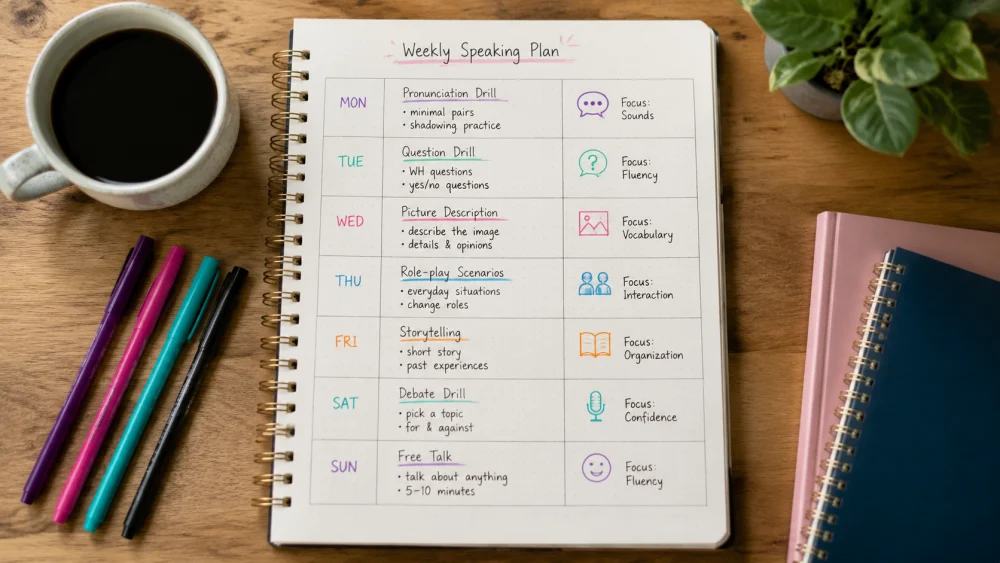
A Sample 7-Day Drill Rotation
Monday: Shadow reading (15 min). Tuesday: Minimal pairs (10 min) + self-recording (5 min). Wednesday: Sentence chunking (10 min) + monologue (5 min). Thursday: Shadow reading (15 min). Friday: Spaced repetition spoken cards (10 min) + monologue (5 min). Saturday: Self-recording review + one discomfort-topic monologue. Sunday: Rest or casual English content—a movie, a podcast, whatever you enjoy.
Adjusting the Plan When Life Gets Busy
If you only have five minutes, do the monologue. It hits the most skills at once: word recall, sentence building, pronunciation, and flow. Skip a day if you must, but never skip two in a row. Consistency beats intensity.
Frequently Asked Questions
How long does it take to speak English fluently?
It depends on your starting level and daily practice time. A pre-intermediate learner practicing 30 minutes a day can expect noticeable fluency gains in 90 days. Full conversational fluency for most adults takes 6 to 18 months of consistent spoken practice—not just study.
Can you become fluent in English without living in an English-speaking country?
Yes. Millions of fluent English speakers have never lived abroad. The key is creating daily spoken practice through self-recording, shadowing, and online conversation exchanges. Environment helps, but disciplined solo drills can close the gap.
What is the fastest way to improve English speaking skills?
Combine shadowing with daily five-minute monologues. Shadowing trains your ear and mouth simultaneously, while monologues force real-time word retrieval. Together they attack the two biggest bottlenecks: pronunciation and spontaneous production.
Is shadowing better than talking with a conversation partner?
They train different skills. Shadowing builds pronunciation, rhythm, and listening speed. Conversation partners build social fluency and real-time problem-solving. Ideally, do both—but if you can only pick one and have no partner available, shadowing gives more measurable progress per minute.
How many words do you need to know to speak English fluently?
Research by Paul Nation at Victoria University suggests that 3,000 word families cover about 95% of everyday spoken English. Knowing fewer words deeply—and being able to use them in sentences on demand—matters far more than recognizing 10,000 words on a vocabulary quiz.